Politics & Government
Bridgewater-Raritan Board Advances Device Policy For Members At Public Meetings
The first-reading bylaw would limit how board members use devices, outside communications and AI during public meetings.


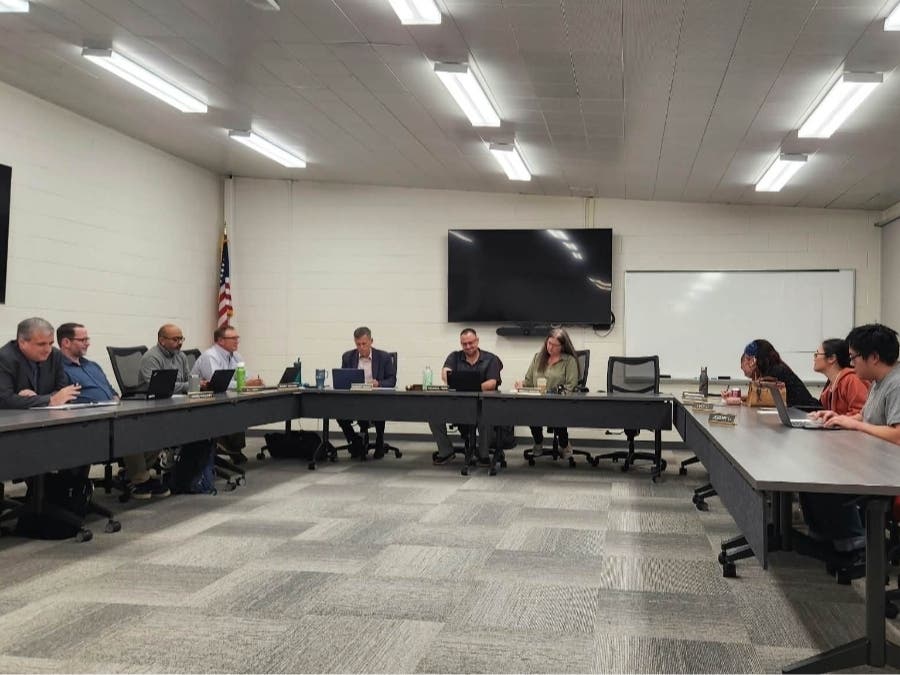
BRIDGEWATER, NJ — The Bridgewater-Raritan Regional Board of Education is looking to control how board members may use electronic devices during public meetings.
The Board approved a first reading of the proposed bylaw, 0169.03, after a lengthy discussion about transparency, data security, enforceability and the use of artificial intelligence.
The vote was not unanimous, with board member Jeremy Li and board president Michael Pepe voting against it.
Find out what's happening in Bridgewaterfor free with the latest updates from Patch.
According to the bylaw, board members could still reasonably use devices during meetings for agendas, policies, resolutions, statutes, notes and other reference materials.
But the proposal says members could not use electronic devices during a board meeting to communicate electronically with other board members or any other person regarding board business, participate in group chats or similar backchannel communications, or use Artificial Intelligence for real-time analysis, prompting, summarization, or strategic response generation related to matters before the board.
Find out what's happening in Bridgewaterfor free with the latest updates from Patch.
The bylaw also says board members shall use district-issued devices and district-approved platforms for board business during board meetings whenever those devices or platforms are provided by the district.
It further says members shall not use personal devices, personal accounts or non-district communication platforms to conduct board business during a meeting.
During the discussion, Li asked what goals the bylaw would advance.
In response, board member Steven Singer said, "We talk about civility, we talk about working as a board, and this is intended to ensure that this board focuses on the business of being at this meeting and not on externalities or other interfering issues."
Pepe added that "There's also a fairness element to members of the public who are here and are following the proceedings, for some people to have kind of an inside view, potentially, if there's outside communications from this table. I think that's fundamentally unfair to people who are, who don't have that, who may not have that access."
Board member Jennifer Loughran said the proposal was meant to address how members use technology while a meeting is being conducted, including when the public is speaking, and said it was tied to Open Public Records Act concerns.
"First, it addresses the use of technology at Board of Education meetings by Board of Education members while a meeting is being conducted, which includes when we're speaking to each other, when it includes when the public is speaking, that we are paying attention to the public and not typing on our computers," said Loughran. "And it also includes the use of AI, and whether or not it is appropriate for board members to be using AI and to be using social media platforms to have discussions with outside members while a public meeting is taking place."
Board member AJ Joshi pointed to cybersecurity, saying district-issued devices have firewalls and updates and added that the district had previously been affected by ransomware.
"Just a few years ago, we had the ransomware. The fact that the entire district has these devices that are given to us by our IT department ensures that such things don't happen again. There are firewalls, there are updates that are being put on this," said Joshi. "I mean, we have to be careful, because I think we were down for a couple of days, so that's one of my concerns, and why this is important in this day and age."
Some members questioned how the bylaw could be enforced and whether it was too broad.
Li pointed to a scenario where a board member may want to type noted when a member of the public is speaking.
"What if they're actually typing about the concerns that are brought up. How would you even know? I mean, it's a little ridiculous to just assume in bad faith that every board member just needs to sit there and stare at a member of the public is speaking when a board member should really be making sure that those concerns are addressed and they understand the optic side of it," said Li.
"I understand the optic side of it, but you can't tell whether or not a member is, I don't know, using AI, or even doing whatever on social media, or actually typing and thinking about the genuine concerns that are brought up here to this board. I just want to know how exactly is this bylaw going to be enforced?"
Pepe said he shared some of the same concerns as Li.
"I agree with the spirit of this [policy] 100 percent and what it is trying to do, and keeping everyone present in the meeting," said Pepe but added he doesn't know enough about it yet.
"I plan on voting no for this for now, because I do share some of the enforceability concerns. There are just a lot of what-ifs that can happen," said Pepe.
Some of his concerns centered on what if a board member's computer breaks down and they need to use another one?
"What if there's some kind of an outage or something happens where you were where this device does not work? What if you get a communication that can only come in one certain way that might impact the board, like for a liaison and delegate report? I just think I need a little bit more time to consider this before moving forward," said Pepe.
Before the final vote, the Board confirmed that spare backup computers could be arranged if a member’s device failed.
The motion to advance the bylaw on first reading ultimately passed.
View the policy below:
POL 26 23 CRC 1st Reading by Alexis Tarrazi
Have a news tip? Email alexis.tarrazi@patch.com.
Get more local news delivered straight to your inbox. Sign up for free Patch newsletters and alerts.