Community Corner
Somerset County Regional Center Sets 2020 Priorities
Establishes agenda to coming year

The Regional Center Partnership of Somerset County has met to reorganize for 2020, elected a slate of officers for a two-year term, and welcomed new members from the three participating communities of Bridgewater, Raritan, and Somerville, set the major projects aganda for the coming year.
The Regional Center Partnership serves as the board of the Somerset County Regional Center (SCRC) and addresses quality-of-life issues, obstacles, and projects that are multi-municipal in nature. The group meets to plan and facilitate the advancement of the goals and objectives for the SCRC and further the mission of creating “vibrant connections” throughout Somerset County.
New to the Partnership for 2020 are Mayors Matthew Moench of Bridgewater and Zachary Bray of Raritan; Administrator Michael Pappas and private sector representative Andrew Fesco of Bridgewater; Councilman Michael Patente and private/institutional sector representative Nick Zamora of Raritan; and Deidre Rosinski, Somerville Planning Board representative.
Find out what's happening in Bridgewaterfor free with the latest updates from Patch.
Re-elected as officers for 2020 and 2021 were Chairman Troy Fischer, Bridgewater Commons; Vice-chair Jason Dameo, Dameo Trucking; Treasurer Victoria Allen, RWJ Barnabas Health; and Secretary James Ruggieri, Somerset County Planning Division.
Among the initiatives for 2020 is a newly revised Challenge Grant Program that will be offered to give the towns the ability to propose utilizing the funds towards a priority of their local master plans with the stipulation that the project or planning initiative is consistent with one of the SCRC Strategic Plan’s four themes, Health and Wellness, Resiliency, Embracing the Raritan River, and Job Growth and Private Sector Investment.
Find out what's happening in Bridgewaterfor free with the latest updates from Patch.
In addition, the Regional Center Partnership will continue to work in collaboration with the Somerset County Business Partnership to advocate for a new state business/economic development incentive program that will be more equitable for suburban areas like the Regional Center and Somerset County when those areas are applying for incentive assistance.
The Regional Center Partnership meets on the third Wednesday of March, May, July, September, and Thursday, November 12, 2020. Meetings are at 5:00 P.M. in the Engineering Conference Room, 2nd Floor, County Administration Building, 20 Grove Street, Somerville, NJ.
Details on all Regional Center accomplishments and programs is available online at www.regionalcenterpartnership.org.
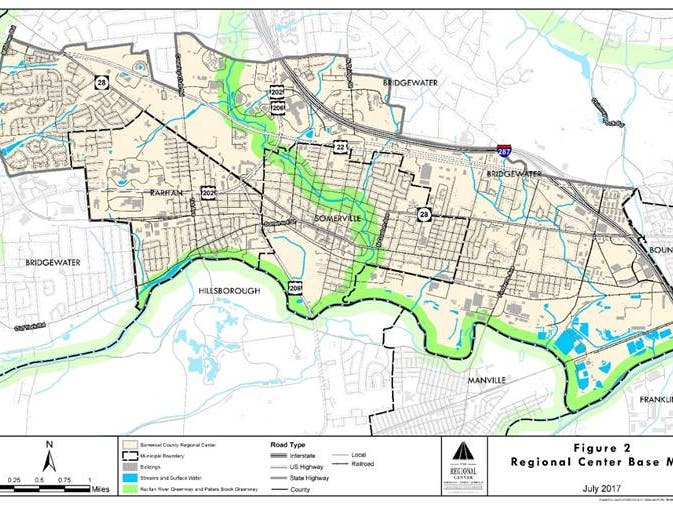
PHOTO CAPTION:: Map of the Somerset County Regional Center
BACKGROUNDER
The Somerset County Regional Center is the strategic center of the County consisting of 12.6 square miles encompassing Raritan Borough, Somerville Borough, and a portion of Bridgewater Township. The Center is bisected by U.S. Route 206, U.S. Route 202, U.S. Route 22, NJ State Route 28, and I-287 with public transit options and serves as the focal point of County government and the regional economy.
The Regional Center designation:
• encourages achievement of policy objectives in critical areas of growth
• enables development and redevelopment by providing priority funding for land use studies, the reclaiming of brownfields, and a broad range of planning and implementation initiatives
• makes available priority funding for economic and community programs that provide for
assistance with redevelopment in existing downtown business districts, new infill
development opportunities, and residential and non-residential development along major
highway and mass transit corridors
• will foster establishment of more effective mass transportation linkages and will provide priority funding for key intersection and corridor improvements and improved pedestrian
accessibility
• makes available support and funding for linear open space concepts, for the planning and design of new and existing active recreation facilities, for passive open space
acquisitions, and for new and existing historic preservation and revitalization programs.