Politics & Government
'Art of the Appraisal' and Its Impact on W. Caldwell
Officials explain tax implications from upcoming revaluation of all town properties.

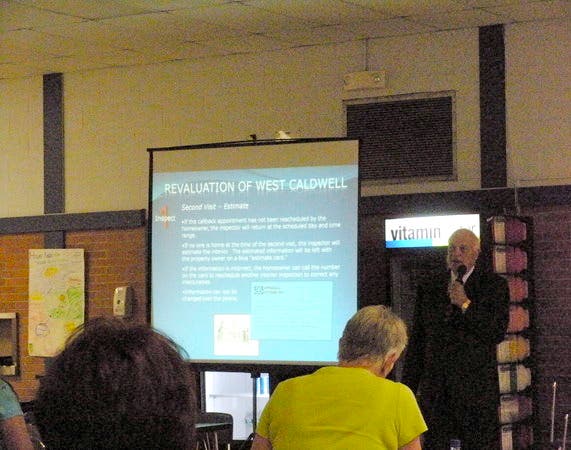


West Caldwell Tax Assessor Richard Hamilton discussed the "art of the appraisal" Wednesday night at James Caldwell High School's cafeteria during the second public information session held by Appraisal Systems Inc., which will conduct the town's first revaluation this summer in 22 years.
The "art of the appraisal" is a combination of mathematical equations based on gathered statistical information and assessing the value of negative and positive conditions of the home, Hamilton pointed out.
, will begin Tuesday, July 5 and will last approximately four to five months.
Find out what's happening in Caldwellsfor free with the latest updates from Patch.
While West Caldwell has a stable real estate market, Hamilton said the current assessment ratio is 44 percent—a disparity that cannot be ignored.
Hamilton explained that the 20 percent increase each year in property value since the beginning of the decade for a five-year period has had a significant impact in the discrepancy between assessment and market value.
Find out what's happening in Caldwellsfor free with the latest updates from Patch.
The deviation has also led to an increase in tax appeals over the years due to the recent economy, prompting the need for revaluation throughout the state.
The Essex County Department of Taxation began an 11-year cycle in 2001, mandating that all of its municipalities conduct a revaluation.
Since West Caldwell's coefficient of deviation, a measurement of tax assessment uniformity throughout a municipality, hasn't exceeded 15 percent since the previous revaluation 22 years ago, the town was included with West Orange in the last year of the county's cycle, which will begin again in 2011.
According to Ernie Del Guercio Sr., CEO of Appraisal Systems Inc., Essex County has "looked at the number of appeals, changes in neighborhoods, inflation and recession and changes in legislation over the years" and decided West Caldwell required revaluation.
Del Guercio's company conducted West Caldwell's last revaluation in 1988, but the town's properties were reassessed in 1994 after the real estate market depreciated from 1988 to 1993.
Unlike a revaluation, a reassessment does not require a field inspection. Instead, properties are assessed based on current market conditions and trends.
Since 1988, technology has blossomed and, according to Del Guercio, the company uses an advanced program to calculate an accurate assessment based on the statistical information gathered by the field agents.
Digitized sketches and pictures of the homes within the community alongside categorical information will be available on the company's Web site.
Hamilton said accurate information is necessary in order to achieve equity. Therefore, property owners are encouraged to inform Appraisal Systems of inaccuracies on their revaluation report at a one-on-one meeting after the process is completed.
"For example, if a home contains two bathrooms and three are accounted for, it is unfair for the town to tax you for an additional bathroom you do not have," Hamilton said.
"You cannot appeal your taxes," Del Guercio said, "but you can appeal the value of the assessment."
In a revaluation year, the deadline to file a tax appeal is May 1. After more information is gathered at an informal meeting to discuss the analysis of the property, the home will be reassessed before submission to the county.
"It is a mathematical impossibility for revaluation to increase taxes. All revaluation does is create fairness in the tax list. It's about creating equity," Del Guercio said.
"Since New Jersey is the No. 1 state that is reliant on its property taxes to meet its budgetary demands, it is critical that fairness be achieved. Everybody's taxes are too high in the state of New Jersey, that's a given, and all we're about as the global assessor is to make sure those taxes are fair."
Hamilton explained that the net effect of revaluation is neutrality. Therefore, if one home value increases, another town residence will have decreased.
"Revaluation does not mean that the town collects more taxes," Hamilton said.
Mayor Joseph Tempesta further explained revaluation's effect on taxes within the town by saying, "if the property value goes up, the rate will have to go down—that does not mean your taxes necessarily."
The mayor explained that while the county and school taxes comprise the bulk of residents' tax bills, West Caldwell's municipal levy was a 2 percent increase—less than $4 a month for the average home.
"We are not waiting for the governor to tell us how to be responsible," Tempesta said. "We went up for the average assessed home $3.75 a month—we can't run a town any cheaper than that year over year."
Get more local news delivered straight to your inbox. Sign up for free Patch newsletters and alerts.