Community Corner
History Comes to Life at Caldwell Community Center
Borough resident and former 'tin can sailor' discusses World War II experience.
Rob Paterson, the new director of the Caldwell Community Center, has infused new programs and activities this summer for what has become the center's most popular camp to date.
On Tuesday, the campers received a bit of a history lesson from a "tin can sailor."
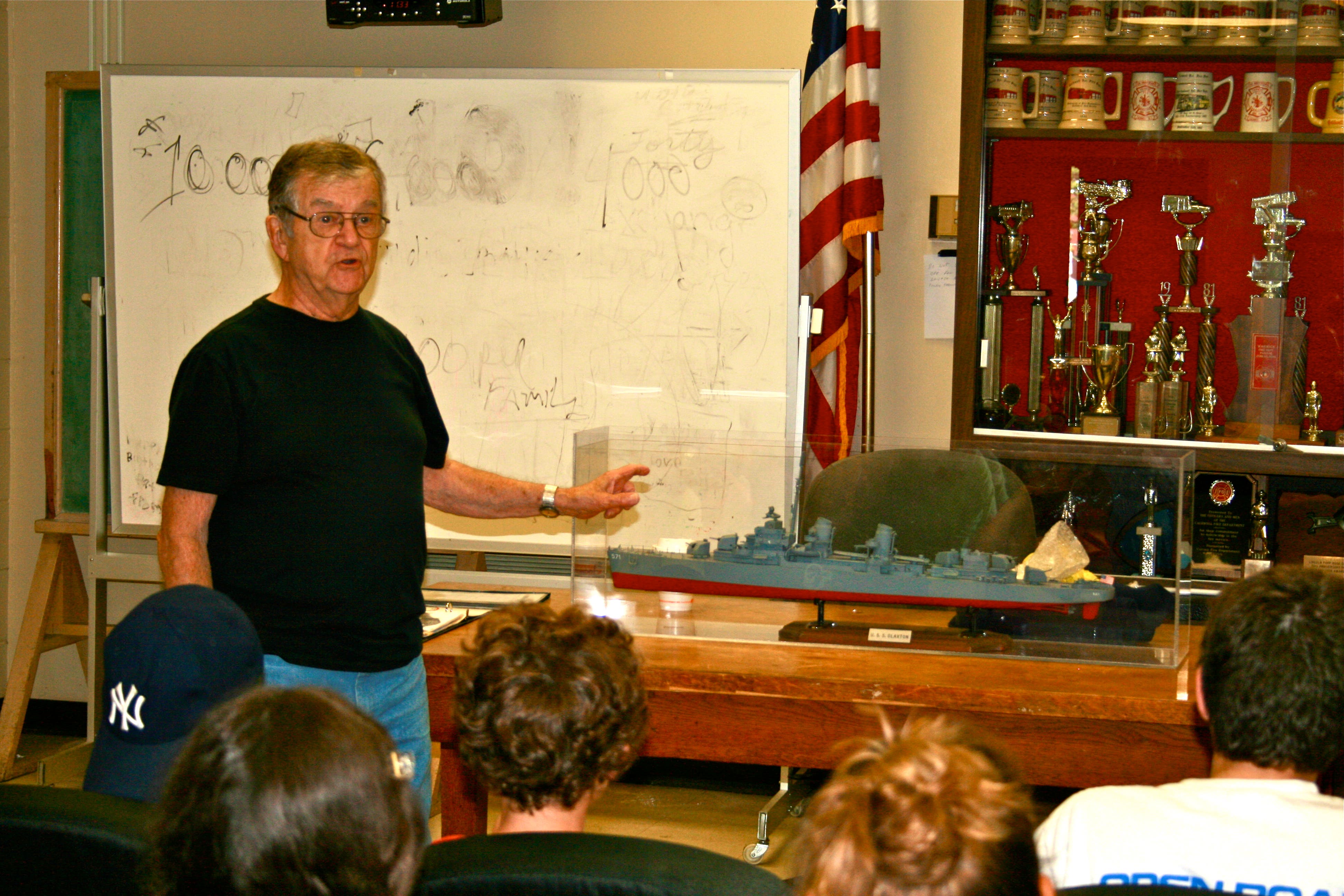
Joe Kinney, an 87-year-old Caldwell resident who grew up in Newark, discussed his experience in World War II and his time on the U.S.S. Claxton. Kinney brought along with him a replica of the ship that his son assembled about 30 years ago.
Find out what's happening in Caldwellsfor free with the latest updates from Patch.
If there was a theme to Kinney's presentation to the 9- to 12-year-olds, it was about the triumph of teamwork, ingenuity and the human spirit in emergency and less-than-ideal situations.
His examples were numerous. One story he recounted was a time when a hole was blown into the side of his ship.
Find out what's happening in Caldwellsfor free with the latest updates from Patch.
"American ships were designed to be water tight," he explained. "If water ever got into one section, we could shut the doors and stop it. What we had to do was fill the hole with mattresses—leaving three guys behind. When we stopped the water from rising, we got the guys out."
Another recollection involved Japanese kamikaze pilots, who flew their planes right into targets if they had to.
"We were at 'general quarters' (a state of readiness) when this plane came out of a giant cloud," Kinney said. "We had a guy shooting at the plane, but he couldn't get him. Finally, we turned the ship out of the way."
Kinney added that he has a photo showing a crew member posing with a piece of that plane, which landed at his feet during the descent.
In addition to being an electrician on board ("it was a little complicated," he said), Kinney had another responsibility as well.
"I was here," he began, using the model ship to explain where his swinging canvas bunk was located. Kinney said that he had to ensure that everything on the ship was sealed from water entry.
In addition to attacks from the Japanese, Kinney needed to be prepared for what Mother Nature threw at them as well. Storms that produced 60-foot waves "would go up one side of the ship and down another," he recalled.
Children Attentive, Inquisitive
The group of campers beheld Kinney with rapt attention, and when he invited questions, hands shot up.
In the front row, 9-year-old Nick Plichette asked, "How long were you in the service?"
"I was in the Navy three years and six months," Kinney replied. "Some of that was schooling."
Pointing to the model ship, Kinney added, "I was on that destroyer for a little more than a year."
He also revealed that at one point, he was at sea on the Claxton for more than nine months straight.
This writer also got into the act, asking why the Navy was his service division of choice.
"I was 5-foot-4 and 115 pounds—I wasn't going to be in the infantry."
What would you do when not on duty?
"I'd be fishing and swimming."
Did the ship ever lose all power while at sea?
"We almost did one time, but we had a big diesel engine that could generate power for things you absolutely had to have."
Kinney's friend, Jerry DiVincenzo, came along for the presentation. He is also a World War II U.S. Navy veteran.
"I'm a survivor of the U.S.S. Chicago," he said, proudly.
He added to the program, by helping piece together recollections and offered a brief lesson in Navy slang.
"A bathroom was a 'head,' coffee was 'joe' and ice cream was 'geedunk.' I don't know how to spell it," he said, laughing.
"We ate a lot of powdered food," Kinney laughed. "Powdered eggs!"