Community Corner
Playgrounds of Peril: Schoolyards' Scary Side
The fun and dangers of monkey bars, seesaws, slides and rides that spin.
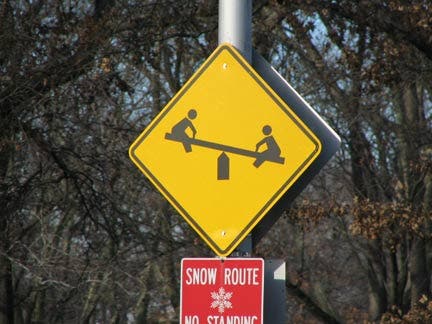


Let's all say we're a bunch of second-graders in 1978. It's a warm day and we're at school during lunch time: It's time to play outside.
Yes, up to 30 glorious minutes are ours for the taking. We sometimes may choose to play kickball, but today, for the sake of this developing dissertation, all the balls are flat, and the one good one has been kicked on the roof.
Today we're going to hit the playground, and partake in some of the finest equipment the '70s had to offer—and a surprising fixture as well.
Find out what's happening in Caldwellsfor free with the latest updates from Patch.
I went to Roosevelt and Wilson schools during this era, and when considering the other Caldwell-West Caldwell houses of learning at the time, Wilson, in particular, was a the most perfect example of a school playground of the time. Locally, only Harrison was close to being it's equal, in size of "play" property.
If you went to Wilson, you'll surely recall all of this. If you didn't, it's a fairly universal recounting—complete with danger ratings!
Find out what's happening in Caldwellsfor free with the latest updates from Patch.
The Monkey Bars
These things have been staples of playgrounds forever. It's their height and what's under them that have evolved. In the good ol' days, Wilson's playground featured two.
Monkey bars were/are great. They measure your progress and have built-in goals—can I make it at least halfway across by hanging from them and moving forward rung by rung?
They were certainly cool—they were higher (taller) back in the day, and sometimes sat on top of unforgiving surfaces if one fell, like pavement. At Wilson, there were two monkey ... barses(?), and both were made of the hardest steel, unpainted and fairly high.
There was also another structure that was like a distant relative of the simian arm hanger. It was a tripodian structure, with three curved climbers that met in the center, with a few more bars there. I loved climbing to the top of it with a couple of other pals—everyone got their own "seat" up above and could hang out.
In the middle was a pole where you could slide down—if one didn't mind leaving a top layer of skin behind. It's not that it should have been greased, but man, it was all about friction.
You're probably hearing that "squeak" sound in your head right now that sliding a few inches to a grinding halt would produce. You actually push yourself down as much as possible, then say, ruck with it and jump down. The fire department could not use this pole for drills.
Even with the unyielding pole, out of all the stuff in the Wilson playground, this is the one I'd love to have in my backyard today.
Danger rating: Two band-aids out of five. One could fall from either the monkey bars fixture, or the big mama one, and could get a sort of rug burn that would minimize the time in Mrs. Shain's social studies class after lunch—if only one could be so lucky.
The Seesaw
Ah, the seesaw ... what a name, what a game. An equal-opportunity activity, where everyone eventually gets hurt!
Seesaws (a.k.a. teeter-totters—that's two weird names) were fun—for who, I have no idea, maybe vengeful Klingons?
You'd get one side and someone would get on the other, and the fulcrum fun would begin ... and usually end in short order.
First off, if the two people riding these things weren't of equal weight and/or leg strength, it would bring out a malicious streak in even the nicest student.
The heavier/more frog like kid could bounce down, making the other shoot upward so fast they would almost lose their grip at the top. Then, they could strand the other at the top by not "tottering."
Then, the following would happen: "Let me down—C'mon!"
While crouching, the heavier kid would quickly depart the device, leaving the other guy/gal to violently crash to the ground. It hurt.
Thud!
Then it became sort of a faceoff, a mental and physical contest where two kids in Toughskins would approach the seesaw without taking their eyes off the "opponent." Then, if they were both up for it, would mount the 'saw simultaneously.
It was one of these contests around '79 when I found myself on the seesaw. I forget who I was riding with, or against, but we hadn't gotten too far in trying to destroy one another's coccix bones. The reason was Wes Lockward had come over to us with R2D2—not the actual robot, but a pretty darn good fascimile on a necklace he had gotten from an Avon lady.
It was pretty cool, all silvery and shiny heavy metal. It could probably claim a couple of teeth very easily if suddenly propelled upward.
I wanted to see it closer so I started to step off the seesaw, taking a small piece of it with me in the process.
Now let me re-familiarize you with seesaws of the '70s (by the sea shore)—at least at Wilson School.
They were wood. Old, cracked former tree planks painted 100 times—probably by the janitor, Mr. Stewart—with lead paint.
I'll never forget it. I was wearing these hideously red, soft cotton track suit pants. While today I'd wear them to ShopRite to embarass the wife, then I was just a victim of creepy disco fashion. Anyway, a nice-sized sharp sliver freed itself from the rotting plank and slid into the right side of my lower, lower back area.
It really got in there, and it hurt, and continued to for a long time. What was I going to do? I cerainly couldn't go to the nurse, and basically moon the poor woman ... I decided to suffer, in silence: This was all over a stupid Star Wars necklace. I knew better—Star Trek is way cooler.
I had that splinter a long time. Finally, my body absorbed it or broke it down or something.
Danger rating: Four-and-a-half band-aids. The crash landings, the splinters ... these things were rough stuff.
Slides
There were two slides at Wilson—I could just hear the Board of Education back then saying, "order two slides and two monkey bars for over there—we don't want the kids waiting!" One was near the seesaw. The other was farther back, away from the school and closer to Happy Time Nursery.
These slides were about as smooth of a surface as sand, and like the stuff at beaches, they could burn you.
The surface of the slide (where you sat) was almost like a mirror. On sunny days, they were hotter than anything. Even though they were in shaded areas, they could still give you first-degree burns.
Danger rating: Two band-aids. I would have went with three, but I took one band-aid off since you could write on the back of the slides with pencil. I wrote "Kiss rules" on the tall one a bunch of times.
The "Spinning Thing"
These things may have a name-recognition problem, but made their presence known. Who the heck invented these things for a playground, and not as a torture device? It's like they were medieval instruments of punishment, maybe better than red-hot pokers or vats of oil.
They were about an 8-foot big circle, with some bars to hold on to. You would run along the side of it, pushing it and then you would hop on and spin around, enjoying the fruit of your labor.
Let's review: After eating at recess you would run really fast in a circle, then spin in one. I'm getting sick writing about it.
There was nothing worse than these things—and there is no direct descendant of them on playgrounds today.
Danger rating: Got nausea? I'm going the full Monty here—five band-aids ... and one bottle of Pepto-Bismol.
Odd Inclusion Alert! The "Tree Fort"
There was something at Wilson School that no other place had—the tree fort! It was really cool—it was all wood (uh oh) and painted red.
There was a central area with benches and a roof was flanked by two long bridges leading to big, sqaure platforms. Each platform had a pole to slide down, because the whole deal was a minimum of 7 feet in the air.
I'm sort of fuzzy on how you would get on the fort, but I'm pretty sure that in an awesome early example of recycling, a wall of tires was on the side of one of the bridges. I'm uncertain if snow tires were included. It was funny when it rained—the tires would of course collect water. It was gross.
Sometimes Mrs. McBride would take us outside for music class and we would sing her awful songs on the "tree fort." She was particularly fond of that old Harpers Bizarre "Feelin' Groovy" song and that equally maddening "One Tin Soldier" tune from the early '70s.
She later added Pink Floyd's "Another Brick in The Wall" to the mix. I don't know what's worse, the fact that she had third-graders sing "we don't need no education" in class or the truism that she asked me to bring in my 45 of the tune to learn from!
Legend has it that the tree fort was built by a guy who was "a friend of the school." Does anyone have more information? I'd love to interview the guy.
Danger rating: Three band-aids. The tree fort was fairly "open" in terms of space; there were plenty of opportunities for falling and grabbing the poles was kind of tricky—you had to lurch out into the air to get to it. Perhaps due to its location, we weren't always allowed on it during lunch.
And, there you have it.
The Wilson School playground was pretty amazing in size, fun stuff and in one more regard: Mrs. McWilliams rarely took to the grass. The World's Toughest Lunch Lady was more of a pavement-pounder—she ruled mightily on terra firma of the pavement kind.
Safe, But Sad
Today, Wilson has cool stuff (I tried it with the kids at summer camp) but it's all in one main area and very close to the building (an admittedly smart move). All the other stuff is long gone, and there's a huge expanse of presumably unused land.
In this day and age, school playgrounds are nowhere near as cool as they once were. It's ironic. In spite of innovations in softer surfaces, lighter materials and the like, they are pretty much shadows of their former selves.
They are usually comprised of one or two clusters of climbing structures in total. Even at that, many schools are getting rid of them. The school I teach at recently ripped theirs out and put in a parking lot.
It's lame—while I wouldn't want to see anyone get really hurt, well-stocked playgrounds offered a lot in terms of developing kids' motor skills and promoting physical fitness.
Today, many students wander aimlessly at lunchtime—even balls are sometimes banned. Schools should let 'em climb, and work off some steam, balancing the physical with the mental.
I know, it's about liability, safety (common sense) and money.
The great irony and upshot is that town parks have become flat-out awesome. Stop by Memorial Park or even Richard Park in West Caldwell—there's a lot for kids to do there, with even the possibility of a concussion. The modern stuff is pretty cool, when imagination is present, too.
Grover Cleveland Park is really happening nowadays —it has a pretty good kiddie spread, modern but wondrous, and get this: you can fry your legs on one of the tire swings! Retro ouch.
It's Not All Bad
If there's one thing to appreciate about today's kiddie zones in parks and schools, it's the ground. Dirt and cement (first and worst), wood chips and mulch (better, but mostly as a house for a mouse) have given way to soft, synthethic creations.
Recycled tires and similar materials are used below swings and other playground equipment today, and as a parent, I couldn't be happier about it.
But overall, anyone would have to admit it's not the same.
Here's to the splinter-giving, butt-burning school playground of my youth.
See you next time, when I'll take you on a school-age camping trip—Remember When? style!