Community Corner
Youth Movement in The Caldwells
Finding freedom by pedaling around the streets, touring stores along the way.


Welcome to your Caldwells Patch time machine! When I was writing my first main feature last time about bike riding, I noticed two things:
1. Wow, my childhood is interlaced with bike activity!
2. I've missed my calling—I should have been working in the bicycle industry in some capacity.
Find out what's happening in Caldwellsfor free with the latest updates from Patch.
This week, I'm going to share tales from my kiddie biking days when I moved to Whitaker Place from St. Charles Avenue. It was a new neighborhood with new kids and new places to ride.
After this, there will be one more bike feature, which will include my really big biking idea!
Find out what's happening in Caldwellsfor free with the latest updates from Patch.
Read on!
Four Wheelin'... Temporarily
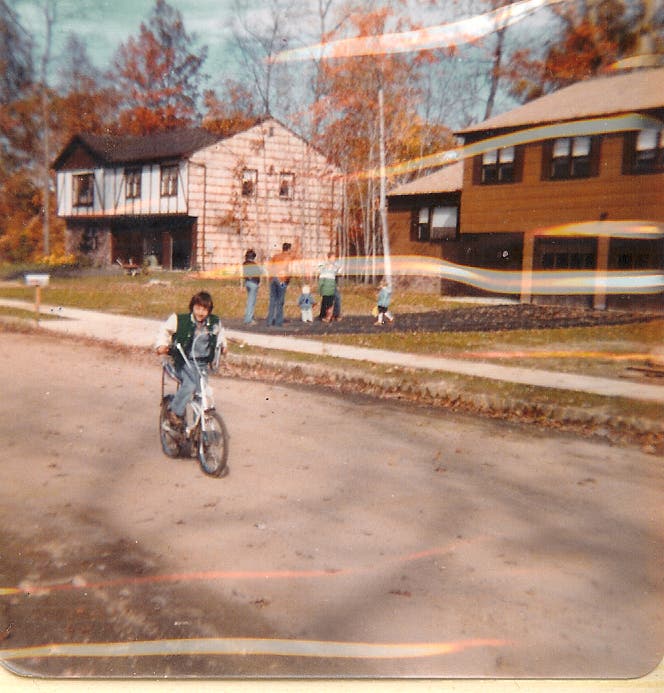
We moved into 12 Whitaker in October of 1977 (see the pictures for some rare ones of a new house in The Caldwells in the '70s!) For the first month of school, my mother drove me up to Wilson School every morning from Nutley—we were staying at my grandparent's house there, since moving out of the St. Charles house in July. It came close to being a smooth transition, but the move out/move in times didn't perfectly coincide.
On top of it all, my mother had to lug my then 3-month-old brother along for the ride. It was his fault they had to buy a new house, anyway.
The trips up and back were great, though—I'd play the old lady's Kiss and Aerosmith 8-tracks constantly and rock out the Caddy, bopping around the back seat. Although I was only still 7 years old, I was not in any car seat—they were not common yet, mostly used for the smallest of humans, like my brother.
Pimping My (Bike) Ride
In emulation of teen Mike Purcell down the street (whose "magic wrench" I sometimes borrowed), half of my garage became a bike workshop. My beloved Bicentennial Kent became my personal Frankenstein. First, I'd strip it; taking off the wheels, chain, sprocket, pedals, seat, handlebars, forks—everything.
Then I'd hang it with a rope on the garage door track. With the frame dangling in mid air, I'd shake up a can of Krylon spray paint that I'd buy at Bradlees and spray away.
Spray painting is not an exact science; the particles tend to go everywhere you don't want them to.
In short order, I ended up tinting various things in the garage, much to the consternation of my father. I added a tye-dye effect to one of the support poles; the wall took a hit; and then there was his car. The old man's 1979 black Lincoln Mark V was given an ever-so-slight, yet clear royal blue accent on the passenger door and window that wasn't listed on the sticker price. His reaction was more Italian Guy than Tom Bosley.
This is how the Kent was reborn, numerous times ... I had the technology, I could rebuild him (it). The aforementioned Bradlees carried a full complement of Dorcy-brand bike accessories—pedals, pads and much more. I'd pick up what I needed there—sometimes, I'd even pay for it.
Sidenote: I got really into spray painting—a silver baseball bat that I sometimes used for decidedly non-sportsmanlike activities was painted blue and adorned with red polka dots (it was a psychological ploy). I still have that bat. I colorized some of the rocks in the backyard brook.
Bike Shops Back in The Day
Uptown in Caldwell, there was the Schwinn shop on Bloomfield Avenue. Until the late '80s (?) it was located just to the right of the Colony Diner's driveway, where a salon is today. In addition to selling all kinds of their namesake bikes, they did repairs. Unfortunately, their prices were out of reach for us kids. Someone in the neighborhood had a flat tire or something fixed there, and their mom or dad was outraged at the charge. Besides, I was a tinkerer.
By the way, today Schwinn bikes are considered American classics, and are very collectible—there's always a guy who hangs a flyer at ShopRite looking for them.
Other popular bikes of the day were Mongooses and later, GTs, but I much preferred my custom job. My Kent was at least three colors by the time it was retired by ... Burt Reynolds?
Eastbound and Down
The Huffy Bandit was inspired by the film "Smokey and The Bandit." I'm not kidding; and it must have been the only one of its kind until recently, with "High School Musical." I mean, did anyone ever have a "Kramer vs. Kramer" Cruiser? The Huffy folks must have thought they were really onto something.
There was a commercial for the bike that ran constantly on Channel 5, between Burger King spots and "It's 10 p.m.—do you know where you children are?" announcements. It had me transfixed to the tube.
In the ad, the bike is seen zooming around rugged terrain to a constant refrain of "Huffy Bandit ... BANDIT!" played over and over. This bike was taking turns and kicking up dirt like nobody's business. Ironically, the ad emphasized that the bike was not for off-road activity, lest someone get confused that this "bandit" could make wacky beer runs.
My parents picked one up for me for Christmas, but didn't know where to put it so I wouldn't see it. They stashed it next door at the Rapa's house. Chaz Rapa would later tell me how he tried the bike out, riding it in his upstairs hallway.
When I finally got it on Christmas morning, it was a study in how, especially in the '70s, something could be so cool on TV and not cool in person—I suppose today's equal could be a match.com profile.
It was black, gold and weird. Everything on the bike, from the handlebars, tires, frame and seat was unconventional and exclusive to the model. There were some additional cool plastic pieces like the chain guard, that said "bandit" on it. The seat said "bandit," too. Parts that were removable on other bikes were permanently attached.
The tire treads looked like Hieroglyphics—did the movie bandit ever race around the Pyramids in Egypt? The rims were shiny gold. The handlebars were the worst—sort of double-sized upside down 10-speed ones.
Today, the Huffy Bandit is also a rare collectible—anyone have one for sale?
Gettin' Tricky With It
I did the best with what I had, and along with my buddies, I could do some tricks. "Poppin' a wheelie" was a favorite—in case you live under a rock (or are female!) wheelies are when you would yank up and back on the handlebars to make the front tire (wheel) go up off the ground.
You'd do (or "pop") a small one upon starting to ride, for example leaving your driveway or an impromptu meeting of the Whitaker Boys somewhere on the block. These were easy, as your front wheel would only be in the air for a couple of seconds at best, and it looked cool: you'd be leaving the scene in style.
Longer wheelies were truly impressive, but were harder. They're right out of the shoes of dirt biking and motor cycling—but with a slightly different skill set. Whereas with a motorized two wheeler, one has to master the throttle and not end up gassing it too much, at the risk of being thrown backward like on a bucking bronco or mechanical bull.
With a bicycle, when going for the longer wheelie, one would have to not only achieve a perfect balance while pulling the front wheel up by leaning back, but would also have to pedal at the same time. I could do this a little bit, but there was no guarantee that I wouldn't wipe out. I left this to kids like Ray Gajewski, who could do it almost the entire length of Pine Tree Place.
There were carryovers from other vehicle riding. A holdover from the Big Wheel days was skidding and seeing how long one could do it for; "peeling out" was emulating what dirt bikes could do on less-than solid ground surfaces, only with a bicycle it was done with a man and not machine.
A couple of other little street tricks were "jumps," which were done by going off of curbs at the side of driveways among other things and "bunny hops." The former were fun and the latter kind of odd.
A "bunny hop" was sort of a jump without the benefit of a makeshift ramp. To do one, you'd just pull up on the handlebars and with your legs, too. The result would be a pretty useless hop, but it was a trick.
A variant of the above was getting the back tire off in the air—with a little practice one could kick it up and out, knocking over various objects and other things. One time when my pals and I were riding around, Ronell Agatep ("Egg") nailed a beer bottle with this maneuver, smashing it to bits. It was one of the coolest things I ever saw—and if I wasn't looking, I wouldn't have believed it.
Other bike "tricks": Riding with no hands was always a biggie, but looking casual doing it was the key. I'd sometimes stand on the bar on the frame between the seat and neck, and it's a wonder I didn't break mine.
"Almost tricks": Giving others a ride, either by them sitting on the seat while one "stood" and pedaled or by having the extra passenger sit on the handlebars. I couldn't do this with the bandit—it didn't have a bar across the top. Instead, it had a plastic piece that said "bandit" on it.
One thing to note: we weren't out to be stuntmen. We were road hogs as opposed to Kawasaki bikers. We looked cool.
Riding in "Whitaker Park"
As I was coming age, I naturally wanted to ride my bike to other places, but it was initially a constant tug-of-war with my mother. At first, I was only allowed to ride on Whitaker Place, period. The street was a half circle, so back and forth I'd go while my friends could go on Pine Tree and at least do a lap.
Luckily in my assigned area, there was a "park" of sorts. On the first corner of my street off of Pine Tree, coming in from Passaic Avenue, there was a smallish parcel of land. There were trees on it, but they were spaced out enough, leaving room for a dirt trail to cut through it, which we broke in. The whole spot was also sunken in, so in the winter after rain and snow any open area would freeze over, and made for a cool, decent-sized imitation ice skating spot. While some would actually show up with blades, I'm not sure how well that went. Most just showed up with their Kinney shoes and slid around.
In the late '80s, something sort of weird happened to the lot—a house suddenly appeared on it. That's not too weird, right? What was strange, at least for our area, is that it was a modular home. Years later, I met the guy who lives in the pre-fab house.
"Whitaker Park" was gone.
A Challenger to The Two-Wheel Trans Am
I was growing tired of my movie-tie-in bike, and "Mrs. B" (Remember her? If so, who was she, huh?) was having a sale. For like $149, I bought a black Huffy Challenger at Bradleess. This would be my final main vehicle, like when William Shatner settled into a police car on TJ Hooker.
But speaking of Star Trek, secretly a couple of years before the Challenger, and after the Bandit, I had bought yet another Huffy—a 10-speed.
I named it "The Enterprise." It was blue all over, right down to it's grips on it's rams-head handle bars. It was a spare bike, not only for myself, but for the whole neighborhood if someone needed wheels for our adventure.
As a side note, do 10-speed bikes even exist anymore? Much like SUVs displaced the station wagons, gear-switching mountain bikes for the most part have put them out to pasture. I think I know why: 10-speeds stink! I mean, the wheels can barely cut through a puddle, let along grass. You can't really do wheelies (though Lord know, I tried) or other tricks. I suppose one looks sophisticated pedaling around on one, though. It was very much a teen bike back in the day.
The Challenger was the bike I grew up riding the most. It was the one I rode around with the gang and tried to look cool on ... and ventured beyond my neighborhood on?
A Whitaker Boy Leaves Home
Let me emphatically state that the best way to see The Caldwells is on a bike. On foot doesn't cut it; the area is too spaced out.
My first trips outside my neighborhood were to The Trails (but not too much), and to other kids' houses, usually across Passaic Avenue in Wilson School territory.
Brian Road was the big challenge over there. The street is flat until after crossing Memorial Road, where it goes upward gradually and then fairly brutally. It was an achievement to make it up it all the way. Some of us would make it about two-thirds up (Chris DeCroce, and others), and then hop off our bikes and walk them up. To the left off of Memorial Road, Dana Road was a less-strenous option.
Why did we ascend Brian Road? Because it was there. And the payoff of riding down it was great.
ShopRite Becomes Shop-Lift
Hitting the stores to the north of the neighborhood was really the big thing. Getting something to eat at Gino's or playing video games was the big draw. Bradlees was the main stop for checking out rock albums, as was Mr. Melody later on.
As it was the first store we'd come across in our journey, we'd also hit ShopRite—we'd put our bikes at the Asian phone booth outside—and I used the word "hit" on purpose.
In an era before Price Plus cards, we always got a great deal, sometimes to the point where Scrunchy Bear himself would blush.
After making the one-mile biking trek from Whitaker to the stores (like the Old English, we had some abitrary distance measurement going on), we'd go there to power up.
How? First, there was the Brach's candy display. Thinking that their customers might enjoy their shopping experience more on a sugar high, the ShopRite powers that were put a little can out with a sign instructing candy wanters to put a set amount of cents in there per piece, and then take what they paid for.
Along with watching Captain Kirk (what is it with Star Trek this week?) this is where I developed my somewhat decent (so I say) acting chops. I'd put in literally a penny (if we still had the half-cent coin at the time, I would have used that, too), look like I was mulling over choices, and quickly grab at least a half-pound of candy, each piece in little cellophane wrappers.
If anyone else can remember Brach's candy back then, you'll know it was good, really good stuff. Grandparents were all over the stuff—what does that tell you? I always went for the caramels, and those orange slices, both of which are probably still in my intestines.
I stuffed an orange one in a knot hole in a tree along the Whitaker bike route in '82, and it was there for a whole summer. The only thing I missed from that Brach's section in the produce aisle was their chocolate stars—I guess they couldn't figure out to individually wrap them.
Today, a version of this still exists in ShopRite—you can buy the store-made cookies right at the case by putting money in a box. Don't blame me if you aren't honest with the system! I am.
In the earliest biking adventure days, my hands were small enough to stick them in the drop slot on gumball machines and the like. I put my hand up there, pull back a spring—and voila!—something would tumble down. In an act of unabashed audacity, sometimes something would get stuck in the chute and I'd get a ShopRite worker to open it up.
Can-can, indeed.
The End of The Road?
Though the above recounted petty-crime tale could have led to a reduction of it, having a bike way back when was a big part of a kid's freedom. It was an extension of one's identity, too.
It was also linked to pushing limits—exactly how far would my pals and I go on our bikes? What's my big idea?
Read all about it next time ... and add your bicycling stories!
Related Links:
1. An online Huffy museum is here:
http://bmxmuseum.com/bikes/huffy/
2. I've finally found it! The Museum of Classic Chicago Television has a clip that contains the Huffy Bandit commercial. However, one has to donate to see it (I did).
Please add you childhood bicycling memories right here in Remember When?