Schools
Carusi Students Learn from Each Other—With a Little Help from Socrates
Seventh-graders use an ancient method to pick apart a book and get a different take on learning at the same time.


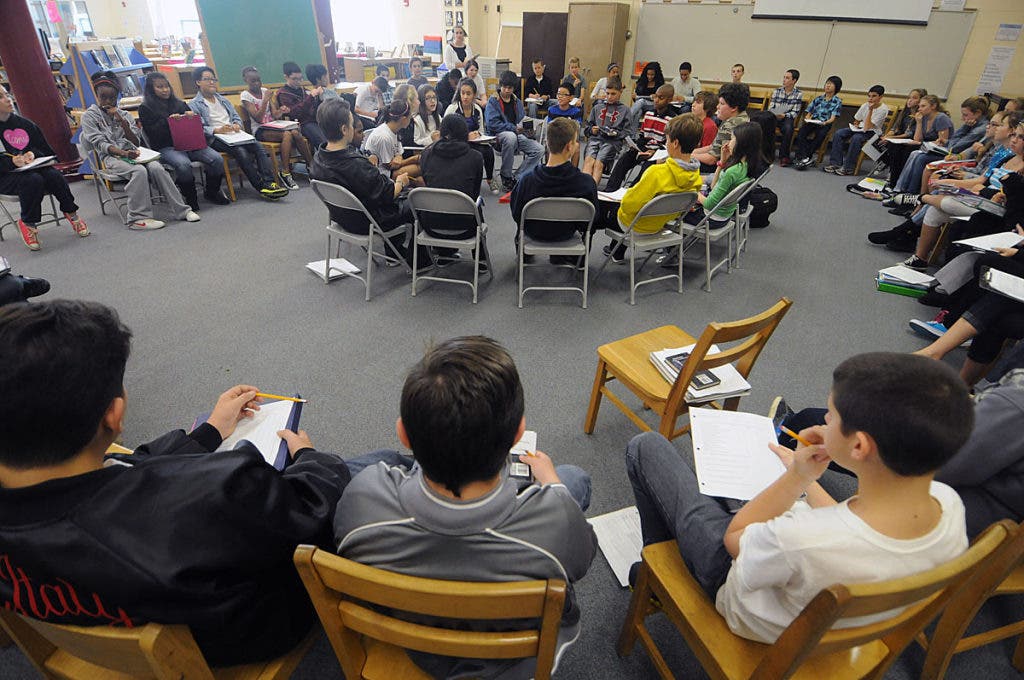


Socrates, it turns out, still has a place in the modern classroom.
Instead of the typical teacher-driven discussion, three classes’ worth of seventh-graders at Carusi Middle School got the chance to explore S.E. Hinton’s The Outsiders on their own, using a method developed nearly 2,500 years ago by the Greek philosopher.
Arranged in concentric circles—the outer observing and critiquing the discussion in the inner—the students spent their class period bouncing questions off each other, slowly at first, but building to a more natural back-and-forth on the book’s themes, how it related to their lives and what meaning they could find within its pages.
Find out what's happening in Cherry Hillfor free with the latest updates from Patch.
“I thought it was good for everyone to be able to share their experiences,” Ryan Mailahn said. “You really get to see stuff that you didn’t see before, when just your class was reading it.”
That’s exactly the aim of trying something like a Socratic circle in the classroom, said Michelle Corona, a language arts colleague teacher at the middle school. Fostering that kind of discussion is not only a great way to analyze a book, she said, but gets students more involved in their own learning.
Find out what's happening in Cherry Hillfor free with the latest updates from Patch.
“It’s empowering—it takes away that idea that the teacher is the center of knowledge and power in the classroom,” Corona said. “It gives them the opportunity to see knowledge is something you work for.”
Of course, being thrown in with two other full classes made it a bit nerve-wracking for some, but Sydney Aquilino said hearing some of the questions she had in her mind expressed by others was comforting.
“I was a little surprised that people were wondering what I was wondering, too,” she said. “You don’t feel alone.”
At the same time, several students said they were surprised at which directions the discussion turned, and what questions grew out of it.
“Some questions I never would’ve thought of came up,” Mailahn said.
That experience of a lively give-and-take, with questions spiraling up from all directions, can lead to students drawing insights they might not have before, Corona said—something they can take outside their language arts class, whether to the science lab or the football field or beyond.
“Those aren’t just standards we’re trying to meet in the classroom, but those are life lessons that the kids get to take,” she said.
The students seemed to share that sentiment, and said the discussion time made learning exciting.
“It’s a lot more fun,” Rahner Park said, comparing it to a written project. “In a book report, you have to write it—it’s better to talk it out with other people.”
And, as language arts teacher Carolyn Strasle said, trying something like the Socratic circle provides proof learning can be engaging.
“It teaches the students that we can have academic, intellectual discussions in school about a topic and they can be fun and interesting,” she said.
Get more local news delivered straight to your inbox. Sign up for free Patch newsletters and alerts.