Neighbor News
Difficult Directors: Joseph Losey, Part 2
After a decade of exile in England, Losey became an internationally renowned director
I recently saw Trumbo (2015), an account of blacklisted screenwriter Dalton Trumbo and his attempts to evade the HUAC blacklist. He used several means to get his work produced, like using a “front” to get screen credit as was done for Roman Holiday (1953). Another time he used a false identity for The Brave One (1956), for which he won an Oscar (no one went up to claim it). Another false identity he used for The Prowler (1951), a film directed by another blacklisted artist, Joseph Losey.
Losey’s response to being subpoenaed testify at a HUAC hearing was to leave the United States, although, like Trumbo, he had to use a pseudonym for his initial films in Europe and England: Stranger on the Prowl (1952); The Sleeping Tiger (1954); and The Intimate Stranger (1956). It wasn’t until the 1970s that he didn’t stop having trouble getting his films distributed in the United States.
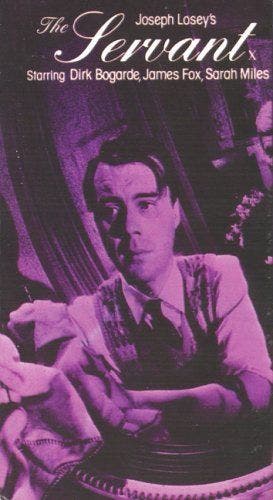
The Sleeping Tiger brought him into contact with Dirk Bogarde, who would star in The Servant (1963) and Accident (1967), two films which made Losey an internationally renowned director. Bogarde would also star in King and Country (1964) and Modesty Blaise (1966). Another actor, Stanley Baker, was also important during Losey’s rise, first in Chance Meeting (1959), then The Criminal (1960), Eva (1962), and Accident.
Find out what's happening in Collingswoodfor free with the latest updates from Patch.
The Servant brought Losey together with his most important collaborator, Harold Pinter, who also wrote the screenplays for Accident, and The Go-Between (1970), the latter winning the Palm d’Or at the Cannes Film Festival. Pinter’s left-leaning politics fit perfectly with Losey’s worldview. Even more, Pinter’s tortured characters and their grating relationships were the stuff all of Losey’s films were made of. The Servant and Accident exemplify the merger of two sympathetic visions whence Losey depicts social injustice and inequality and Pinter dramatizes people’s repressed resentments of the social structure and family dynamics. The Go-Between returns to Losey’s de facto theme: aristocrats (the wealthy) and the working class, the latter being deprived of romantic fulfillment.
His career and critical recognition took off with The Servant, but several of his English dramas in the 1950s are worth watching. In particular, Sleeping Tiger, The Intimate Stranger, Time Without Pity (1957), Chance Meeting, and The Criminal. The last of these is the most interesting, a late British noir, also known as The Concrete Jungle (an attempt by producers, no doubt, to invoke memories of The Asphalt Jungle). Here, the ‘Concrete’ refers to a prison into which Baker’s criminal is thrown after a jewel heist. He dictates much of what happens to the other prisoners, protecting some from other prisoners, if he chooses, and clashes frequently with the head guard (Patrick Magee). You rarely see prison films like this, where the prisoners seem to spend more time outside their cells. Baker is offered a way out of jail by the diamond heist’s mastermind (Sam Wanamaker) to retrieve the expensive stash. Fulfilling a noir-ish destiny, the gang slaughters each other in a muddy field, the diamonds remaining buried and lost to the world.
Find out what's happening in Collingswoodfor free with the latest updates from Patch.
Losey takes on Marxist ideology squarely with The Assassination of Trotsky (1972), with Richard Burton as Trotsky and Alain Delon as the assassin who insinuates himself into Trotsky’s home in Mexico City. This film, along with Boom! (1968), mark two critical low points but remain interesting if not undervalued. Boom!, especially, written by Tennessee Williams, plays out the tumultuous Burton-Taylor marriage beneath the plot of a rich woman obsessed with a penniless poet. Taylor starred in Losey’s next film, Secret Ceremony, a powerful psychological thriller, with Robert Mitchum and Mia Farrow. The stars of this film could be volatile by themselves. Dealing with Taylor’s marriage and Mitchum’s drinking was trying enough for Losey without bringing in Farrow, who had just gotten divorced from Frank Sinatra.
Losey seemed to match a successful film, from 1968 to 1975, with a failure. After Secret Ceremony, he made his most minimalist work, Figures in a Landscape (1970). Essentially, a two-man movie – Robert Shaw and Malcolm McDowell – the scenario has two mercenaries escaping a prison in an unidentified Latin American country. There is no political context and the main antagonist is a black helicopter chasing them. After The Go-Between, he made Trotsky and A Doll’s House (1973). Doll’s House starred Jane Fonda, who came to loathe the director, and during the film’s publicity campaign, much energy was spent by Fonda and Losey disparaging each other, which didn’t help the box office (equally unhelpful was another version of the play had been released a few months prior, starring Claire Bloom, and Losey’s film suffered critically in comparison). Losey returned him to his dramatic roots in the American Film Theater presentation of Bertolt Brecht’s Galileo (1975), starring Topol. It was one of fourteen plays produced by Ely Landau and became a fair to middling success in the reserved seat series.
This was followed by his last great work, Mr Klein (1976), starring Alain Delon, whose title character is an Art dealer in occupied Paris in 1943. He acquired valuable paintings from desperate Jews in need of money to escape the Nazis. One day The Gestapo visits Klein, for they believe he is Jewish, confusing him with a man, we find out, who had sold Klein some paintings. The more Klein tries to prove he’s not the other Mr Klein, the deeper he slides into a well of suspicion. Soon, he’s determined to search for the other Klein, finally tracking him down during the roundup of Parisian Jews. Inevitably, as he chases his double, the art dealer gets swept with a crowd toward the freight cars headed for the concentration camps.
Delon’s Klein embodies many of Losey’s troubled protagonists. Initially sure of their social standing and moral positions, he or she is reminded by the world there’s no easy way out of one’s problems. As they struggle to maintain or restore their worlds and illusions, the double bind of exploitive capitalism and social inequality collapses the fortress of their egos.
I mentioned in the previous Losey article that it was difficult finding M (1951). I have also purchased The Servant, Figures in a Landscape, and The Criminal. As of October 11, 2016, only four of his films are immediately available on Netflix: King and Country, The Romantic Englishwoman (1975), Don Giovanni (1979), and The Trout. Two of his films, The Lawless (1950) and The Big Night (1951), were available on Netflix streaming until last year. You Tube provides a way to see: Chance Meeting, Boom!, The Intimate Stranger (under the title Finger of Guilt), These are the Damned (1962), Modesty Blaise, The Prowler (1951), and Galileo.