Crime & Safety
Final Fugitive Safe Surrender Event Sees 800 Total Surrenders with Two Days Left
The program, being held in Atlantic City, allows people wanted for non-violent offenses to turn themselves in at a neutral location.




On Wednesday, April 25, Fugitive Safe Surrender comes to a conclusion nationwide, and the is currently being held in Atlantic County.
Fugitive Safe Surrender Southern New Jersey Region is a program that has allowed anyone with who has committed non-violent crimes or has been ticketed for disorderly conduct offenses to surrender of their own accord in exchange for reduced penalties, including reduced fines or probationary consequences in place of jail time.
Those surrendering don’t have to be from New Jersey, but the offense has to have been committed in the state. The program continues on Tuesday and Wednesday, from 9 a.m. to 4 p.m.
Find out what's happening in Collingswoodfor free with the latest updates from Patch.
The national Fugitive Safe Surrender program was launched by the U.S. Marshals Service out of Cleveland, Ohio in 2005.
As of Saturday, the highest percentage of surrenders for the final event stemmed from Atlantic County, at 30 percent. Essex County was second with 15.5 percent, followed by Union County with 8.4 percent, Camden County with 5 percent and Hudson County with 4.2 percent.
Find out what's happening in Collingswoodfor free with the latest updates from Patch.
“We’re the only state that’s had four,” Atlantic County Sheriff Frank X. Balles said. “This is the last one ever, nationwide, and I was very vocal about getting it to Atlantic County. I think that’s why we’re seeing a high number of people coming in from other areas.”
People have not just come from other counties; they’ve come from other states, including Florida, Georgia, California, New York and Pennsylvania.
“I’ve been talking to an Atlantic City resident since Friday, who called to tell me his grandson lives in California and he has a parole violation,” Balles said. “He said he wants to turn himself in. He’s going to fly in tomorrow, take care of everything and then fly back.”
Balles said this person had a drug problem, but he’s been clean for over a year. He lived in New Jersey initially, but left the state because of his legal problems.
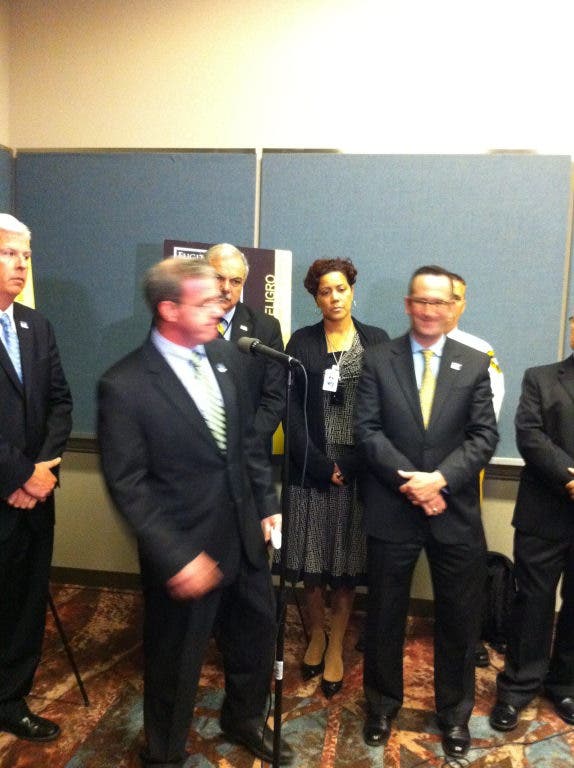
According to Attorney General Jeffrey S. Chiesa, most of those who have participated in Fugitive Safe Surrender Southern New Jersey Region were doing so because of problems with child support and traffic violations. Chisea spoke to the press following a tour of Fugitive Safe Surrender Southern New Jersey Region Monday afternoon.
“Very few people have been detained,” said Chiesa, who said that between Saturday and Monday morning, about 800 people have participated.
He said there was one case of first-degree sexual assault, stemming from a surrender Monday morning.
Most people come away with everything being cleared up.
“I thought I had three traffic warrants, but I only had two tickets I had to pay,” said Ezra Hines, 25, who made the trip from Jersey City.
He ended up owing $252 in fines and getting no points on his license.
“It’s similar to traffic court, but in traffic court, they don’t give you deals like this,” Hines said.
“I was here for three hours, but it was worth the wait,” said an Atlantic City resident who had traffic violations and wished to remain anonymous. “It’s about the same as traffic court, but the judge was more lenient (here).”
“There are so many warrants outstanding, and you can get arrested when you least expect it,” Atlantic County Prosecutor Ted Housel said. “You can get pulled over by a police officer for something and they can run your information, find out you have a warrant and you get in trouble. Here, you can just come in, take care of it and it works to your benefit.”
The first Fugitive Safe Surrender was held in Camden in 2008. One was held in Newark in 2009 and one was held in Middlesex in 2010. The federal funding for the program was cut a year and a half ago.
For the final event, those wishing to surrender register at the Grace of God Church, 201 Atlantic Avenue in Atlantic City, and are then transported by jitney to the Atlantic City Convention Center, where they register their information, and are then able to speak with prosecutors and public defenders from the area.
There are 14 courtrooms set up in the Convention Center, including two designated for Superior Court cases. The Convention Center houses a massive waiting room, where those surrendering can pass the time by watching TV, or get something to eat, provided by the Salvation Army.
Ultimately, the sides arrive at a mutually beneficial conclusion, and just about everyone has been allowed to go home the same day.
“People are bringing money,” Balles said. “They’re not just showing up and saying I’m here, now you decide what you’re going to do with me. People are showing up with money and the judges are reciprocating. It makes it a lot safer. You never know what people are going to do when they hear the words, ‘You’re under arrest.’”
“This is more efficient,” Chisea said. “It’s a safety issue for law enforcement.”
Get more local news delivered straight to your inbox. Sign up for free Patch newsletters and alerts.