Neighbor News
Gatsby and the Wolf
Two men pursue the American Dream. One is sentimental and hopelessly in love. The other is amoral and in love with money.
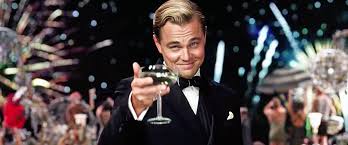


2013 saw a pair of movies situated around NYC and featured extremely successful men who became successful in very suspicious ways. Making the comparison more poignant, the films star the same actor playing Jay Gatsby and Jordan Belfort: Leonardo DiCaprio.
Both films center on the men’s respective pursuit of the American Dream. The Wolf of Wall Street is not going to make us forget Gatsby – book or movie – despite Martin Scorsese making the better film. Indeed, The Great Gatsby has been made into a film three other times: 1926 with Warner Baxter (unavailable); 1949 with Alan Ladd; 1974 with Robert Redford. I liked Redford as Gatsby and Bruce Dern as Tom Buchanan but Mia Farrow wasn’t my cup of Daisy. Nor did I like the overall cinematography of the 1974 Gatsby, although it was better than the flat black and white 1949 version.
Often, films overwhelm our memories of the books portrayed. We can’t think of Rosemary in Rosemary’s Baby (1968) as anyone but Mia Farrow. Clark Gable and Vivian Leigh run away with their Gone with the Wind (1939) characters and the film makes us forget the book. So does the film version of To Kill a Mockingbird (1962) with Gregory Peck as Atticus Finch. This doesn’t happen with Gatsby played by Ladd, Redford, or DiCaprio. Maybe it’s the way they say “Old Sport.”
Find out what's happening in Collingswoodfor free with the latest updates from Patch.
All of Baz Luhrmann’s excessive stylistics in the recent Gatsby are appropriate for depicting the 1920s. One might call his use of Jay-Z, Beyonce, will.i.am, Fergie, et ales. inspired. It certainly separates it from the other Gatsby movies. But when I write about Gatsby and the American Dream, I am probably referring to the book. The reason may be that the films can’t make Gatsby’s pursuit of this Dream different from the novel.
The 2013 Gatsby, however, can be illuminating when one compares to the American Dream. Plus, The Wolf of Wall Street can deepen our view by finding points of comparison, to the point where we might judge Gatsby through the prism of Jordan Belfort. Is Belfort a ‘Gatsby in Wolf’s clothing’? Is Belford unredeemable because he doesn’t have Nick Carraway sentimentalizing Gatsby’s quest?
Find out what's happening in Collingswoodfor free with the latest updates from Patch.
Speaking of wolves, it’s not coincidental that Gatsby rubs elbows with Meyer Wolfsheim. What’s suggested in Luhrmann’s film is that Gatsby attains propitious wealth through intermediaries. In fact, there’s more than a suggestion that Wolfsheim and others have played dirty on the stock market. And this should remind us of another Wolf, Belfort, who made a fortune pushing penny stocks and using the power of his personality and schtick to separate investors from their money.
On the surface, we wouldn’t mistake the dreams of the respective DiCaprio characters. Nick Carraway (Toby Maguire) has infinite hope in Gatsby’s dreams, especially his wanting to marry Daisy. Nick arranges the first meeting. This is a long way from the relationship established between Belfort and Donnie Azoff (Jonah Hill). Azoff is a protégé of Belfort’s, perhaps just as much of a lapdog as Nick is for Gatsby. Donnie and Belfort aspire to nothing but ascending to the top of the pile. They are reprehensible during the entire route of successful maneuvering; their moral repulsiveness becomes an object of fascination.
Love versus prurience. Never shall they meet. Gatsby represents a better, more wholesome past. He became rich to attain love. Gatsby invests his entire existence in his desire to have a woman who represents something greater than success. We love Gatsby because he believes in love. He gives up his life for Daisy. Do you remember the first encounter Belfort has with his future wife?
We are situated more deeply in Gatsby’s corner when we see who opposes him: Tom Buchanan. The man is brutal by anyone’s definition, increasing his brutishness is his level of social standing. Tom states this baldly to Gatsby:
We’re all different from you. You see, we were born different. It’s in our blood. And nothing that you do or say or steal... or dream up can ever change that.
This difference is apparent to Daisy eventually. She likes Status. The American Dream isn’t her dream. Let those who attain the Dream don’t mess with those who make the Dream available. F. Scott Fitzgerald’s critique of the American Dream uses this as its pivot. Gatsby, via Nick, maintains some nobility and, by extension, the American Dream lives on.
Jordan Belfort is living some kind of dream – maybe he’s indicative of the American Dream reduced to a process: namely, trying hard and succeeding. It can get ugly. Pete Rose (Charley Hustle) ugly. Sammy Sosa ugly. Lance Armstrong very ugly. Bernie Madoff grotesque.
There may be feel good stories out there – only they make for lousy movies. Some public response to The Wolf of Wall Street is illuminating. If the people who lost money to Belfort weren’t complaining how the film ignored their suffering, others found his depiction glorifying the man. I suspect there might be more people who envied Belfort and thought him a lascivious Depok Chopra. Belfort mastered a method that is impervious to morality. He fits in with the long gallery of Scorsese gangsters from Butcher Bill to Tommy DeVito.
What we might call the Gatsby myth – the sentimental dream of finding true love – will endure longer than the Belfort myth – success breeds more success. When myths endure like Gatsby’s, they become reality. Calling Gatsby a “Belfort in lamb’s clothing” will not do. A fifth Gatsby film will come around 2050, deal with the same matters, and Nick will still have us believe we are witnessing something great in the dream of a lovelorn, go-getting American.