Neighbor News
Luddite Films: MODERN TIMES
Chaplin adroitly gets around industrial technology to criticize industrial technology
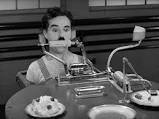


Modern Times (1936) is Charles Chaplin’s first sound project, sort of. It has all the trappings of a traditional silent film. For example, there are title cards to account for what Chaplin and others are saying. The cards also show passage of time and designations of places. The sound comes primarily from mechanical reproductions of voice. There is also the accompanying music, composed by Chaplin himself.
The sound of a human voice we first hear when the president Allan Garcia of the Electro-Steel Company (which produces nothing specifically that anyone can see or touch) calls down orders to a workman to speed up the assembly line. A few minutes later, when The Tramp (Charlie Chaplin) is taking a cigarette break in the lavatory, the president appears on a screen firmly saying: GET BACK TO WORK. Then into his office enters a salesman with an invention: a machine that feeds a worker while still working on the assembly line. The sales pitch consists of the man putting on a phonograph record producing his voice describing the benefits of the eating machine.
The machine is tried out on Charlie, with uproarious comic effect as the machine breaks down and literally goes berserk. The sales pitch for the machine, the president interrupting a work break, and the same president ordering more rigorous work from the men on the assembly line, all pejorative examples, there’s little doubt how the film views technological industry. Yet, criticism of industrial society is bound to contain contradictions, no more apparent than in the art medium, film, which depends on industrial technology.
Find out what's happening in Collingswoodfor free with the latest updates from Patch.
Modern Times signals an awareness of the contradiction during the end of the Tramp’s first stay at the factory when he has a nervous breakdown from the frenetic work pace. It starts with his jumping onto the conveyor built to complete his task (fastening a pair of bolts on the conveyor every ten seconds) and being swallowed into the bowels of the machine. He curves through the central part of it before the belt is reversed and he comes back to the factory. While going through the machine, we can’t help noticing that the engine resembles a film projector with the conveyor belt representing the film snaking through.
Chaplin may also be teasing a comparison between mechanical industry and film during the sequence when the salesman plays the phonograph record. This episode has an analogue in Singin’ in the Rain (1952) when the studio head exhibits a ‘speaking film’ which has a man on the screen explaining the process. The man’s voice and look are not much different from those during the eating machine sales pitch. It should also be noted that Singin’ in the Rain satirically renders the transition from silent to sound films.
Find out what's happening in Collingswoodfor free with the latest updates from Patch.
Another film also alludes to this sequence in Modern Times, specifically a phrase used by the salesman. A Clockwork Orange (1971) has doctors producing the Ludovico technique, which will prevent criminals from having aggressive or violent thoughts. Alex, upon whom the technique is tried, is subsequently presented before an audience for a demonstration. The government minister introduces the episode by explaining what the technique should do but eventually stops and says: “Actions speak louder than.” Exactly what the salesman said on the phonograph record at the end of his pitch. Like the eating machine, the Ludovico technique also failed but more because it worked too well.
Chaplin’s argument might be this. There’s a qualitative difference between work productivity (efficiency) and entertainment. Applying industrial methods to create a medium of fun and pleasure could be acceptable use, so to speak. Fun and pleasure from silent cinema is enough. Why do we need sound in movies? How much funnier and more pleasing can sound make a movie? About the same as an eating apparatus makes efficient work on an assembly line.
The flat out attack on industrial modernity Modern Times exhibits in two ways. First, the methodically stultifying routine of the work. Second, the ultimate aim of working more and more to obtain a dream house and life gets defeated by destroying workers’ capacities for happiness and relaxation. The prelude to the film reads: “’Modern Times.’ A story of industry, of individual enterprise - humanity crusading in the pursuit of happiness.”
Indeed, the idea that the Tramp, the principal character portrayed in Chaplin’s prior films, working in a factory is anomalous. He quickly proves he doesn’t belong. After a stint at a mental facility, the tramp is later arrested when he inadvertently joins a communist demonstration. After stopping a prison break, he’s rewarded with his own cell and many perks. Unfortunately, he’s given his release, fails at another job at a shipyard, and then proceeds to try to get arrested and put back in prison.
During this process, he meets the gamin (Paulette Goddard), a young orphan sixteen years old, and they escape together from the prison van. He tries to be a night watchman, which has its own perks, but he fails at that as well. Meanwhile, the gamin has made a home out of a shack. At breakfast one morning, the tramp reads in a newspaper that the factory is hiring more workers. She packs him a lunch and he rushes to the factory, fights his way through hundreds of workers, and is the last to get inside the gates.
His going back to the factory is predicated strictly on the dream of having enough money to buy a home and live the dream life with the gamin. But things fall apart during a strike and in a subsequent fight with police he is arrested again.
By the time of his release, the gamin has gotten a job as a singer at a restaurant. She brings the Tramp to the joint and gets him a job as a singing waiter. At long last, Chapin will finally talk. However, the song is in French and he is more expressive with his movements than the words. His success is immediately ruined by the authorities who want to put the gamin into a juvenile home (Chaplin showed a predilection for younger women in real life – he married the 14 year old Oona, daughter of playwright Eugene O’Neill -- anticipating the exploits fifty years later of Woody Allen). It’s as if modern society won’t let the Tramp alone.
The tramp and the gamin soon find themselves out of the city, on the road, mountains and desert ahead. She’s crying. He tells her to cheer up. Puts a smile on her face. They walk down the road into the sunset.
This is Chaplin’s true goodbye to silent films. No more Tramp. To some extent, there’s an end of innocence. His next film is The Great Dictator (1940) where a Jewish barber is mistaken for a Hitler-like dictator. His postwar film Monsieur Verdoux (1947) deals with a man who supports his family by marrying and murdering wealthy women. A long, long way from the Tramp and the Gamin.