Neighbor News
Orson Welles's MR ARKADIN: Purging the Past
Welles may have created and inhabited his most iniquitous character in this mid-1950s film.
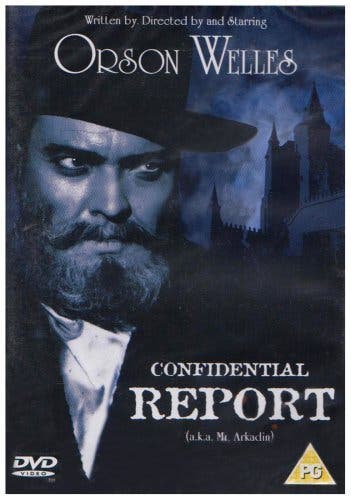

Orson Welles’ Mr Arkadin (1955) has been called “a Citizen Kane (1941) in reverse.” As in Kane, a man explores the past of a larger – if not richer – than life character whom everyone knows and fears. Kane’s and Arkadin’s true nature elude the respective investigator. What did Kane mean by his last word, ‘Rosebud’? How did Arkadin become so rich? Many people are interviewed and we seem to be getting closer to the truth, only the truth of the past becomes an illusion.
The basic difference between the films is that Arkadin dispatches Guy Van Stratten to discover what happened to Arkadin before 1927, whereas News on the March sends out Mr Thompson to complete a news documentary. Instead of uncovering Arkadin’s identity (and initiating the “reversal”), Van Stratten helps Arkadin obliterate his past. Calling Mr Arkadin a mirror image to Citizen Kane would be apt, except that the mirror used would come from the funhouse from The Lady from Shanghai (1947), whence the image is first distorted and then shattered into thousands of pieces.
Reversed or mirrored might only begin to imagine the ways to categorize Mr Arkadin. It could also be a European Citizen Kane or the Multi-national Corporate Kane. While Kane and Arkadin are intolerably controlling, Arkadin borders on the pathological. First, look at an image of Arkadin (above), especially the hair. Second, Kane’s uncomfortably obsessive delusion to make his wife Susan an opera story appears normal and loving compared to Arkadin’s smothering (incestuous longing) of his daughter, Raina. Lastly, Arkadin turns out to be a human trafficker and mass murderer.
Find out what's happening in Collingswoodfor free with the latest updates from Patch.
Gregory Arkadin appears to have come from eastern Europe and was part of criminal syndicate. He has used Van Stratten to find his ex-cronies and begun to eliminate them. This purging of the past suggests the modus operandi of a totalitarian regime which would want no witnesses to the leader’s questionable origins. Arkadin’s mission is to protect his daughter from knowing his horrific transgressions and, inevitably, betrays himself an even worse monster.
The film, in fact, points to a particular dictatorial monster, Josef Stalin. Most explicitly, he tells Van Stratten that he was born in Tiflis, capital of Georgia, located in the Caucasus Mountains near Russia. Tiflis (aka Tbilisi and Tpilisi) is the birthplace for Uncle Joe. I mentioned Arkadin’s face, which is framed as stiff, glaring, medieval, with a very odd beard. More, Welles frames Arkadin so he towers over everyone around him. And the way Welles frames the face reminds one of Sergei Eisenstein’s Ivan the Terrible Part Two (1958), which Stalin never let be shown because Ivan’s destructive actions resembled Stalin’s own.
Find out what's happening in Collingswoodfor free with the latest updates from Patch.
Welles always attacked authoritarianism in his films, and occasionally aimed at totalitarian tendencies in films like Mr. Arkadin and The Trial (1962). However, except for The Trial, in which the oppressive components are bureaucratic and not individual, he rarely strayed from defining the psychology and motives of individual autocrats: Charles Rankin in The Stranger (1946): MacBeth and Othello; Hank Quinlin in Touch of Evil (1958). Like many great artists, he critiqued a significant aspect of his own personality.
A recent documentary, Magician: The Astonishing Life and Work of Orson Welles (2014), recounted numerous ways that Welles dominated and manipulated his actors on a set. Richard Linklater’s Me and Orson Welles (2008), dramatizes a Mercury Theatre Production of Julius Caesar circa 1937 and Welles does not come off very sympathetically. His production, significantly, was a modern day, fascist representation of Shakespeare’s tragedy. The man could be monstrous with other people, completely ignoring their feelings and ideas. Only Welles did not fear himself and methods, which proved aesthetically on the mark again and again.
Magician also digs into the downfall of Welles in Hollywood and how he eventually was forced to make films with limited budgets and shaky producers. Mr Arkadin’s fate figures as the best example of the difficulties Welles faced after 1950. He had many acting roles but couldn’t get his own films financed. When he found financing for Mr Arkadin, the producer fired Welles during post-production, claiming that Welles hadn’t finished the film in time.
As a result of this, five versions of Mr Arkadin appeared over the next decade. For a while, the main version seen in the U.S. was called Confidential Report. Eventually, a ‘Comprehensive’ version was established from three of the versions (all of which can be found in the Criterion Collection of Mr Arkadin).
Another film, The Other Side of the Wind, completed in 1975 by Welles, was never distributed. Many lawsuits by members of the cast and Welles’ heirs have kept it out of circulation. There had been reports that the film would finally premier in May, 2015, to coincide with Welles’ 100th birthday. It didn’t happen. However, it may be released by 2016.