Neighbor News
Preserving Her Virtue: Three Movies
Three comedies deal with Women trying to find true romance and love. Only one ultimately succeeds in being comic and profound.
I watched two movies back-to-back after having recorded them a week apart when they respectively appeared on Turner Classic Movies. Waltz of the Toreadors (1962) was on the “saved” list of my Netflix queue, which meant I had little chance seeing it for a long, long time. Whereas, I had resisted watching The Moon is Blue because of its reputation (more later on this), but having recently read a critical work on its director, Otto Preminger I wanted to see how well the film held up.
Neither film alone would be worth much notice time had not each embodied an element that could be considered anachronistic if not quaint. The leading lady in each film has made it her goal to save herself for the man with whom she will spend the rest of her life. In the case of Waltz, she has had an affair with an English general Leo Fitzjohn (Peter Sellers) for seventeen years and has resisted his sexual advances until he gets a divorce. Preserving her virtue is less a part of the plot and more of the mild comedy, especially compared to the directness that Patty O’Neill (Maggie McNamara) takes toward her suitors (William Holden and David Niven), such that she is called by her rival for Holden a “professional virgin”.
A third film, That Obscure Object of Desire (1977), will finally deal with this theme of women preserving their virtue more comically and profoundly.
Find out what's happening in Collingswoodfor free with the latest updates from Patch.
The course for Waltz’s virtuous woman ends both with her resisting the general and giving in to the general’s aide, Lieutenant Finch (John Fraser). Given all of the advances toward the General, starting with her coming to England to marry him, the General cannot extricate himself from his sickly wife, Emily (Margaret Leighton). Indeed, he fritters away several opportunities to consummate his relationship with Ghislaine (Dany Robin) and she ultimately finds a more suitable suitor.
Being a virtuous mistress is a novel if oxymoronic approach to a relationship. Fitzjohn is partly afraid to betray his wife; however, her health, physical and mental, declines during the years that he invests his imaginative energy toward Ghislaine. The film’s inability to work successfully as a comedy in part stems from not being madcap enough. This seems impossible given the presence of Peter Sellers. Ultimately, the filmmakers did not make him crazy enough; worse, he’s more of a dud: Sellers is 37 years old playing a man 20 years older. Not enough farce is injected into the action as, say, was when Sellers played three characters (one was a Grand Duchess) in 1959’s The Mouse That Roared.
Find out what's happening in Collingswoodfor free with the latest updates from Patch.
Patty O’Neill’s virtue in The Moon is Blue is preserved, although she ultimately gives in to having a relationship with William Holden by film’s end. The trick is that Holden’s playboy ways must be shed for him to have her, consummating their love once they are married. David Niven is thrown into the mix as Holden’s friend and rival for Patty, despite the fact that Niven’s daughter, Cynthia (Dawn Addams), is Holden’s current paramour. This imbalances the action more than the continual discussion about Patty’s virginity.
Otto Preminger deliberately provoked the Hays Office in Hollywood by constantly bringing up the then taboo word “virgin”. He was constantly battling the censors, who stubbornly prevented divorce from happening in films (and if a couple was divorced, they couldn’t be happy). The Catholic League of Decency condemned The Moon is Blue but failed to prevent audiences from flocking to it; in fact, the League’s failure here contributed to its decline of influence. However, audience expectations for Sex may have been too high and caused some disenchantment or, at the least, wonder over the fuss. The League of Decency disapproved of frank discussions of sex and, apparently, the audiences didn’t enjoy Moon just having the discussions. The latter became a plot point in an episode of the television show, M*A*S*H.
Two dialogue examples should suffice to convey the essence of what, over time, seems insufferably flat though at the time was considered witty rapport. Donald and Patty are in a taxi:
Donald: You won’t mind coming up, will you?
Patty: I am not so sure. Will you try to seduce me?
Donald: I, I don’t know. Probably. Why?
Patty: Why? A girl wants to know.
Donald: A girl is supposed to be intuitive about those things. You don’t go around bluntly asking questions like that.
Patty: I do. I always do.
Donald: And what happens if they say yes, they are going to try to seduce you.
Patty: I generally believe them. And then I am out one dinner.
Donald: And if they say their intentions are honorable?
Patty: I generally believe that. But you get fooled some times. I hate men like that. I mean, after all, they are lots of girls who don’t mind being seduced. Why pick on those who do?
And later:
Donald: Why are you so preoccupied with sex?
Patty: Who, me?
Donald: Yes, you.
Patty: You really think I am?
Donald: Well, you are always asking if people plan seduction or they’re bored with virgins or they have a mistress... Now, if that isn’t being preoccupied with sex, I’d like to know what is.
Patty: You may be right.
[pauses momentarily]
Patty: But don’t you think it’s better for a girl to be preoccupied with sex than occupied?
Okay, it was originally a play and it was 1953. Perhaps its flaw, all talk and no action, cannot be resolved. The film’s settings are nearly all interior, except for going twice to the top of the Empire State Building, and the adapted play never becomes cinematic.
Where Dany Robin’s Ghislaine has some charm and appeal in Waltz, Maggie McNamara’s alleged charm in Moon (the movie’s conceit that she would attract Holden and Niven) is difficult to find. She’s plain annoying, emphasized when Cynthia she calls here a professional virgin. The appeal to have a relationship with her is tenuous to most men watching the film. The film’s failure rests squarely here. Despite my personal feelings, Ms McNamara earned a Best Actress Academy Award nomination for her first movie (she had starred in a Chicago stage production of Moon). She later appeared in Three Coins in the Fountain (1954) and Preminger’s The Cardinal (1963) and several television shows. That was it. She died at age 48.
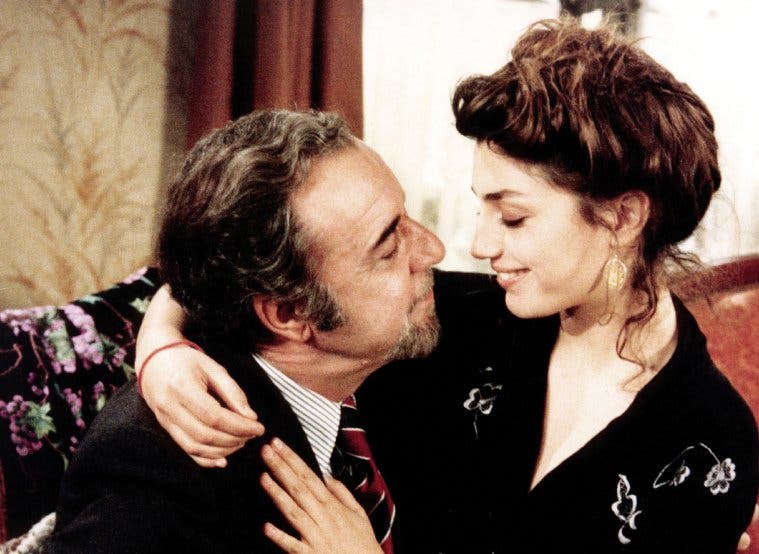
In stark contrast to the way these films handle a woman maintaining her virtue, Luis Bunuel’s That Obscure Object of Desire takes the question of male sexual desire and a woman’s response to it more seriously, less glibly, and still able to be terribly funny. Mathieu (Fernando Rey) meets and becomes Conchita’s companion. His long-term goal is to make her his mistress and freely enjoy carnal relations with her. He performs the time-tested ritual of ‘taking care’ of Conchita. But something happens which puts his desire on a different plane. Conchita is played by two actresses (!), Carole Bouquet and Angela Molina, who despite their dark hair look very different. Only Mathieu never sees the difference. For him, Conchita is someone who exists to be taken to bed. She could be anyone.
Intuitively understanding her position, Conchita refuses to give in sexually. At times, she flirts with and teases him. At her worst, she can be cruel, as when she lays with another man in front of Mathieu. Mathieu becomes increasingly frustrated, even violent, but ultimately never gives her up. Bunuel partly represents his frustration externally by having violent terrorist acts occurring around the times he has been frustrated.
It’s not about preserving her virginity nor is it necessarily about being virtuous. At one point, Conchita bluntly tells him that if he really loved her, he wouldn’t need to have sex with her. It’s not as if she‘s saying once he’s proved that he loves her for herself and not to bed her that she will ultimately sleep with him. She never intimates it. Nor does Mathieu ever fully disguise his physical desire for her.
This seems the ultimate test that neither Maggie nor Ghislaine want to try with their men. Ghislaine gives herself to Lt. Finch almost immediately upon leaving the General. Maggie, on the other hand, seems to want to talk and talk until she gets married, as if marriage kills one’s (the professional virgin’s) preoccupation with sex.