Neighbor News
Witness for Agatha Christie Movies
The best two films from her work come from works not dealing with Jane Marple and Hercule Poirot

As it happens, two of the strongest films from Agatha Christie books didn’t include her famous detectives (Hercule Poirot and Miss Marple): And Then There Were None (1945), directed by Rene Clair, and Witness for the Prosecution (1957), directed by Billy Wilder.
And Then There Were None is also known as Ten Little Indians, and three increasingly inferior versions were produced in 1965, 1974, and 1989. The original stands out by utilizing strong character actors like Barry Fitzgerald, Walter Huston, Judith Anderson, Roland Young, and Louis Hayward. The concept of the film overwhelms the characters to such an extent – they keep dying -- that we can’t fasten to a strong leading type. The accomplished second tier actors carry the story along with strong direction (no wasted moments).
The concept is problematic. Ten people are invited to a remote mansion on an island and are stuck there long enough for all to be killed. Who is the murderer? In the novel, Christie appends a note written by the killer, explaining all. Suffice to say, one of the victims fakes his or her death then later commits suicide. The film must get around this and have survivors who have figured out the killer’s game. The movie’s producer’s couldn’t spoil thing by having the more truthful title: And Then There Were a Couple Left. A fake victim as killer is used in various mystery plots, as well as its corollary, an intended victim being the murderer. We see this used in The Mirror Crack’d (1980), with Angela Lansbury as Miss Marple and Death on the Nile (1978), with Peter Ustinov as Poirot.
Find out what's happening in Collingswoodfor free with the latest updates from Patch.
Just as I favor Poirot over Marple, one cannot avoid favoring a particular characterization of a famous detective, like Sherlock Holmes and Hercule Poirot. The television versions of the detectives tend to be superior, Jeremy Brett as Sherlock Holmes; more so, David Suchet as Poirot; and Joan Hickson as Miss Marple. Filmed versions of the characters are very problematic.
Christie’s readers felt more comfortable with Lansbury than they had with Margaret Rutherford’s four turns as Marple in the 1960s: Murder She Said (1961); Murder at the Gallop (1963); Murder Most Foul (1964); and Murder Ahoy (1964). The first title has a serendipitous connection with Lansbury’s television show, Murder, She Wrote (1984-1996).
Find out what's happening in Collingswoodfor free with the latest updates from Patch.
Then you get Peter Ustinov in four movie versions (and three television movies), yet he’s nearly on the same scale as Margaret Rutherford’s Marple. In 1965, the British tried a spoof of Poirot in The Alphabet Murders, with Tony Randall playing Poirot. It’s very difficult to watch, if only because it isn’t funny but, worse, the unrequited humor destroys interest in following a potentially compelling mystery.
The filmed version of Witness for the Prosecution I watched on the ABC Sunday Night Movie in the late 1960s. It starred Charles Laughton, Tyrone Power, and Marlene Dietrich, received six Oscar nominations, and is ranked 83 on the IMBd list. Power is puffy and less the glamor boy, his character accused of murdering his wealthy spinsterish girlfriend. Laughton’s barrister is in ill-health but defends Power against a strong circumstantial case. As the title suggests, the defense turns around the testimony of Marlene Dietrich, playing Power’s seemingly conniving and bitter wife. The film’s surprises, especially the final one, are superb.
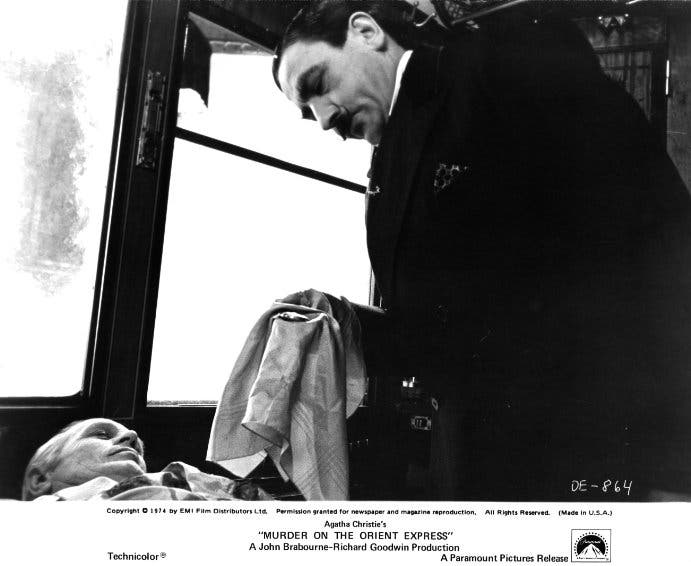
Poirot’s movie appearances, however, are reprieved by Albert Finney in Murder on the Orient Express (1974). Finney received a Best Acting nomination; Ingrid Bergman won the Best Supporting Actress Oscar; and there were four other nominations. Besides, the film is directed by Sidney Lumet, who ranks with Billy Wilder as one of the best. Finney, as does David Suchet, buries himself in the character such that he’s not recognizable as “Finney”. Thus, when Peter Ustinov comes along, despite Ustinov’s impressive acting resume, including two acting Oscars, we can’t see Poirot through him, despite the attempt at a French-Belgian accent.
Finally, I must mention an odd film, Agatha (1979), starring Dustin Hoffman and Vanessa Redgrave, which is a fictional version of a real-life 11-day disappearance of Agatha Christie. Apparently, she wants to prevent her husband, played by Timothy Dalton, from divorcing her. Many people had thought she had committed suicide. Hoffman plays a reporter who is going interview Christie. He joins the search for her and, then, finding her, doesn’t immediately reveal where she is. Hoffman nearly quit film acting after making this film and, I remember, he spoke against the film during its release. I haven’t seen it for 25 or 30 years and is difficult to track down.