Neighbor News
Passing the Lamp: 18 Years of Guru Vandana, and Why I Keep Returning
During Teacher Appreciation Week, families in Edison and across the country gather for a small ceremony with a very old idea behind it.

Passing the Lamp: 18 Years of Guru Vandana, and Why I Keep Returning
By Pushpahas Hadap, Edison, NJ
Every first week of May, schools and communities across the United States observe Teacher Appreciation Week — a tradition that began as a grassroots effort by education advocates in the early 1980s and has grown into a national tribute to the people who shape every generation. Cards are written. Coffee is brought to staff rooms. Bulletin boards fill up with thank-yous.
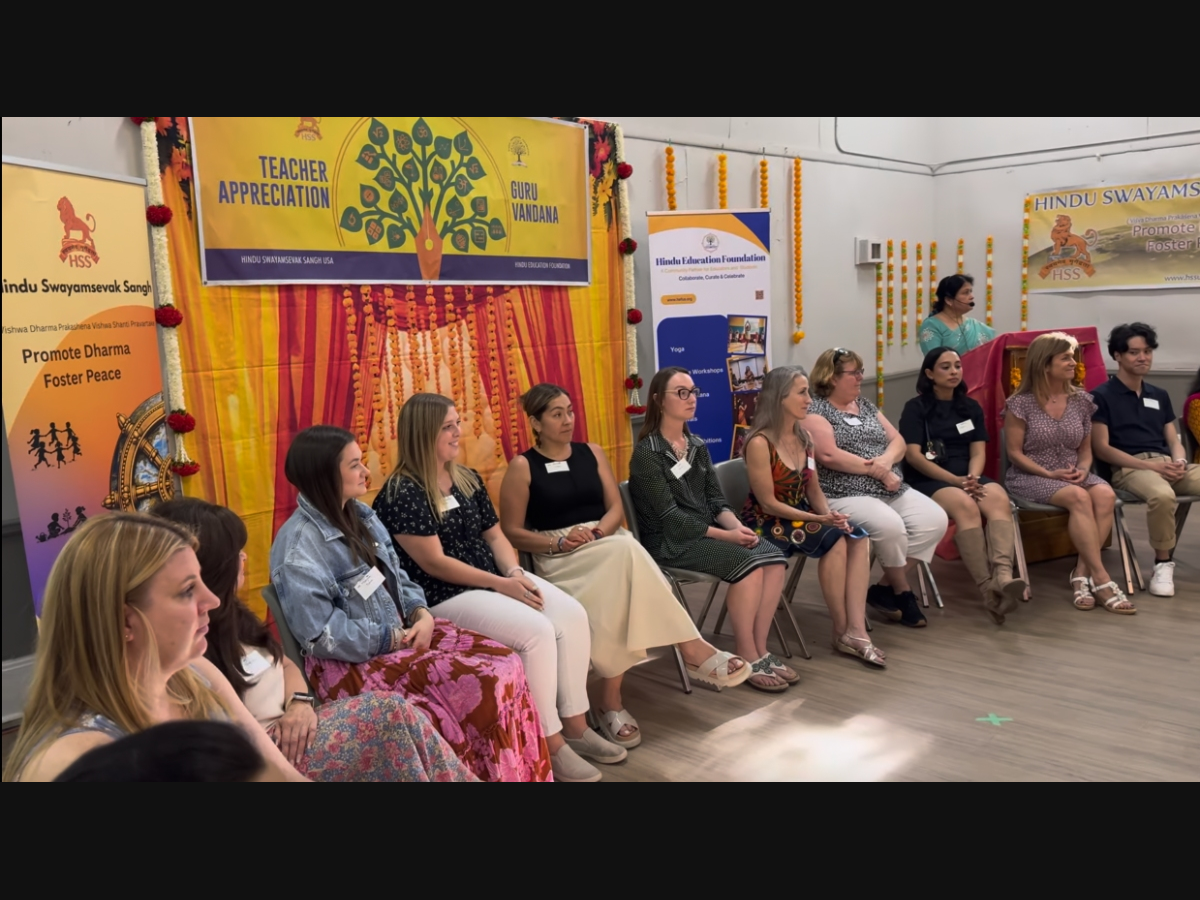
In our community, that same week looks a little different. Alongside the cards and the classroom gestures, families gather for an event called Guru Vandana — and for many of us, it has quietly become one of the most meaningful days of the year.
Find out what's happening in Edison-Metuchenfor free with the latest updates from Patch.
What Guru Vandana is
The name comes from Sanskrit. Guru means teacher, mentor, or spiritual guide. Vandana means reverence. Put together, it's a simple idea: a moment, set aside each year, to honor teachers the way our tradition has taught us to — with humility, with ritual, and with the whole family present.
In Hindu culture, teachers have always held the highest place — not merely as instructors, but as gurus: figures who embody wisdom, mentorship, and guidance. The phrase Acharya Devo Bhava — "the teacher is divine" — is something many of us grew up hearing at home.
Find out what's happening in Edison-Metuchenfor free with the latest updates from Patch.
Guru Vandana is organized by volunteers of the Hindu Education Foundation (HEF) in partnership with the Hindu Swayamsevak Sangh (HSS), with chapters running the program in cities across the country. At each event, children offer flowers to their teachers, recite Sanskrit shlokas, and perform a short, traditional ceremony of gratitude. Teachers — many of whom have never been part of anything quite like it — leave visibly moved.
It is a small bridge between ancient wisdom and modern classrooms. And it has held up well.
How I came to it
I attended my first Guru Vandana on May 11, 2008, in Sunnyvale, California. It was Mother's Day. I walked in holding my three-year-old daughter's hand — unsure, a little nervous, mostly curious.
That afternoon, I watched the idea of Acharya Devo Bhava come alive in a way I hadn't experienced before. It didn't feel like a program. It felt like something we had carried across oceans and quietly rebuilt.
One shloka stayed with me from that day, and it still does:
Gurur Brahma, Gurur Vishnu, Gurur Devo Maheshwara…
It is easy to recite. Guru Vandana made me pause long enough to actually think about what it means. A guru is not just someone who teaches facts. A guru shapes how we think, how we act, and who we become. Watching my daughter, very small at the time, offer a flower to her teacher, I realized she was learning something deeper than anything in a workbook — not just respect, but gratitude as a habit.
From Sunnyvale to Edison
Life moved us from Sunnyvale to Irvine, and eventually to Edison. New cities, new neighbors, new routines. But Guru Vandana stayed constant. Every year looked a little different and felt familiar in all the right ways.
My role changed gradually too. I started as a parent in the audience — taking pictures, feeling proud. Over time, I became more involved in organizing the event, understanding what goes into it and why it matters. Somewhere along the way I became the one explaining it to friends, neighbors, and teachers — what it is, why we do it, and why something like this still matters today.
Without quite realizing it, I had grown into my identity as a Hindu-American — holding on to where I come from while fully participating in where I am.
Why I kept coming back after my daughter graduated
My daughter graduated from high school in 2022. By a practical definition, my connection to Guru Vandana could have ended there. But stepping away didn't feel right.
Because at some point I understood that Guru Vandana was never only about my child. It is about keeping a way of thinking alive — a way of expressing gratitude that doesn't depend on occasion or convenience.
Today I find myself on the other side of the experience. Welcoming new families. Encouraging parents who are unsure. Watching young children go through the same motions my daughter once did — and reminding them, sometimes gently, that what feels like a small effort now often stays with them much longer than they expect.
"But these aren't even your child's teachers"
People sometimes ask why we honor teachers who may not even teach our own children. That question misses the point.
Guru Vandana is not about a specific teacher. It is about the value we attach to teaching itself. When children grow up seeing teachers respected — not casually, but consciously — they carry that attitude into every stage of life: school, college, work, and beyond.
And I have seen its impact firsthand. Not just on students, but on teachers too. Many of them are surprised, even moved, by the experience. In a system where appreciation is often limited or transactional, a simple gesture of sincere respect leaves a lasting impression.
What stays steady
Eighteen years have passed since that first event in Sunnyvale. Every year, when the program begins, it still feels familiar. Grounding. The format hasn't changed much — and maybe that's the point. Some things are meant to stay steady so they can quietly shape us over time.
As long as we carry these values forward, wherever we live, the connection remains.
|| तस्मै श्री गुरवे नमः ||
Tasmai Shri Gurave Namah — "Salutations to that revered Guru."
Pushpahas Hadap lives in Edison, NJ, and has volunteered with Guru Vandana programs organized by the Hindu Education Foundation and Hindu Swayamsevak Sangh since 2008.
Tags: Edison NJ, Teacher Appreciation Week, Guru Vandana, Hindu Education Foundation, HSS USA, community, culture, schools, gratitude