Business & Tech
Interactive Map: Pinpointing New Jersey's Polluters
According to the federal EPA, the aggregate toxic chemicals in NJ's air and water is on the rise


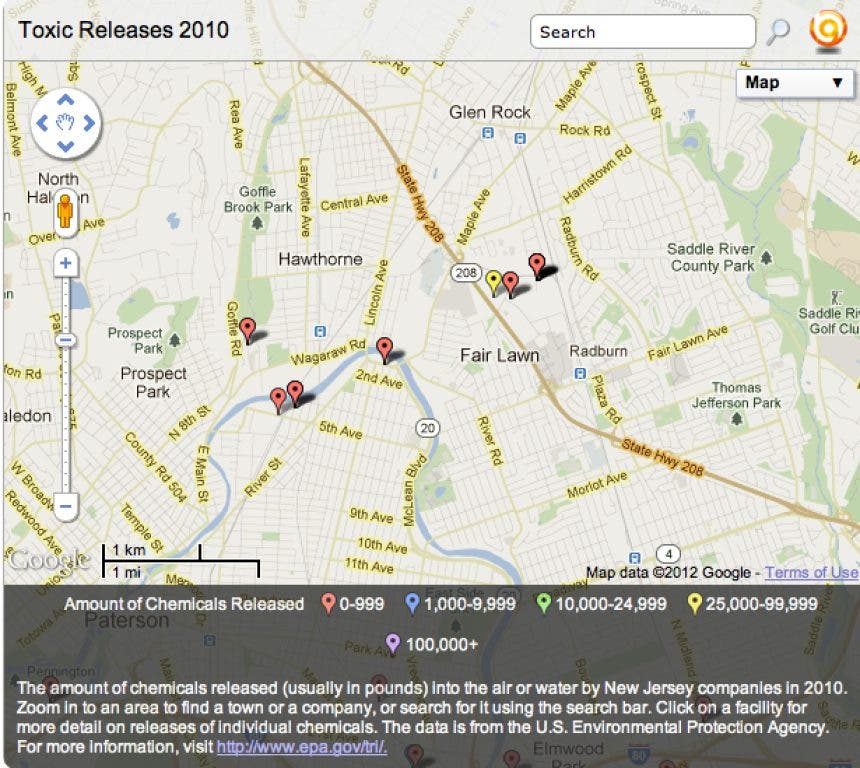
(Edit. Note: Three sites in Fair Lawn are listed as polluters on the TRI map for 2010, including which is the second largest polluter in Bergen County, as determined by the EPA, due to its release of ammonia. The other two polluters in town are and Biomet, for their release of formaldehyde and chromium, respectively.)
By Colleen O'Dea, NJ Spotlight
The amount of toxic chemicals released into New Jersey’s air and water in 2010 rose by almost 2.5 percent, according to the U.S. Environmental Protection Agency’s Toxics Release Inventory, climbing from 12.9 million pounds in 2009 to more than 16 million pounds in 2010.
Find out what's happening in Fair Lawn-Saddle Brookfor free with the latest updates from Patch.
“An increase in toxics in our air and water is a big problem," said Dena Mottola Jaborska, executive director of Environment New Jersey. "Our air-based cancer risk is already well above the federally set risk.”
She added that in counties like Hudson, that risk is 1 in 500, significantly higher than the federal goal of 1 in 1 million.
Find out what's happening in Fair Lawn-Saddle Brookfor free with the latest updates from Patch.
More than 7.5 million pounds of nitrate compounds were released in New Jersey, virtually all into the water. High levels of nitrates, which come from nitrogen-based fertilizer, sewage, and manure, can make it difficult for an infant’s blood to carry oxygen and can cause kidney and spleen damage in adults.
The most commonly released carcinogen was nickel, which has been linked to lung and nasal cancer. According to TRI, 11 New Jersey companies released 58,397 pounds of nickel into the air and water.
In all, New Jersey facilities released 38 different carcinogens.
Dupont Chambers Works in Deepwater was the largest polluter, pumping almost 5.9 million pounds of 56 chemicals -- including six carcinogens -- into the air and water. Dupont's presence made Salem County New Jersey’s top site for releases.
Conoco Phillips' Bayway Refinery ranked second, releasing 2.6 million pounds, followed by Public Service Enterprise Group’s Mercer Generating Station, at 1.1 million pounds.
TRI is a public database containing information on the release and disposal of more than 650 toxic chemicals by some 20,000 facilities across the country.
Jaborska said TRI is an important way to provide the public with a look at the cumulative amount of pollution for numerous sources.
“It’s the total amount of pollution that affects our health, not what just one company produces,” she said.
Click here to see the interactive map of New Jersey's top polluters
Get more local news delivered straight to your inbox. Sign up for free Patch newsletters and alerts.