Health & Fitness
Education in America - Part II: When Is $16K Per Year for Education Not Enough?
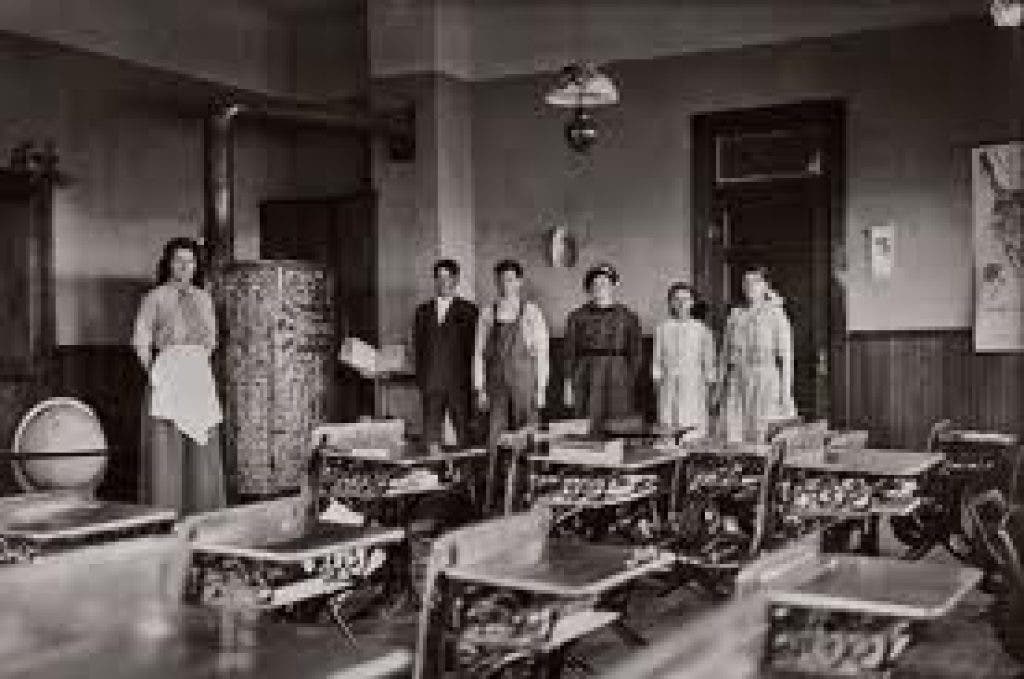
The one-room schoolhouse brought together students of all ages allowing the young and immature to learn from the older, more mature students. Now that's what I call real socialization.

This is part two of a six-part series. Click here for part one.
Has the American public school experiment seen its better days? Has its usefulness been exasperated? On June 6, 2012, Gloucester Township Patch reported on . We are informed that the Black Horse Pike Regional School District's actual per-pupil expenditures for the 2010-2011 school year were $16,025 per pupil. Given an October student count of Triton, Highland, and Timber Creek high schools, we are talking about $66,183,250. I contend that we, as a nation, are funneling billions of dollars a year into our public school systems and the ROI (Return on Investment) seems to drop with nary a care for the billions we continue to invest.
The lofty ideal to bestow a liberal education upon every citizen has a long history and is not in question here; what is in question is what that ideal has turned into. For instance, are we to assume that everyone has the same abilities and that therefore everyone should receive the same education? I contend that such a methodology of education does nothing more than hold back those who would excel due to a forced waiting for those amongst them who struggle. Those that are failing become the focus of attention in such a system and the plan is thus continually tweaked in an attempt to rescue those failing, much to the detriment of those who would, with the correct amount of attention, otherwise do well.
Find out what's happening in Gloucester Townshipfor free with the latest updates from Patch.
Additionally, somewhere along the line we decided that we needed to remove every vestige of religion from education. Strange, the King James Bible was originally used, and for years after, continued to be used as a textbook whereas now some would attempt to relegate the world’s most widely read book to the fiction shelf in some dusty library.
The one-room schoolhouse brought all the students of varying ages together in one place. Now, first, allow me to state that I consider such a scheme as real socialization comparable to what the student will be confronted with in the real world; people of all ages, some wiser, some still immature and foolish thereby needing interaction with those older and more mature. It also gives the teacher a break because the older can tutor and help the younger, thus more skills are taught and learned. Each student in the one-room schoolhouse learned at his or her own rate. Contrast that to a group of 20 to 30 hooligans in a class room, all equally immature and thus encouraging more bad behavior than really anything else. I can tell you I remember sitting in a high school health class and watching as every time the temporary teacher turned his back he was pelted with spit balls and hoots as a number of my more immature classmates had their way. Suffice it to say that no learning was going on there except the learning of bad behavior. Is that what we want to term as socialization?
Find out what's happening in Gloucester Townshipfor free with the latest updates from Patch.
A recent Big Brothers Big Sisters TV commercial asks us to imagine that we can remake our world where everyone would finish high school and everyone would thus go on to college and that we can further that dream by donating to Big Brothers Big Sisters. How, may I ask, would that make things better? Is college for everyone? Again, I repeat from an earlier blog that a friend of my youngest daughter received a Camden County College two-year scholarship for maintaining a 3.00 GPA through her time at Triton High School. Unfortunately, she failed the CCC entrance exam twice and was required to take remedial math and English at her own expense before she could take advantage of her scholarship. What more can be said about that?
College graduation rates are extremely hard to measure, but, doing the best we can with the available data, it is safe to say that 60 percent of college students in four-year degree programs graduated within six years. I will leave the reader to consider whether that is a reasonable or acceptable ROI.
On the other hand, I continue to hear about the need for skilled electricians and machinists. These are not low-paying professions. How will we ever rebuild our housing sector without skilled electricians? Can our manufacturing base ever hope to rebuild without skilled machinists? In fact, I first attended a technical school and learned the skills of an electronic technician years before my employer promoted me into the engineering discipline and then paid for me to get a Bachelor of Science degree in a related field.
Stay tuned for part three, where I look at how ExxonMobil is trying to help.