


Many Haddonfield residents and business owners already have a sort of unspoken “I know you’re there” relationship with the local ghosts.
After all, they walk same streets and occupy the same buildings American colonists built. But it might surprise many in Haddonfield, or even in South Jersey, to know how spirited, so to speak, Haddonfield’s history is with tales of ghosts and a monster. The monster, of course, being that old trickster, the Jersey Devil.
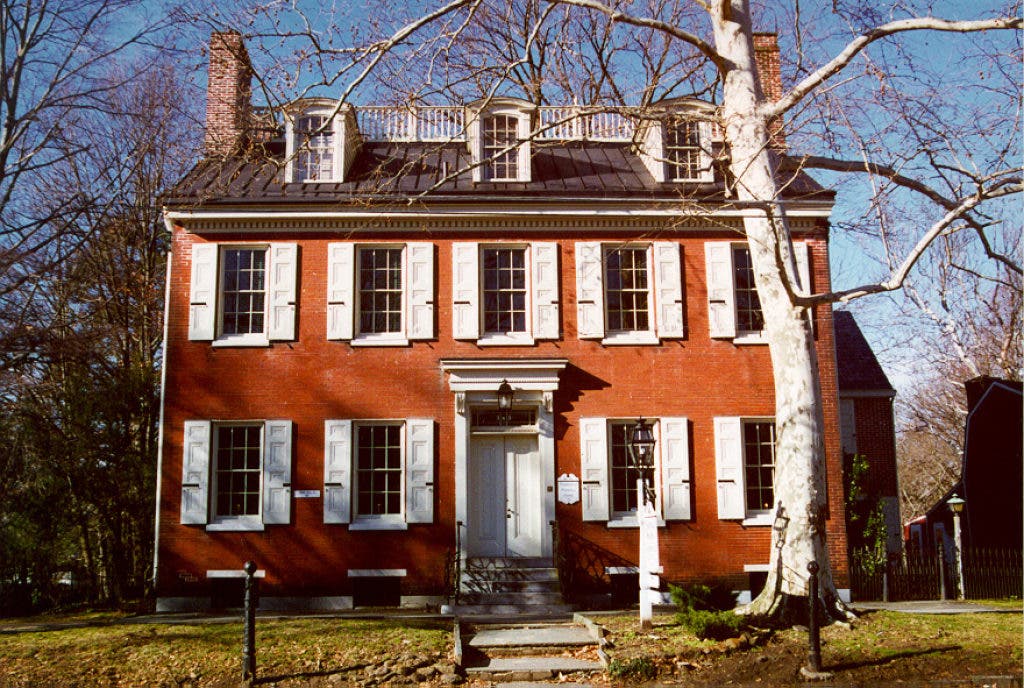
A group of approximately 35 flashlight-wielding people—children and adults—gathered in front of Greenfield Hall last week for the “Haunted Haddonfield” tour, led by author William E. Meehan Jr. An encore performance is scheduled this weekend on Friday and Saturday night. For more information, call 856-429-7375.
Find out what's happening in Haddonfield-Haddon Townshipfor free with the latest updates from Patch.
Meehan begins the tour with a story about Greenfield Hall itself. The house is the third such structure built on that site by the Gill family, starting with a long-extinct log cabin built in the mid-1700s.
The current brick structure was built in 1841. Meehan pointed his flashlight at the window of the master bedroom which, in the 1960s, the town had undertaken to repaint.
Find out what's happening in Haddonfield-Haddon Townshipfor free with the latest updates from Patch.
As it happened, only a few minor touch-ups remained at the close of day and one painter said he’d stay to finish it. The painter stayed late, alone and if this had been a horror movie, people would be screaming “Don’t do it, you idiot!” As he worked, the man became aware of that ever-so-creepy feeling of being watched.
Looking down from the ladder, he saw an old woman, small, dressed in the simple gray garb and white bonnet of a Quaker. She stared at him and didn’t answer his questions. When it finally occurred to the painter that the woman closely resembled the portrait of the 19th century Mrs. Gill hanging downstairs, the painter began to get a clue. When she suddenly dissolved like a puff of smoke before his eyes, the painter decided, on the spot, to seek a new career. He never returned to Greenfield Hall but the implication was that Mrs. Gill may not have made the same decision. She could possibly still inhabit what she considers her house. Small tools, Meehan said, go missing in the Greenfield Hall only to turn up in unlikely places, a sort of “screwdriver in the freezer” situation.
More amazing tales
The tour group followed their guide to various sites from Greenfield Hall, to the memorial garden near Evergreen Street, to Roberts Avenue, the , and back to Greenfield Hall. Everyone came away much better informed and possibly terrified because in some situations, ignorance really is bliss.
Meehan also posed some interesting questions on the tour. For example, how could a child in the 1940s know of the existence of another child who’d lived in his same house in the early 1800s when no one else knew about those previous tenants? In this instance, the child (an only child) was asked at school to draw a picture of his family. His drawing showed a family of four, not three people. One was depicted as a young girl in very outdated clothing. The child had named her Jane and the adults chuckled about his imaginary friend. The chuckling stopped when the family undertook renovation and, in exposing old pipes below the floor boards found one marked in ancient handwriting—“To Jane’s room.”
The stories Meehan told were also remarkable for the time span they covered. Recorded events of 18th- and 19th-century people show up as ghosts in the mid 20th century. There were the Haddonfield lamplighter’s two young daughters who both died of influenza in the 1830s. When a family with two daughters moved into that house in the 1950s, those girls also came down with the flu. Medicine being what is was by then, they were not in danger of dying but they did have fevers and they did occupy the same room as the unfortunate girls. Their father told them not to put blankets on their bed but every time he’d go to check on them, the girls had blankets pulled to their chins. The father took them off. The blankets reappeared. Three times. When the father grew frustrated, the girls claimed they weren’t doing it. “The man did it,” they said. And the man they described was wearing exactly what a 19th-century lamplighter might have worn.
Meehan’s book has many examples of these stories, from Frederick Sutton in the Baptist Cemetery whose gravestone notes he was lost at sea in the “SS Titanic” to Alec, the ghost of the spring at the bottom of a steep ravine. Alec parted angrily from his fiancée and though she waited for him by the spring and eventually died a spinster, Alec did not return until he was a ghost, haunting the spring while either looking for a cool drink or for a chance to apologize for going away in the first place. The spot would come to be called, “Alec’s Spring.”
The Jersey Devil pays Haddonfield a visit
Perhaps the most prominent local myth in which Haddonfield figures prominently is the appearance in Haddonfield (twice) of the Jersey Devil. This legendary creature made a much bally-hoooed appearance in Haddonfield in 1859 and again in 1909. (There are actual photos of its footprints. Or hoof prints, as the case may be.)
In 1909, that appearance was cause for statewide alarm as the devil (described as something like a green painted kangaroo with wings) left its time-honored home in the piney woods and showed its face (snout?) in public places from Delaware to Philadelphia.
It appeared atop streetcars. It killed small dogs. Two gentlemen from Haddonfield, a Mr. Glover and Mr. Holloway, were deputized in one of several posses formed to find and destroy the Jersey Devil. Though the creature evaded capture, Mr. Holloway managed parlay his role in Devil-chasing into a campaign platform.
He was elected mayor of Haddonfield. Time passed. The Jersey Devil reverted back to myth and small dogs were finally able to sleep again at night.