Schools
Superintendent Calls for Greater Emphasis on Math and Science
Lecture focused on the importance of math and science skills as technology and science industries contintue to expand and evolve.
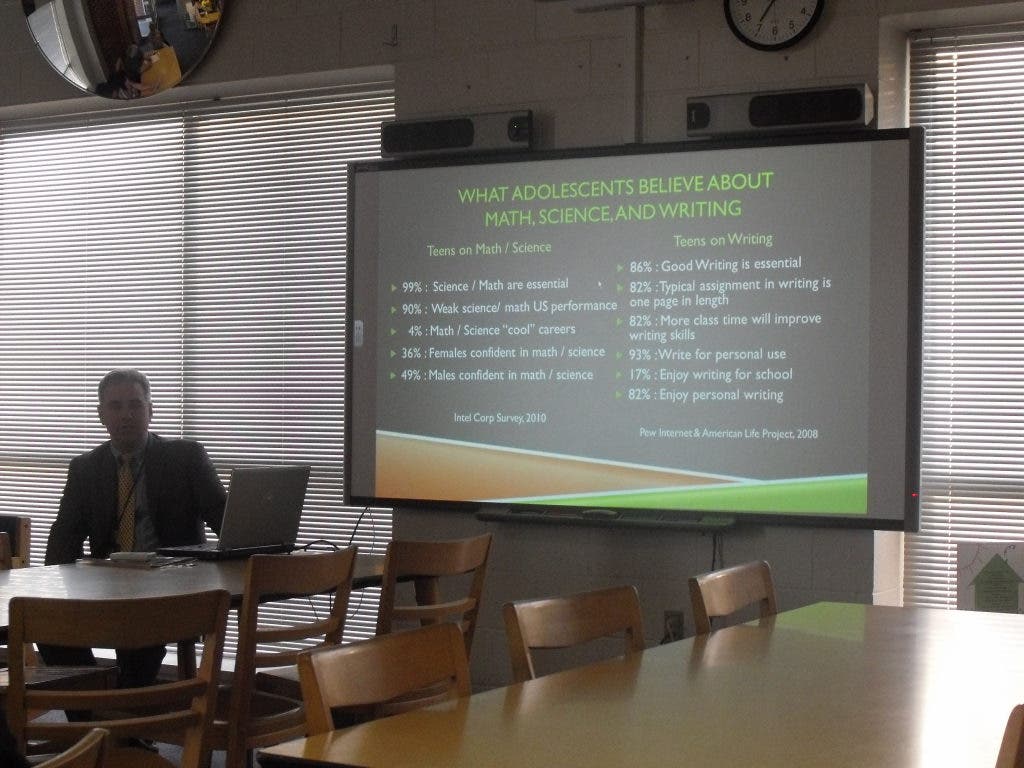


Making careers in math and science-based industries attractive to students was the subject of a lecture by Superintendent of Schools Dr. Mark Porto Tuesday night.
The lecture was part of the school district's Community Outreach Program, and was held in the the Media Center at the high school.
Porto discussed the importance of emphasising math and science in elementary schools and high schools, as emerging industries in the 21st Century are heavily reliant on those skills.
Find out what's happening in Hasbrouck Heightsfor free with the latest updates from Patch.
"When we were younger," Porto recalled, "and we were going to high school and college, everyone was getting Humanities degrees -- in English or History. These aren't the main majors anymore."
Porto discussed the various careers that have emerged over the past decade and continue to grow, such as environmental science, gerontology and alternative energies.
Find out what's happening in Hasbrouck Heightsfor free with the latest updates from Patch.
During the multimedia presenatation, Porto showed a graphic with statistics regarding young people's perceptions about math and science. These statistics were the result of an Intel Corp survey in 2010. According to these statistics, 4 percent of the students surveyed believed that careers that are math and science based are "cool," and 36 percent of the female students felt "confident in math/science."
Conversely, another survey conducted in 2008 by Pew Internet and American Life Project, revealed that students perceptions about writing were more favorable.
"Writing is important," Porto said. "And there is a connectivity between science and math and writing."
He added, "We're not talking about diminishing Humanities courses in favor of math and science. But we need to show how that these disciplines are interrelated. You need good reading and writing skills in science careers; you need to be able to read texts and write reports."
In addition, female students need to be empowered and shown that they can have science and technology careers.
Porto believes that the way math and science courses are taught needs to evolve -- adopting a more hands on approach, where students make connections themselves through deductive reasoning and problem solving. This, Porto said, is similar to the new approach museums are taking to present information in their exhibits.
"We also need to discuss careers with the students, and share information about earning potentials and benefits in science and industry careers."
Illustrating his point, Porto explained that currently the pharmacology industry has zero percent unemployment.
"And we need work on getting students to overcome math anxiety," Porto said.
"Math anxiety is generated by a teachers comfort level with the subject. If they themselves aren't comfortable, it passes on to the student. We need to develop a comfort level."
Part of overcoming math anxiety would be shifting the emphasis from getting correct answers, and focusing more on making sure students understand the process that gets them there.
Moving forward, Porto believes that the school district needs to introduce a more hands-on science and math curriculum, which could include a robotics club, as well as interactive science presentations that allow students to make discoveries and develop problem solving skills.
"To do this, we need to get the community and the parents involved -- we need to generate interest."