Crime & Safety
Crash Survivors Bring Anti-Texting Message to HHS
In 2009, David and Linda Kubert survived a crash with a driver who was texting.

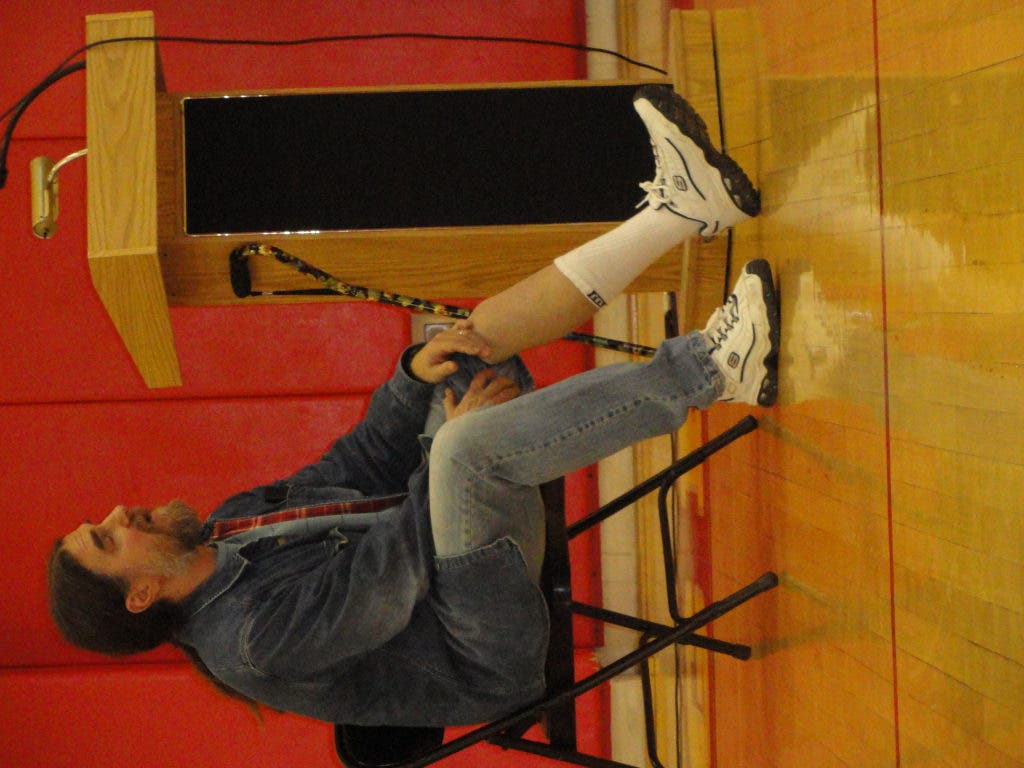

A Monday morning program brought an anti-texting and driving message home for students, when Linda and Dave Kubert came to speak to students.
The Kuberts survived a head-on collision with a driver while on their motorcycle in 2009—a driver who turned out to be texting at the time of the crash.
“We never thought in a million years that what happened would happen to us,” David Kubert said. “We were on a two-lane country road, and, as I go around the corner, I see a pickup truck with a young man driving with his elbows on the wheel, texting.
Find out what's happening in Hillsboroughfor free with the latest updates from Patch.
“He didn’t see anything, and—boom— he hit the bike,” Kubert said.
The accident left the Kuberts with serious injuries that led to David’s leg being amputated below the calf, and Linda’s leg also being amputated. David Kubert now walks with a cane, and, while his wife does not use a similar device, still suffers the affects of her injury.
Find out what's happening in Hillsboroughfor free with the latest updates from Patch.
“It’s definitely a nightmare,” Linda Kubert said. “It’s not like you get better and grow a new leg.”
The presentation is part of the second phase of the Somerset County Prosecutor’s Office’s distracted driving crackdown. The first phase, which took place in December and January, included crackdowns on texting and driving and talking on cell phones while driving.
This week, the office intends to expand its campaign to county schools through anti-texting pledges and by showing students a 10-minute documentary on the effects of distracted driving. In Hillsborough, students watched the video during an extended homeroom period, but are the first school to have the Kuberts as guest speakers.
According to Prosecutor Geoffrey Soriano, police departments in Somerset County issued about 2,800 warnings during the first two months of the campaign. Now, police departments will be looking for improper cell-phone—and handing out summonses.
Locally, there will be several patrols looking for distracted drivers specifically, Police Chief Paul Kaminsky said.
The key to the campaign is alerting younger drivers, according to Prosecutor Soriano. It’s one of the reasons the focus is on high schools and student drivers—and reinforces the lessons learned in Drivers Education classes.
“I trust myself that I won’t text and drive,” Suzie Inglin, a sophomore, said. “But not everyone out there had the privilege of seeing this presentation.
“I never thought about the consequences or the injuries like he (Kubert) said,” she added. “It was good to hear it from a real person.”
“You send texts every day and night,” Mackenzie Conway, a sophomore said. “It’s just hard to realize there’s a time that you shouldn’t be doing it.”
Though she’s not driving yet, Inglin hopes she’ll avoid the temptation to text and drive—though she’s still considering ways to avoid the pull of the phone.
“I’ll probably think I can do it,” she said. “But I’ll try to remember it’s not a good thing to do.”
As a senior who’s already driving, Thomas Zobele has his strategy planned. He simply turns his phone off and places it in the cup holder when he’s in the car.
“Precious cargo,” he said. “Sometimes I’m driving my brother and sister.
“I don’t text and drive so it more or less reinforced what I thought originally,” he added.
For Inglin and Conway, the presentation makes them think twice about what they do when they actually begin driving.
“I’m definitely going to be more hesitant to pick up my phone than I was before,” Conway said. “I’m happy I saw this before I started driving because it’s easier to resist it. It made it more real. You always hear that you should do these things. Now, you see what it can actually do.”
Get more local news delivered straight to your inbox. Sign up for free Patch newsletters and alerts.