Schools
Hillsborough School Tax Concerns Driven By State Aid Loss, Says Superintendent
Superintendent Michael Volpe told Hillsborough residents the district lost $34 million in cumulative state aid since 2018-19.


HILLSBOROUGH, NJ — After residents expressed concerns about rising taxes, Hillsborough Township Schools Superintendent Michael Volpe shared a presentation addressing taxes, state aid and district spending.
At the Monday night Board of Education meeting, Volpe said his presentation was not intended to be a full financial review, but a response to questions raised by residents at an earlier meeting.
Volpe said Hillsborough is often compared with Bridgewater and Montgomery.
Find out what's happening in Hillsboroughfor free with the latest updates from Patch.
Hillsborough has "the lowest per pupil cost spending between Hillsborough, Montgomery, and Bridgewater" while posting results "right there in the same ballpark," said Volpe.
He also said Hillsborough's state aid baseline fell by $8 million, while Montgomery’s rose by $3.5 million and Bridgewater’s by $5.3 million.
Find out what's happening in Hillsboroughfor free with the latest updates from Patch.
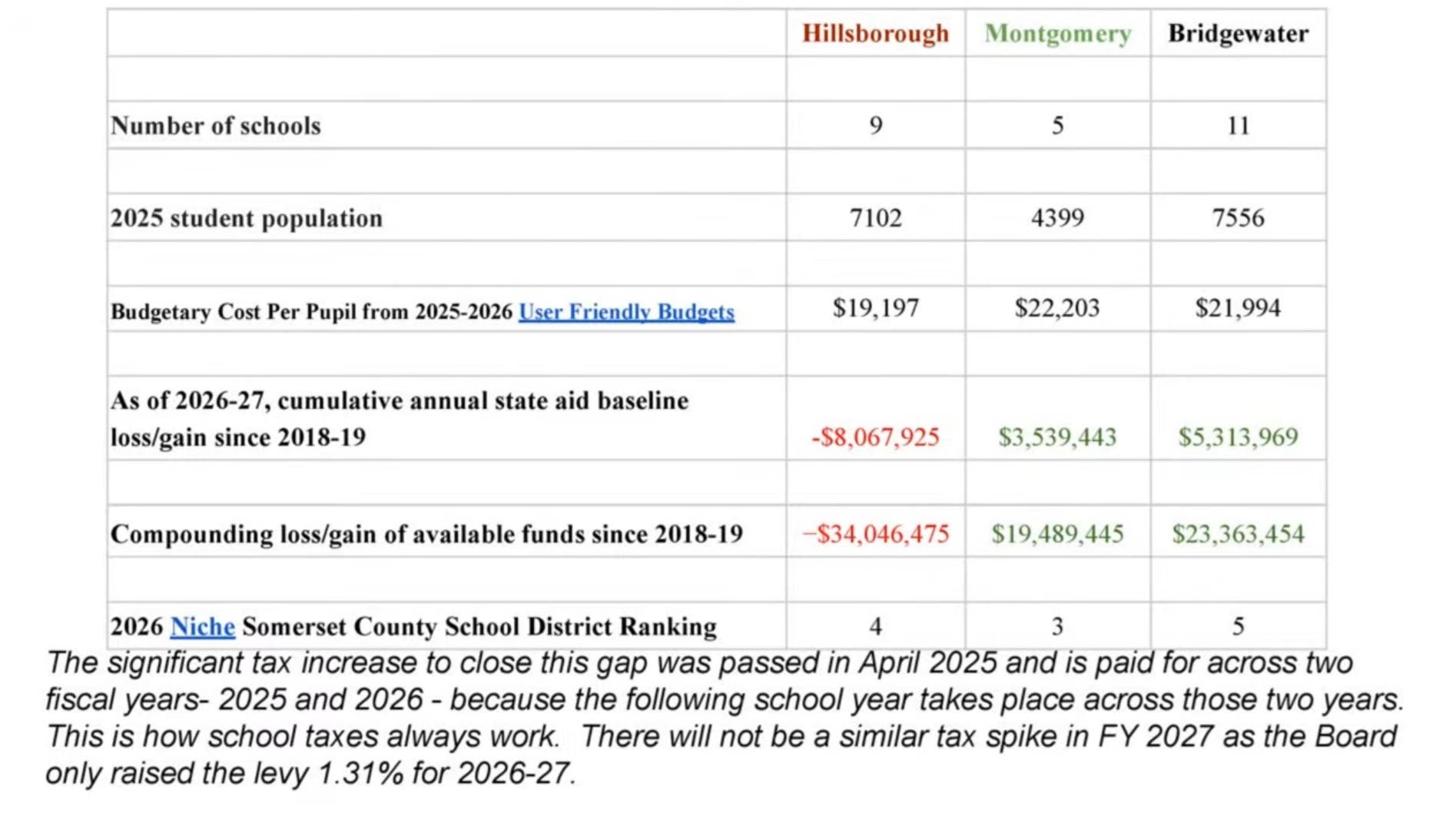
According to Volpe, the district’s cumulative aid loss since 2018-19 reached $34 million.
He said that gap was part of the backdrop for a significant tax increase approved in April 2025. Read More: Hillsborough Approves School Tax Levy Increase Of $22.9M
This large increase is paid over two years because a school year runs from 2025 to 2026.
"That's why if some of you still saw a big tax increase in this year's tax bill, it wasn't because of the budget that the board passed this year. This year the budget was raised only 1.31 percent on the tax levy. So coming into next year when you open your tax bills, you are not going to see as big of a spike because that big spike has been paid off," said Volpe.
Volpe said Hillsborough is already operating efficiently. He said the district is the 36th largest in New Jersey and ranks strongly on per-pupil spending measures against similar K-12 districts and within Somerset County.
"We are efficient," Volpe said. "We spend our money as wisely as possible."
While the district is already efficient, Volpe pointed to several cost-control efforts to continue to bring costs down, including cooperative purchasing, competitive bidding, attorney review of public bids, energy purchasing, a self-insured health plan and a five-year facilities plan.
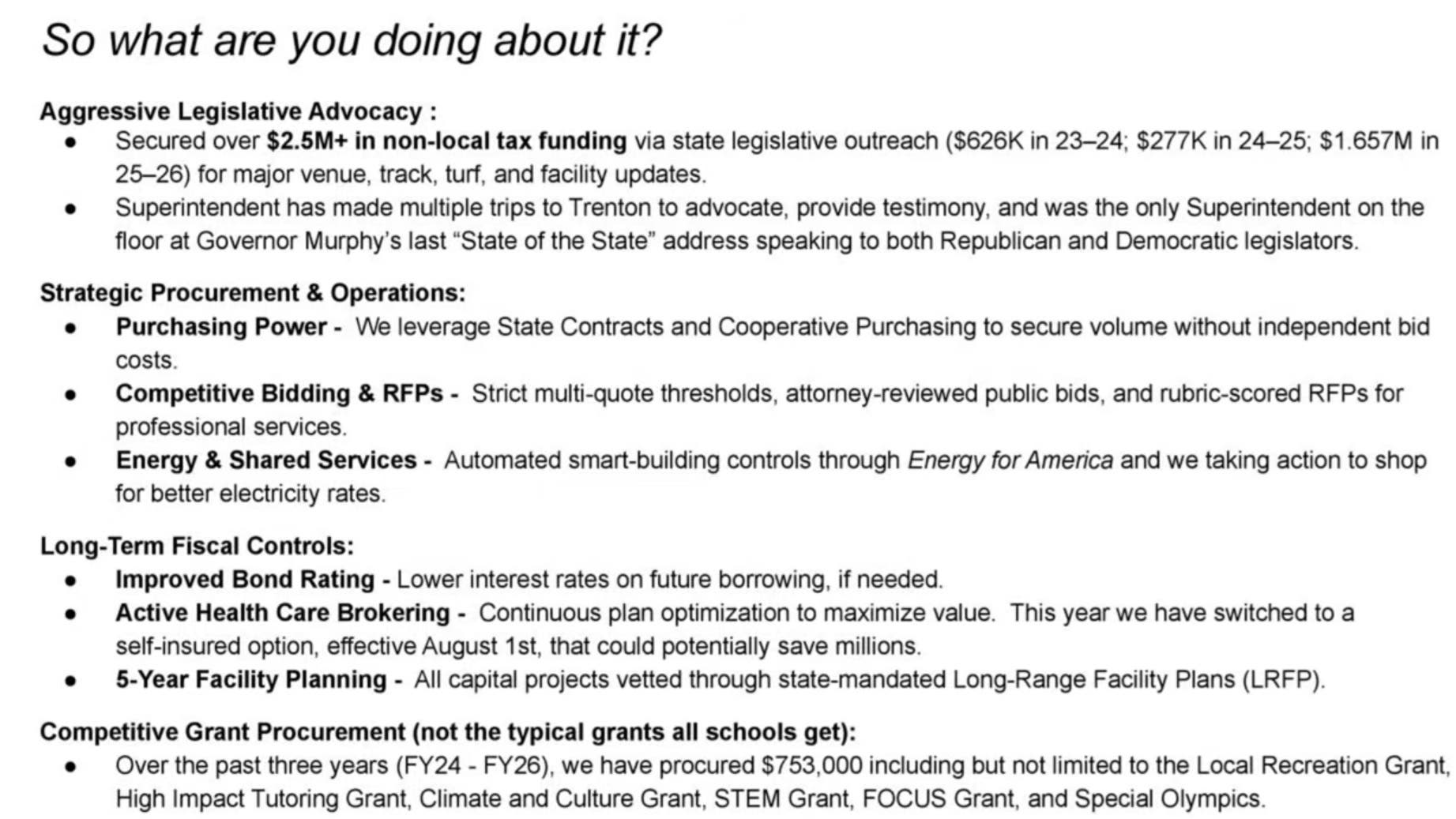
Volpe also said the district’s bond rating improved from AA- to AA, which he said should help with future borrowing costs.
He said the district has secured "$2.5 million allocated from the state" for projects and "almost three-quarters of a million dollars in competitive grants."
During public comment, several residents thanked the board and administration for addressing concerns but asked for more measurable steps to limit future tax increases.
One taxpayer said, "What we're asking here is there a way we can cut something? Is there a corner? Every little bit."
Another resident said, "My taxes have gone up 25 percent in the last two to three years."
Board member Cynthia Nurse said the latest tax bills were a shock even after months of budget discussion.
"I am paying astronomical taxes, as everybody is. I have to make a decision when my children are finished in the school system whether it's feasible for us to stay," said Nurse.
Nurse, who is up for re-election in the fall, also noted that while she is serving on the board, she will continue to support the budget.
"If we do not continue to support our schools and what our kids need, not only is it going to be making hard decisions about what to take away from our children, from our staff, but also in the end, it's going to bring our property values down because we cannot compete with neighboring schools," said Nurse.
Board member Paul Marini said the Board is "kind of stuck between a rock and a hard place."
"Nobody likes to vote either way, honestly, because we don't want to raise taxes, but we don't want to lose features and functions and staff of the district," said Marini.
Volpe said the budget season will likely begin in late September or early October and run through April or May.
Get more local news delivered straight to your inbox. Sign up for free Patch newsletters and alerts.