Community Corner
From Turtles to Motorcyles, the History of Hoboken's Clubs
The Hoboken Historical Museum has a new exhibit on social clubs.
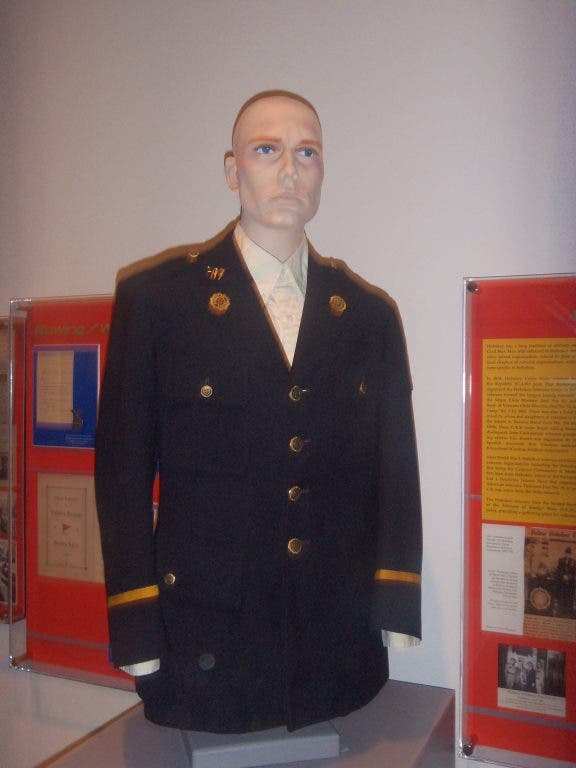


After a July hiatus the Hoboken Historical Museum is open again and featuring a new exhibit on Hoboken's social clubs. During a reception on Sunday guests had their first opportunity to see artifacts, photos and newspaper articles that detail civic groups like the Elks and the Odd Fellows, ethnic associations and recreational leagues.
“We had the idea that these different organizations are the lifeblood of the community,” the museum's director Bob Foster said. “Hoboken is a place with a lot of comings and goings. Usually the first things newcomers do is find a group that they can be a part of.”
The exhibit begins in chronological order, featuring the original Turtle Club, the group of eating and drinking aficionados who met at the pastoral Turtle Grounds near the former Elysian Fields at 10th Street beginning in 1796. Alexander Hamilton and Aaron Burr were founding members, and George Washington was an honorary member. The club lasted until the early 20th century, and later inspired the name of the modern bar.
Find out what's happening in Hobokenfor free with the latest updates from Patch.
Historian Christina Ziegler-McPherson conducted much of the research for the exhibit over the course of several months. She said she encountered difficulty researching many of the defunct 19th century groups because of a lack of thorough record keeping.
“It was really hard,” Ziegler-McPherson said. “I looked at a lot of city directories, but often those didn't provide anything more than names. We don't always have the stories behind objects. We have photographs but we don't know who's in them.”
Find out what's happening in Hobokenfor free with the latest updates from Patch.
Ziegler-McPherson said the most curious discovery she made was finding something called the Scandinavian Pleasure Club, which existed during the late 19th century. “I have no idea what they did,” she said.
But with what she did find Ziegler-McPherson said she noticed a lot of similarities between historic and modern groups. She cited a a frame containing dozens of tickets to WWI era social club dances. “There's a big social component to all these groups, and it's the same now,” she said. “Hoboken likes to party just like it did 150 years ago.”
Melissa Abernathy, the museum's volunteer coordinator, agreed with Ziegler-McPherson. “I see the similarities with the clubs I belong to,” Abernathy said. “The impulses are pretty much the same even if the functions are different.”
Abernathy said she hopes the museum's exhibit inspires the formation of new clubs. It already has helped start one. Foster is organizing a ping pong club for uptown residents near the museum, and said he found five charter members during the reception.
The exhibit also has a social networking center with computers where guests can research current clubs in Hoboken that they are interested in joining. There is also a bulletin board for clubs to post flyers and other materials.
Beginning in September the museum plans to host guest speakers like Ziegler-McPherson, and also tour clubs, such as the Elks Lodge and the Hoboken Motorcycle Club. For more information visit the Hoboken Historical Museum's website.