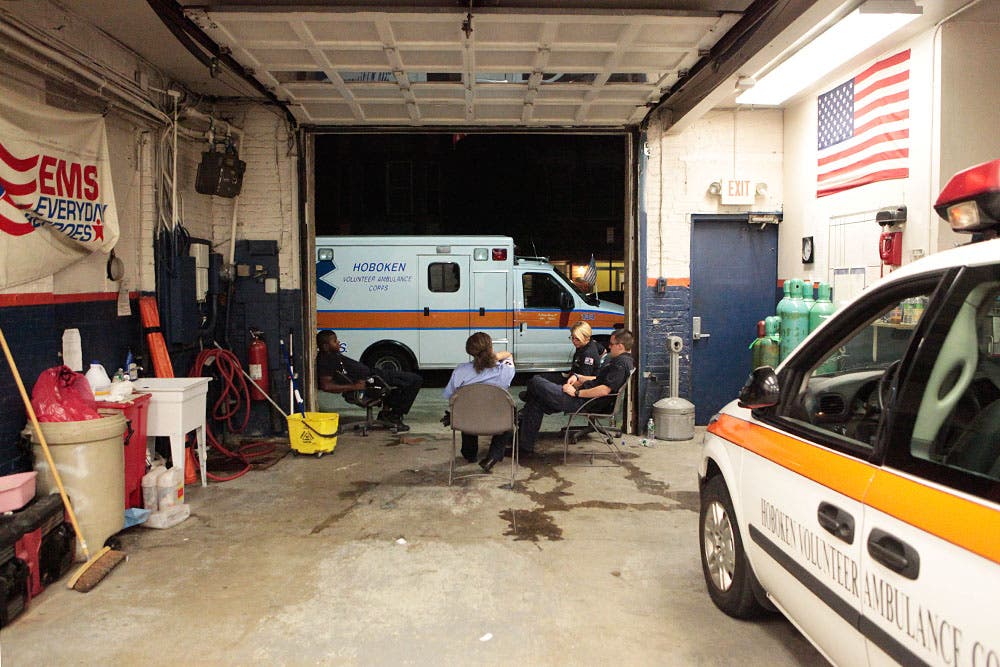
Hoboken Patch contributor Amanda Staab rode with the Hoboken Volunteer Ambulance Corps for two weeks last winter. By the end, she had three notebooks filled and more than 100 interviews recorded. After transcribing everything, she realized the most important story was about the volunteers themselves and the sacrifices they make and not about statistics, the healthcare bill, or any other political issue. This story is the second in a series about the Hoboken Volunteer Ambulance Corps.
Between calls, the volunteers spread out on the second floor at the Hoboken Volunteer Ambulance Corps headquarters, watching shows like Dog the Bounty Hunter and Cops on an oversized TV. When they're not in the main area, they're usually out getting coffee, downstairs with a cigarette, or packed in President of the HVAC Tommy Molta's office, across the hallway from the door to the garage. Some of them stand, some of them sit, and some clutch a Styrofoam cup in one hand and a smoke in the other. The day before last New Year's Eve, the ashtray on Molta's desk was filled with butts. He reminded his crew that the corps was going to have two rigs in service the next night and that should be enough. He swiveled in his chair to face his computer.
"We just got a classified intelligence bulletin from the FBI regarding al Qaeda and terrorism," he said. He explained that the corps is registered with the U.S. Department of Homeland Security and receives information from the FBI through the state police. "As of right now, there's no credible threat for tomorrow night. They don't anticipate any problems and they say just go about your business."
Find out what's happening in Hobokenfor free with the latest updates from Patch.
Due to Hoboken's proximity to Manhattan, the volunteers have to be more alert to potential threats than EMTs working in other towns. Molta seems easy going by nature but not when it comes to the protection of his hometown and the people in it. He is a terrorism awareness instructor and highly trained in how to assess and cope with dangerous situations, but he said, he too got caught up in suspicion right after 9/11.
A strange man came to headquarters looking to sign up with the corps. When he handed over his application to Molta, he asked how quickly he could get a uniform, a badge, and an ID card. "It was just a little unusual for a guy, his first day here, he doesn't know anyone, and he's asking about police radio frequencies," said Molta. "'Give me frequency numbers,'" Molta said the man requested. "'Do you have a ten-code list?'" Molta said he notified the police and never heard from the stranger again.
Find out what's happening in Hobokenfor free with the latest updates from Patch.
Later that Wednesday before New Year's Eve, Mike Szekely, who tinkers with cars for fun and is now in charge of corps vehicle maintenance, and Zak Opperman, one of the youngest EMTs at headquarters, were on duty. It was already getting dark when they were called to the downtown Dunkin' Donuts, across the street from the PATH station. "What exactly did the dispatcher say?" Szekely asked Opperman from the driver's seat, while he moved his head side to side, looking for any pedestrians in their way. "Cardiac arrest," said Opperman, playing on his partner's fear of having to crack someone's ribs during CPR. "Don't tell me that," said Szekely, as he flipped on the siren.
While Opperman, a high school kid from an affluent town in Essex County, commutes 30 minutes to volunteer at the corps, Szekely is a "b and r." He grew up and still lives just down the street from headquarters. He's 24 with short brown hair and pale green eyes, a Celtic cross tattooed on his right forearm and a protection symbol on his left. He's streetwise and says he used to get into a lot of fights, like when he was 13 and his neighbor sliced his arm with a box cutter and he lost consciousness. His welcoming smile and hospitable disposition, however, betray that notion. In the corps, Szekely is happy to be the sergeant of vehicles and keeps a running to-do list in his head, but his true ambition is to be a Hoboken police officer.
When they got to Dunkin' Donuts, the volunteers found the same homeless man from the day before, drunk and lying underneath a small table, where only a paper bag and a napkin were left. Frosting clung to the man's beard and two police officers stood over him, one with his wooden battalion drawn. The officers hardly moved, and the women huddled together near the bathrooms didn't flinch when Szekely and Opperman snapped on their plastic gloves, lowered the gurney, and scooped up the man they've gotten to know so well. "I'm claustrophic," the man bellowed, looking down at the hands that were trying to strap him in under the fluorescent orange bands of the stretcher. A young male Dunkin' Donuts employee watched from behind the counter, as the volunteers wheeled the man away, back into the cold, and onto the paved sidewalk that was wet from melting snow. They got to the ambulance parked at the nearest corner and lifted the man into the back. Commuters returning to New Jersey from their Manhattan jobs ignored the scene and walked by without so much as a glance.
Inside the back of the ambulance, underneath six lights that look like they should be installed near the bottom of a pool, Opperman sat on the long cushioned seat next to the gurney that had been secured to the floor of the vehicle. He started writing on the sheet attached to his clipboard and asking the patient questions, when the man interrupted his concentration. "Are you a Jew?" the man asked Opperman. In a steady voice, Opperman, with the face of a brown-eyed boy and a frame half the size of his patient's, answered that yes, he is, in fact, of Jewish faith, and he continued reading the required questions on the sheet. "I'm half Jewish and half Irish," the man continued. "Can you believe it?" Opperman didn't say a word. He is an experienced EMT with compassion, and he was recently accepted early decision at the University of Pennsylvania's School of Nursing. "We're brothers," the man went on, and Opperman stood up to open the back of the ambulance. "He's my brother." The man looked around to see if anyone was listening.
Through the double doors of the emergency entrance for EMTs, the hospital appears friendly enough with white walls and a white and green linoleum floor broken up by the occasional pink tile. No one in the emergency room looked surprised to see the man, and as doctors and nurses passed him, he asked them if they, too, were Jewish. "This kid," the man said, pointing to Opperman, "is Jewish. He's a Jew." When a short, dark-haired man in blue scrubs finally told the patient that he was being rude, the patient shifted his focus and pulled out a paperback book, The Jester by James Patterson, from his jacket pocket. "You read this one?" He asked, arching his back to see Opperman standing behind the gurney. To keep the conversation short, Opperman told him he doesn't read Patterson. The man might not have read it either. The book is where he keeps his lottery numbers, written in black ink on the edges of each page, he once told Opperman.
While Opperman stayed with the man and the triage nurse to finish the paperwork, Szekely pulled the sheets off the cushion of the gurney and grabbed fresh linens from a cart in the hallway. Outside in the driveway for emergency vehicles only, Szekely went over every inch of the cushion and the gurney – and anywhere the man might have touched inside the ambulance – with industrial-strength alcohol wipes that made the air around them temporarily unbreathable. While he maneuvered the stretcher back into the ambulance, Szekely said he knows he's doing this to help people, but someone could be having a heart attack right now, and his crew would be tied up with the same games the homeless man always plays. Opperman came out and climbed into the passenger seat, and the volunteers were on their way back to headquarters.
The next story in this series is Three.