Politics & Government
Murphy Signs 17 Bills Into Law: Huge Step For Medical Marijuana
Gov. Phil Murphy has signed 17 bills into law, including one bill that is perhaps the biggest step NJ has taken toward legalizing marijuana.


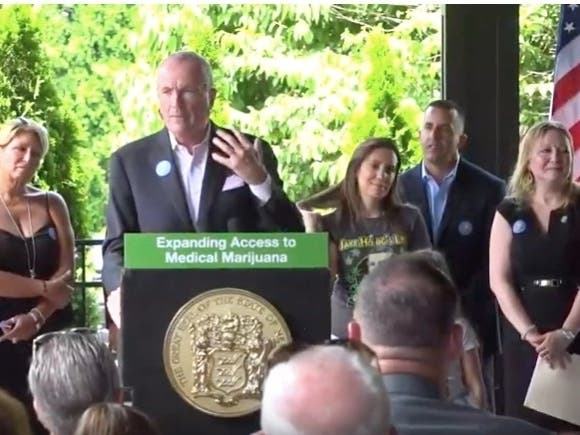
Gov. Phil Murphy signed 17 bills into law this week, including one piece of legislation that is perhaps the biggest step New Jersey has taken toward legalizing marijuana.
And, besides passing the state budget bill this week, Murphy also has signed legislation to establish a state-based healthcare exchange in New Jersey. The law will allow New Jersey greater control over its health insurance market and the ability to establish stronger protections against the Trump Administration’s "sabotage" of the Affordable Care Act, he said.
On Tuesday, Murphy signed legislation designed to make medical marijuana more accessible to patients who could benefit from it.
Find out what's happening in Howellfor free with the latest updates from Patch.
The measure, now known as the Jake Honig Compassionate Use Medical Marijuana Act, was sponsored by Assembly Democrats, Joann Downey, Joseph Danielsen, Eliana Pintor Marin, Andrew Zwicker, Eric Houghtaling and Carol Murphy.
The bill was named after Jake Honig, a 7-year old Howell resident nicknamed “Jake the Tank” who was diagnosed with a rare and aggressive from of brain cancer with a rare genetic mutation at the age of 2. After undergoing dozens of rounds of chemotherapy, proton radiation therapy, and surgery, his tumor went into remission for four years, until follow-up scans determined that the tumor had returned and spread to other parts of his body.
Find out what's happening in Howellfor free with the latest updates from Patch.
Jake was prescribed six different medications to treat his side effects which included nausea, vomiting, agitation and acid reflux, lawmakers said. Medical marijuana proved to be the most effective way of making Jake more comfortable. It helped to improve his mood, appetite and restore his mental well-being, lawmakers said.
Murphy, surrounded by the Honig family, said the signing of the bill means "patients won't need to take dangerous and addictive opioids just because they couldn't be prescribed the necessary amount of vital and appropriate medicine."
Read more: Pass Medical Marijuana Compassionate Use Act, Howell Dad Says
The bill (A-10-3740-3437), expands access to medical marijuana for patients with any diagnosed medical condition, requires issuance of additional dispensary permits, revises certain requirements concerning patients and primary caregivers as well as requirements for physicians to authorize qualifying patients and improves the application, ownership and operational requirements for alternative treatment centers.
The authorization period will also be extended from 90 days to a year, and edible forms of marijuana will become more available. The sales tax of medical marijuana is also being phased out, Murphy said.
Here's what the bill will change:
- Raising the monthly limit from two ounces to three ounces: Currently, medical marijuana patients are limited to receiving two ounces in a 30-day period. The bill raises the limit to three ounces for 18 months, and after that time elapses, the maximum amount will be determined by regulation. Additionally, terminally ill and hospice care patients will not be subject to any monthly limit, effective immediately.
- Extending the authorization period from 90 days to one year: Currently, patients can only be authorized by a physician to receive up to a 90-day supply and must be re-certified every three months. The bill changes this requirement and authorizes health care practitioners to issue up to a one-year supply, which will help reduce the frequency of these visits and decrease costs for patients.
- Edibles for adults in addition to minors: Under the prior law, edibles were only authorized for patients who are minors. This bill allows edibles to be dispensed to adult patients as well.
- Phase-out of sales tax: Unlike most forms of medicine, medical marijuana is currently subject to the sales tax. The bill phases out the sales tax over three years. It goes down to 4 percent in July 2020, 2 percent in July 2021, and is eliminated entirely in July 2022.
- Allowing physician assistants and advanced practice nurses to authorize medical marijuana: Under the prior law, only physicians could authorize the use of medical marijuana for patients. This bill allows physician assistants and advanced practice nurses to also authorize medical marijuana treatments, making medical marijuana more accessible to patients.
- Employment protections for patients: The bill prohibits employers from taking adverse employment actions against employees solely based on their status as medical marijuana patients. The bill clarifies that nothing in the law requires employers to allow the consumption of medical marijuana during work hours or do anything that could result in the loss of federal funding.
- Multiple caregivers per patient: The bill authorizes patients to have two designated caregivers at once. Designated caregivers can obtain medical marijuana for a patient.
- Reciprocity with other states’ medical marijuana programs: Individuals who are registered as qualifying patients in other states can be considered qualifying patients in New Jersey for a period of up to six months. During that time, they can possess and use medical marijuana, and can obtain medical marijuana if they get authorization from a health care practitioner in New Jersey based on a qualifying condition.
- Price lists for dispensaries: Dispensaries will be required to post on their websites a price list that applies to all medical marijuana products and cannot deviate from those prices. These price lists cannot be revised more than once a month. Transparency around pricing will promote competition and help lower prices for patients.
- Home delivery: The bill authorizes the adoption of regulations to enable dispensaries to deliver medical marijuana to patients, which will improve patient access.
- Creation of a Cannabis Regulatory Commission: The bill creates a Cannabis Regulatory Commission in but not of the Department of the Treasury to assume responsibility over the medical marijuana program. The Commission consists of five members appointed by the Governor, with one each upon the recommendation of the Senate President and the Speaker. The initial three appointments made solely by the Governor are direct appointments serving terms of three, four, and five years, and subsequently are subject to advice and consent (story continues below the video).
Murphy's creation of the state healthcare exchange, meanwhile, means New Jersey will no longer will have to use the federal exchange, or marketplace, that provided a platform for consumers to shop for and enroll in coverage.
Transitioning to a state-based exchange will give the state more control over the open enrollment period; access to data that can be used to better regulate the market, conduct targeted outreach and inform policy decisions; and allow user fees to fund exchange operations, consumer assistance, outreach and advertising, he said.
“New Jersey has advanced strong policies to protect access to health care for our residents, access which I believe is a human right. With this law, we take another step in securing the access families need to gaining more affordable health coverage. Creating our own exchange will allow us to take actions that protect residents in our state, and will ensure we are in the best position in New Jersey to defend against the Trump Administration’s assault on the Affordable Care Act,” said Murphy. “I want to thank the many tireless advocates that helped get this legislation over the finish line. This bill makes it so that New Jersey can continue its work to ensure that all residents have access to the coverage and care they deserve.”
Murphy also signed these bills into law:
- A-5601/S-3956 (Pintor Marin, Jones, Johnson/Sarlo) – with Line Item Veto – Makes Fiscal Year 2019 State supplemental appropriations totaling $34,208,000. Line Item Veto of A-5601; Line Item Veto Message on A-5601
- S-3042/A-4619 (Sarlo, Oroho/Pintor Marin, Wirths) – Creates subaccounts for SHBP and SEHBP health care services and prescription drug claims; requires procurement by State of third-party medical claims reviewer.
- S-3599/A-5185 (Singleton/Wimberly, Jasey, Speight) – Revises neighborhood revitalization tax credit program to increase permitted annual tax credit allocation to $15 million.
- A-5604/S-2298 (Freiman, Pinkin, Milam, DePhillips, Zwicker, Land/Corrado, Singleton) – Increases tax credit provided for qualified investments under "New Jersey Angel Investor Tax Credit Act.”
- A-5609/S-3960 (Land, Freiman, Armato, Johnson, Mukherji, Milam, Mazzeo/Sarlo, Addiego) – Increases gross income tax deduction available to veterans from $3,000 to $6,000.
- A-5385/S-3877 (Burzichelli, Pintor Marin, Reynolds-Jackson/Sarlo, Singleton) – Concerns sale, taxation, and forfeiture of container e-liquid.
- A-5603/S-3957 (McKeon, Jones/Pou) – Increases annual assessment on net written premiums of HMOs to support charity care from two percent to three percent in FY 2020.
- A-5607/S-3958 (Murphy, Johnson/Sweeney) – Provides limited period for dissolution or reinstatement of revoked or inactive business charters using expedited process, allows for payment of reduced administrative fee, and revises certain business filing fees.
- S-2020/A-5600 (Sarlo/Pintor Marin, Burzichelli) – with Line Item Veto – Appropriates $38,748,610,000 in State funds and $16,748,645,972 in federal funds for the State budget for fiscal year 2019-2020. Line Item Veto of S-2020; Line Item Veto Message on S-2020
- A-5610/S-3984 (McKnight, Quijano, Mosquera, Mukherji/Weinberg) – Makes FY 2020 supplemental appropriation of $12.453 million; amends appropriations for Camp Irvington and Turtle Back Zoo; adds language provision appropriating $3.1 million for immigration status-related legal assistance.
- A-5611/S-3987 (Timberlake, Giblin, McKeon/Codey, Gill) – Makes Fiscal Year 2020 State supplemental appropriation of $7,500,000 for East Orange General Hospital.
- A5381 (Reynolds-Jackson, Verrelli/Turner) – Authorizes State Treasurer to sell surplus real property located in City of Trenton, Mercer County.S2863 (Sarlo, Sweeney/Benson, Jones, Calabrese) – Revises requirements for grant recipients of Transportation Trust Fund Authority local aid program.
- S2920 (Smith, Bateman, Greenstein/McKeon, Pinkin, Zwicker) – Establishes funding allocations for constitutionally dedicated CBT revenues for Fiscal Year 2020 and thereafter and revises law for State’s open space, farmland, and historic preservation programs; appropriates $500,000.
- S3164 (Greenstein, Diegnan/Benson, Lopez, Murphy) – "New Jersey Transit Corporation Employee Protection Act"; prohibits NJT from asserting sovereign immunity in certain situations and subjects NJT to certain federal statutes and regulations.
- S3587 (Turner/Reynolds-Jackson, Verrelli) – Establishes Trenton Capital City Aid Program; appropriates $10 million.S3651 (Pou, Singleton/Conaway, Mukherji) – Revises law concerning Medicare supplement insurance coverage.
Murphy also vetoed these bills:
- A5608 (Burzichelli, Mukherji/Sarlo) – Allows purchase of lottery tickets through decoupled debit payment method. Copy of Statement on A5608
- A-5098/S-3491 (Pintor Marin, Chaparro, Jimenez/Ruiz, Codey) – CONDITIONAL – Raises, over time, hourly Medicaid reimbursement rate for personal care services to $25. Copy of Message on A-5098
Get more local news delivered straight to your inbox. Sign up for free Patch newsletters and alerts.