Business & Tech
The Future of News Media—Irish or Otherwise
Seton Hall played host to a talk on "Irish Americans in the News Media" on Monday night. But the topic quickly grew broader.

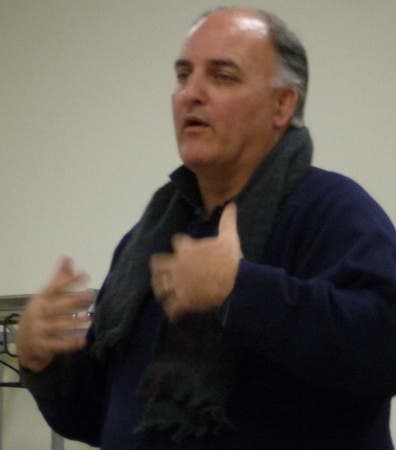
Ray O'Hanlon is living the dream, one would think. As the editor of a major international newspaper, The Irish Echo, O'Hanlon reaches tens of thousands of readers per week with his paper delivered to addresses in all 50 states and found on newsstands in major cities in the U.S. and Ireland. But he has a different dream.
Musing about the town of Ossining where he lives, O'Hanlon noted that the local paper there has "gone bigger" and, in its ambition to cover a larger "swath," is "hence missing things." O'Hanlon told an audience of Seton Hall University students last night that he'd like to fill that gap.
"A reporter's dream is a town of 25,000 to 35,000 people," O'Hanlon said, and he has "a quiet ambition to start my own paper from scratch."
Find out what's happening in Howellfor free with the latest updates from Patch.
But before you go thinking that O'Hanlon is going to run off and become editor of Ossining Patch, know that he is firmly committed to print news media.
"I feel the more lasting impact comes in printed form," said O'Hanlon, though, of course, the Echo does have a website which features non-print items like video.
Find out what's happening in Howellfor free with the latest updates from Patch.
O'Hanlon spoke to a small but rapt group of undergrads gathered to hear a panel on "Irish Americans in the News Media," sponsored by Seton Hall's P.I.P.E., Pirates of Irish Persuasion & Extraction, to conclude the second semester of its Irish Studies Discussion Series and organized by Maura Harrington.
Before O'Hanlon spoke, students were regaled with tales from the courthouse by Kathleen Mullin, a criminal defense lawyer who has appeared on The O'Reilly Factor and Nancy Grace among others. Mullin spoke of her passion for the law and for advocacy as she described her scrapes with the media in high profile cases such as the defense of Nix Mary Brown's mother and her representation of two of the prostitutes involved in the Eliot Spitzer case.
"Growing up around raconteur Irishmen has been helpful," Mullin joked as she recalled her Irish Catholic working-class roots.
Mullin spoke of the idealism of her youth. She harkened back to the lawyers of yore—Atticus Finch in Harper Lee's To Kill a Mockingbird, Jimmy Stewart in all those Capra movies. "There was a time when lawyers were not the butt of every joke, when they were sought out as problem solvers."
So, though her dad was a truck driver and her mom a secretary, their one daughter (and middle child) set out to be a lawyer—but not one of the corporate breed.
"It was important to me to put my expertise to work for a person," said Mullin, who worked as a public defender for 16 years and now as a criminal defense attorney in her own practice for the last four years. Mullin explained that she wanted to be an "advocate" or "counselor" in the old-fashioned sense of the terms. "It's a matter of applying the law to someone's problem and helping them."
Her Irish American upbringing helped her in that "I learned around the dinner table to have your own voice, have your own opinion." She added, "I don't know that it would have different if I wasn't Irish, but the ability to hold your opinion around the table helped."
Throughout her career, Mullin has eschewed the high-paying corporate law jobs to work in the courthouse and with defendants. She credits that with keeping her excited and engaged in her work.
How does Mullin deal with the backlash of defending people charged with heinous crimes—particularly in the case of Nix Mary Brown, a 9-year-old who was neglected and then beaten to death?
"I'm not pro-crime. I'm pro-process. I would defend the devil himself because he is entitled to process and that is why my family came and sailed to this country—for that process."
And what of O'Reilly and Grace and their ilk?
Mullin called FOX's cantankerous personality "gracious and cordial." "A lot is a persona," added Mullin. She noted that Nancy Grace "is very nice off camera," though Grace's on-air combativeness often irritated Mullin's mother to no end. "My mother calls, 'I don't like you going on that show! She's so disrespectful!'"
While Mullin identified very much as an Irish-American, O'Hanlon's experience and perspective were different. O'Hanlon is a Dubliner who emigrated to New York in the late 1980s. "I'm an immigrant. I'm not Irish-American. I'm Irish, and I'm American."
Mullin sees major economic trends dominating the news on the pages of the Echo in coming days. Today, December 7, 2010, he said, "would be a day to live in Irish infamy," as the country introduced a budget that would have Irishmen "throwing themselves off the west coast into the Atlantic."
The final death throes of the Celtic Tiger will bring "a distant rumble—a lot of young Irish people arriving again in America."
With a degree in politics and economics from the University College of Dublin, O'Hanlon's knowledge of history and politics surfaced continually throughout his talk in random ways—from references to Alexander Hamilton's birthplace to a history of the Irish in New York identifying themselves not by their streets or neighborhoods but by parishes in the 1920s.
The intellectual rigor that O'Hanlon brings to news reporting informed much of his talk as he agonized over whether or not the electronic media would apply the same standards as print media. For instance, O'Hanlon wondered, would the Watergate papers have had the same impact in an age of electronic media when everything needs to refresh continually. O'Hanlon felt that news stories on websites were not given enough time before disappearing into the ether.
But newspapers are a different story.
"The Star-Ledger is a great newspaper," said O'Hanlon in response to a question about the health of that paper. While some feel "it's Custer and this is the last stand, it's not the end. There is a need for dependability and a good name. That name, that tradition, that reputation."
However, O'Hanlon said he was not dismissing the new media. Rather, "it's a convergence" as papers and websites try to figure out how to get "the maximum amount of news to the maximum amount of people at the cheapest cost. It's in flux."
With all that flux, O'Hanlon still felt that journalism was a terrific career choice. "I get emails all the time every day from young people trying to get in, get experience, get a job. I like to believe that in journalism there's always a way in. You can talk your way in." Another point in his hard sell: "A media job—you can pack it in your hand and bring it with you."
"Newspapering is a young person's game," said O'Hanlon. "You need an influx of young blood."
It's clearly a career choice that O'Hanlon does not regret. As he said to begin his presentation: "Now that I'm the editor, my one ambition in life? To be a reporter again."
Get more local news delivered straight to your inbox. Sign up for free Patch newsletters and alerts.