Crime & Safety
Convicted Ponzi Schemer From Ocean County Gets 2 More Years In Facebook Fraud Case
Eliyahu Weinstein of Lakewood defrauded investors by claiming he had access to blocks of Facebook stock; also committed real estate fraud


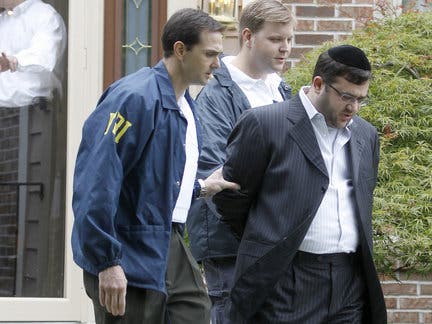
(PHOTO: Eliyahu Weinstein of Lakewood is taken into custody by the FBI. Credit: 5 Towns Jewish Times)
An Ocean County man already serving 22 years in prison for a real estate Ponzi scheme was sentenced Monday to an additional 24 months in prison for defrauding investors in connection with the Facebook IPO and several additional real estate deals, and laundering the proceeds of the scheme, U.S. Attorney Paul J. Fishman announced.
Eliyahu Weinstein, 39, of Lakewood, was previously sentenced to 22 years in prison for running a real estate investment fraud scheme that caused $200 million in losses. Monday, U.S. District Judge Joel A. Pisano, sitting in Trenton, sentenced Weinstein to 135 months in prison, 111 months of which will be served concurrently with his previous sentence and 24 months to be served consecutively. His total sentence for the two schemes is 24 years in prison.
Find out what's happening in Laceyfor free with the latest updates from Patch.
In addition, Pisano on Monday ordered Weinstein to pay $6.2 million restitution and forfeiture. That amount is in addition to the more than $200 million in restitution and forfeiture Weinstein was ordered to pay to the victims of his Ponzi scheme.
Weinstein had previously pleaded guilty before Pisano to an indictment charging him with one count of conspiracy to commit wire fraud, one count of committing wire fraud while on pretrial release, and one count of money laundering.
Find out what's happening in Laceyfor free with the latest updates from Patch.
Two co-defendants, Alex Schleider, 49, of Lakewood, and Aaron Glucksman, 41, of Brooklyn, already have been sentenced after pleading guilty to charges related to the scheme.
Schleider was sentenced by Pisano on Dec. 8 to serve 52 months in prison, three years of supervised release, and ordered to pay restitution of $613,200 and forfeiture of $363,200. Glucksman was sentenced May 5, 2014, to 52 months in prison, three years of supervised release, and ordered to forfeit $1.2 million. Pisano ordered Glucksman’s sentence to run partially concurrently with a 36-month sentence recently imposed by U.S. District Judge Raymond J. Dearie of the Eastern District of New York in an unrelated case.
Charges against another conspirator, Aaron Muschel, 64, of Brooklyn, who was charged in the criminal complaint filed against Weinstein and Schleider in May 2013, remain pending.
“Even while facing federal charges that eventually netted him decades in prison, Weinstein couldn’t resist the buzz around the Facebook IPO and the opportunity to fleece unsuspecting investors,” Fishman has said. “Shamelessly, he even used the money he stole to pay the legal fees he accumulated from the previous scam.”
“Eliyahu Weinstein spent the greater part of a decade creating and executing a series of elaborate fraudulent investment schemes, ultimately defrauding victims of over $200 million by taking advantage of trusted relationships and innocent investors,” Aaron T. Ford, FBI Special Agent in Charge, Newark, said.
U.S. Attorney Fishman credited special agents of the FBI, under the direction of Ford, for the investigation leading to Monday’s sentencing. He also thanked special agents of IRS–Criminal Investigation, under the direction of Acting Special Agent in Charge Jonathan D. Larsen, for their role in the investigation.
According to documents filed in this case and statements made in court:
In February 2012, Weinstein and his fellow conspirators offered a pair of investors (referred to in the indictment as the “Facebook victims”) the opportunity to purchase large blocks of Facebook shares prior to the company’s initial public offering, or IPO, in May 2012. The offer was particularly attractive because large blocks of the shares were extremely difficult to get and were expected to increase in value at the time of the IPO. Weinstein and his conspirators did not actually have access to the shares.
Based on misrepresentations by Weinstein and his conspirators, the Facebook victims wired millions of dollars between February and March 2012 to an account Weinstein and a conspirator controlled. Weinstein and another conspirator provided investors with false documents showing companies owned by various conspirators held assets, which would secure the Facebook victims’ investment.
The conspirators did not use any of the Facebook victims’ money to purchase Facebook shares, instead misappropriating it for their own use. Weinstein used some of the money to pay lawyers and experts representing him in his earlier – and at that time, still pending – criminal case and in related civil matters. Weinstein and his conspirators also used the Facebook victims’ money to make investments in businesses unrelated to Facebook and to make loans for their own benefit.
Around the same time, Weinstein and his conspirators also persuaded the Facebook victims to invest in the purported purchase of an apartment complex, “Belle Glade Gardens,” in Florida. They told the Facebook victims that Weinstein had the opportunity to purchase Belle Glade Gardens at a discounted price and immediately flip it at a substantial profit. Weinstein and his conspirators further told the Facebook victims that Weinstein had already placed $2.5 million in the trust account of a Miami law firm for the transaction; that if the Facebook victims contributed another $2.5 million toward the transaction, those funds would remain in escrow at the Miami law firm until the deal closed; and that the Facebook victims would be repaid within 60 days. The Facebook victims wired $2.83 million to the Miami law firm in order to complete the Belle Glades Gardens transaction. Weinstein and his conspirators did not use the money to purchase Belle Glades Gardens. Instead, they redirected the money from the law firm to accounts that they controlled, returned $1.8 million to the Facebook victims as a purported return on their Facebook investment, and used the remaining money for their own purposes.
In July 2012, Weinstein approached another group of investor victims (referred to in the indictment as the “Florida condominium victims”) and told them he had the opportunity to purchase the notes on seven condominiums in Florida at a discounted price of $3 million. Weinstein and his conspirators falsely represented that they had already paid $1.5 million toward the deal, and that they needed only $1.5 million to complete the transaction. They claimed that the properties had an annual rental income of approximately $780,000 and provided to the Florida condominium victims fraudulent documentation purporting to verify this fact. The three victims transferred $1.5 million to Weinstein and his conspirators between August 2012 and December 2012. Weinstein did not use this money to purchase the notes on the Florida condominiums – many of which he himself had previously owned and lost to foreclosure. Instead, Weinstein and his conspirators converted the money to their own use.
Throughout the scheme, Weinstein was already under indictment and on pretrial release, and was prohibited from engaging in any monetary transaction for more than $1,000 without the approval of court-appointed special counsel. Weinstein pleaded guilty on Jan. 3, 2013, before Judge Pisano to two counts of that indictment, admitting he ran a Ponzi-style real estate investment fraud scheme that caused $200 million in losses and then laundered the proceeds of the scheme. Pisano sentenced Weinstein on Feb. 25, 2014, to 264 months in prison and ordered him to pay more than $200 million in restitution and forfeiture to the victims of his scheme.
Get more local news delivered straight to your inbox. Sign up for free Patch newsletters and alerts.