Crime & Safety
The Lacey Raccoon Slaying And The Politics Of Trapping
A boy beat a trapped raccoon to death while another filmed seven months ago in Lacey. Here's where the politics of trapping come into play.


LACEY, NJ — "IF THE KILLERS BATTERED A CAR THEY WOULD HAVE BEEN PROSECUTED" a sign said as dozens protested outside the Ocean County Prosecutor's Office in May.
They were hoping for justice regarding a raccoon fatally beaten in Lacey.
It's been seven months since a video of a teenage boy beating a raccoon to death while another teenage boy egged him on made the rounds. The raccoon was caught in a leg trap. Law enforcement has not told the public whether kids were prosecuted for animal cruelty and likely never will.
Find out what's happening in Laceyfor free with the latest updates from Patch.
Several animal-welfare experts have called on the OCPO to release the results of its investigation. Read more: Lacey Raccoon Slaying Investigation Raises Concerns From Experts
A petition for justice on the raccoon's behalf has nearly 8,000 signatures on change.org.
Find out what's happening in Laceyfor free with the latest updates from Patch.
But outside of the visible parties involved — a dead raccoon, two boys, prosecutor Bradley D. Billhimer and concerned citizens — the laws behind trapping present another aspect of the story.
New Jersey animal cruelty laws state it is illegal to "unnecessarily or cruelly beat" a living animal. The New Jersey Division of Fish and Wildlife encourages trappers to shoot an animal to quickly kill them. New Jersey also allows for blunt force to kill certain animals, but there is a presumption that the actor is trained to do so.
Licensed trappers can shoot the trapped animal with certain airguns and ammunition, according to New Jersey's DFW (see page 62). The American Veterinary Medicine Association also says, under limited circumstances, it's acceptable to kill an animal with a "single sharp blow to the central skull bones."
The raccoon in Lacey was killed with about eight blows. The person filming repeatedly shouts out orders to the person with the bat, shouting "hit him."
New Jersey's DFW doesn't make it clear exactly which methods of killing trapped animals fall outside its ethical boundaries.
"The animal was beat all over its body, not just its head, indicating no knowledge or experience in performing the killing," said Stuart Goldman, the former head of the Monmouth County Society for the Prevention of Cruelty to Animals.
Animal welfare experts have called for moderate legislation, such as raising the minimum trapping age, to prevent future incidents like the raccoon slaying.
State Senator Vin Gopal proposed legislation in March to raise New Jersey's minimum trapping age from 12 to 18. Gopal introduced the bill to the senate March 18, when it was referred to the Senate Environment and Energy Committee. It hasn't made it out of the committee since.
Gopal cited the Lacey raccoon slaying as an example of why he believes New Jersey should raise the minimum trapping age. The protest outside the prosecutor's office also included chants to pass this law. Read more: Gopal Pushes Bill Relating To NJ Raccoon Slaying

"If we’re publicizing the Lacey raccoon torture and promoting responsible, reasonable, moderate legislation, I think that is going to move the needle toward more representative wildlife management policy and practices coming out of the Division of Fish and Wildlife," said Brian Hackett, New Jersey State Director for the Humane Society of the United States.
There are less than 1,000 active trappers in New Jersey, according to the state Division of Fish and Wildlife. The state regulations behind trapping show a different aspect of citizens' calls for justice and transparency.
The Organization Behind NJ Trapping
The Lacey slaying fell within New Jersey's raccoon trapping season. A person can obtain a trapping license at age 12 in New Jersey.
A 2016 report from the Association of Fish & Wildlife Agencies shows that the minimum age for a junior trapping license varies from state to state. Some states have no minimum age but require certain regulations for youth.
Some have a lower age of entry — Montana's minimum age is 6, while other states have a higher age minimum — West Virginia's is 15, according to the report.
A few states have banned body-gripping traps, essentially only allowed people to trap animals in cages. Arizona, Colorado and Massachusetts are among the states who have done so, according to the Humane Society.
New Jersey's Division of Fish and Wildlife cannot enforce laws on animal cruelty, but it has the power to give and take away trapping licenses.
A spokesperson for DFW said the organization does not comment on pending legislation or cases involving juveniles — spokesperson Larry Hajna declined comment on questions outside of these topics.
But the Fish and Game Council, which falls within the DFW, broadly addressed the Lacey incident on the minutes for their March 12 meeting. Lacey residents Barry Bendar and Alison Lemke — participants in the activist group Lacey Raccoon Task Force — presented the video at the meeting. Lemke previously wrote a letter to the Division of Fish and Wildlife about the slaying.
The council's minutes say "the raccoon was treated in an inhumane manner by a juvenile."
Despite publicly calling the incident "inhumane," officials did not reveal during the meeting whether the Division of Fish and Wildlife will enforce or has enforced disciplinary action.
"(Then-)Director (Larry) Herrighty mentioned that he did receive the letter that she wrote to the department on this issue as well as the prosecutor, this is a juvenile matter and law enforcement cooperated with Lacey Township and handled it according to the protocols for that," the minutes say.
"(Deputy) Chief ( Frank) Panico added that it is a juvenile case and by law, we cannot discuss it. Acting Chairman Virgilio mentioned that there are very strict regulations around juveniles and how they can be treated and what can be done. This is a matter for the prosecutor’s office."
The Number of Trappers
The number of licensed trappers in New Jersey has significantly declined since the 1970s and 1980s.
New Jersey had at least 2,800 total trappers every year from the 1973-1983, according to the Division of Fish and Wildlife. That number hasn't reached 2,000 since 1984, and stayed below 1,000 from 1989-2010. There have been more than 1,000 trappers in the state since 2010 but never more than 1,405 — the 2015-16 figure — in that span.
The report does not contain the number of people who actually participated during each trapping season. A Division of Fish and Wildlife survey says only 692 were active during the 2017-18 season.
"Disinterest due to low fur prices may have reduced trapper activity," the report says. "An estimated 692 trappers were active, compared to 734 active trappers in 2016-17 and 1,159 trappers in 2015-16."
Nine percent of trappers are 16 or younger, according to the survey. Seven percent are ages 16-24. Hackett claimed the declining participation in trapping gives organizations an incentive to attract youth.
"I think generally there is a trend among hunting and trapping groups to have the youth incorporated into those activities," Hackett said. "The reason being, I think, that there’s even more of an emphasis on some of that now is because of the precipitous decline in the participation of New Jerseyans."
Although the number of hunting licenses in New Jersey has declined as well, they remain more common than trapping licenses. The following data from the New Jersey DFW shows the number of licensed hunters and trappers, according to nj.com:
- 1975: 241,522
- 2016: 124,280
New Jersey had 3,192 licensed trappers in the 1974-75 season and 1,405 in the 2015-16 season. So even when you subtract trapping numbers from the bulleted figures, you're left with a significantly greater number of hunters.
The DFW spotlights youth hunting in its recent issues of the annual Hunting & Trapping Digest. The organization established the Apprentice Hunting License for firearm and archery hunters in 2017.
Apprentice hunters ranged from ages 14-88 in 2017, according to DFW. The average age was 34. But the program requires youth supervision — apprentices must hunt with a similarly licensed mentor until they're 21.
Hajna declined comment on how the organization ensures youth use their trapping licenses or permits responsibly.
The Digest lists one restriction for youth trappers: an adult must accompany trappers ages 12-13 if the child uses a firearm to kill a trapped animal. Although DFW lists guidelines for hunting and trapping, it's not as clear to the public how to get that certification revoked.
Getting a License, and Getting It Revoked
Anyone applying to trap in New Jersey must complete an education course. The courses are offered four times throughout the state in September and October. Topics in the course include technique, responsibility, ethics and respect for natural resources.
"Dispatch trapped furbearers in a humane manner," the course says. Dispatch, in the training glossary, is defined as "to put to death quickly." In the raccoon slaying video, a boy beats the animal repeatedly with a baseball bat while the other films.
As previously mentioned, the Fish and Game Council called the killing "inhumane." New Jersey law, however, implies that one inhumane incident isn't enough for license revocation. It generally takes multiple convictions.
If a person is convicted within five years of an initial conviction regarding fish and game laws, a person's fishing or hunting license becomes void.
That law does not mention trapping. And DFW remains mum on how it handled the Lacey raccoon case. However, David Golden — the organization's acting director — mentioned the law in a May 20 note to a concerned Lacey citizen to imply DFW did not have power to revoke licensing in this case.
The concerned citizen forwarded the letter to Patch.
"In addition to only extending the authority to charge adults for trapping violations under NJSA Title 23, NJSA 23:3-22 (the aforementioned law) does not suspend an individual's trapping privileges due to subsequent violations."
See the letter below (click to enlarge). Patch has redacted the concerned citizen's identifying and personal information:
-page-001%20(1).jpg)
-page-002.jpg)
Raccoons
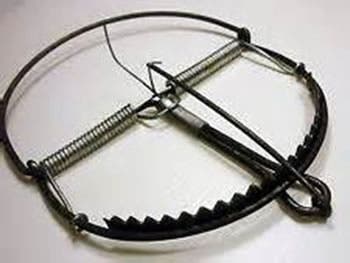
New Jersey prohibited steel-jawed leghold traps, such as the one below, in 1985.
The state allows for certain enclosed foothold traps, listing the two below as examples:

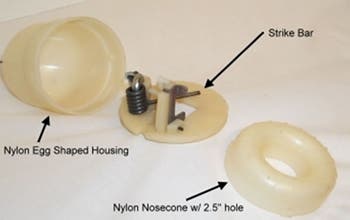
New Jersey wildlife rehabilitator Melissa Jacobs, who is certified to work with raccoons, says the modern foothold traps remain "cruel." They affect some of raccoons' most sensitive areas, according to Jacobs. Raccoons can see, but they also use their hands to sense what their eyes can't fully grasp, she said.
"Your little nerve endings are in their fingers, so when you slam your finger in the door it’s probably worse than if you slammed your shoulder or your foot," Jacobs said. "So when their fingers get caught in these traps, it’s hell for them."
Only one death has been associated with raccoon rabies in recorded U.S. history, according to the Center for Disease Control. A previously healthy 25-year-old man from Virginia died from a diagnosed illness of meningoencephalitis after he was sick for three weeks.
The CDC received 1,275 reports of raccoon rabies in 2017. The American Journal of Veterinary Research reports four people contracted rabies from a raccoon between January 2003 and October 2018.
But rabies gives people reason to view raccoons negatively, Jacobs said.
"In 30 years, I’ve had six cases of rabies in the animal, and I’ve worked with thousands of raccoons," she said. "It’s not to say that you go up and pet them or make pets out of them. But unfortunately, the media gets ahold of one raccoon that’s sick and everybody thinks they all have rabies, and they don’t."
Hackett believes that new laws will be necessary to prevent further inhumane treatment of raccoons.
"We’re not talking about banning hunting or trapping," Hackett said. "We’re just talking about the most extreme, outrageous and reprehensible practices."
Click here to get Patch email notifications on this or other local news articles or get Patch breaking news alerts sent right to your phone with our app. Download here. Follow Lacey Patch on Facebook. Have a news tip? Email josh.bakan@patch.com.
Get more local news delivered straight to your inbox. Sign up for free Patch newsletters and alerts.