Schools
Prom-Bound Lacey Seniors Urged to Make Smart Choices
Project Crash demonstration aims to underscore very real tragedies that can occur with drinking or texting and driving


As police cars roll up, their sirens blaring, their lights flashing, a young man stumbles out of the driver's seat of a green minivan.
Dressed in a dress shirt and slacks, he appears to be coming from the prom. He's bleeding from a cut on his forehead.
He flings a beer bottle to the pavement, where it shatters, then turns and stumbles back to the minivan.
Find out what's happening in Laceyfor free with the latest updates from Patch.
"What's happening here?" one of the officers calls to the young man. "I got in an accident," he says. "You got in an accident, huh?" the officer says, as he and a second officer take him by the arm and lead him away from the van, which is battered from the crash.
A white car sits askew, windshield shattered, its driver slumped over the wheel. Her backseat passengers are bloodied as well. Two girls run up to the car, concerned about friends inside. One of the police officers escorts them away. They stand near the police cars, watching, worried looks on their faces.
Find out what's happening in Laceyfor free with the latest updates from Patch.
On the ground nearby lies a young man, his face bloodied, cuts on his arms and legs, his shirt torn, a shoe missing. He isn't moving.
Motor vehicle accidents are the No. 1 killer of those between the ages of 15 and 20, Andrew Caruso, director of operations for MONOC, the emergency services company, tells the students watching from the bleachers as the scene unfolds.
Of those, nearly a third are alcohol-related, according to 2009 statistics from the National Highway Traffic Safety Administration.
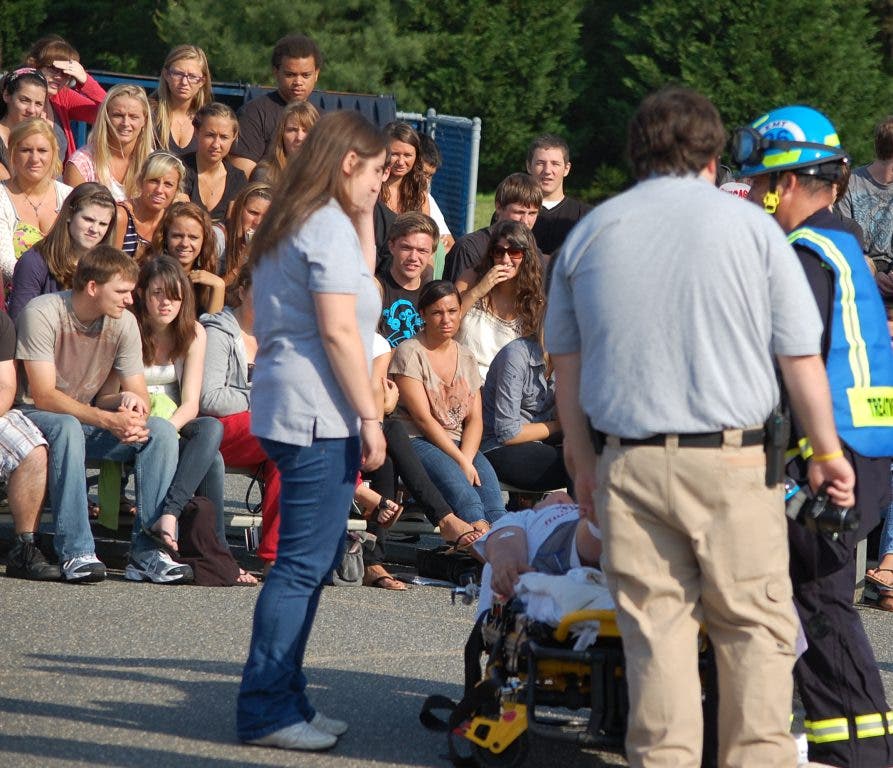
And it is for that reason the students—Lacey High School seniors, about to embark on their prom and graduation and the lives that await them after graduation—were brought together for an assembly Thursday morning behind the school.
The assembly—Project Crash—is in its sixth year, said Renee Gurgacz, adviser of the school's Emergency Services Club and the event's organizer. The assembly aims to show students a lifelike representation of what happens in a car crash, from injuries to how emergency personnel respond, to the tragic consequences of what can happen if you make the wrong decisions, Gurgacz and Caruso said.
"We wish you all a great prom," Caruso said as he introduced the scene to the students. "These are all volunteers, who took time off from their jobs to be here today because they want to make sure you stay safe."
Ambulances from the Lanoka Harbor EMS roll up, as do a pair of firetrucks from the Lanoka Harbor Fire Department. As firefighters set to work prying open the white car and the van, EMS volunteers and MONOC paramedics begin assessing the conditions of the injured.
The young man on the ground still has not moved. First aiders kneel, speaking to him and taking his pulse. They get no response.
In the bleachers, students talk among themselves.
"We could die," one girl says to her friend next to her. "This really could happen."
That is just the message the volunteers and the administrators want the teens to receive, Caruso says after the demonstration is complete.
"We used to be able to show gory photos (of accident scenes) and that was very effective," Caruso says. But privacy laws and a change in sensibilities forced a change in tactics when it comes to educating people—especially teens and young adults—about the dangers of drunk or distracted driving.
"They think they are invincible," Caruso says, which is why the emergency services personnel—24 in all participated in the demonstration—take time off from their jobs to be there. "They think this is that important," he says.
As the rescue work continues, students comment on various aspects of what's happening. Not all of them seem to be getting the message, because they're busy making wisecracks, which draw stern rebukes from adults. But Caruso and Bob Resetar, chief of the Lanoka Harbor EMS and Lacey Township's deputy emergency management coordinator, said some of that wisecracking may simply be a cover for those who want to seem more macho in the face of something so grim.
"As they're walking out you can hear them saying, 'Did you see this, did you see that?' " Resetar says. "It does send some sort of a message."
The young man on the ground still is not moving. First aiders turn him onto his back, carefully supporting his neck, but there are no signs of life. MONOC paramedics are called over to do a further assessment, hooking him up to a monitor to check for a heartbeat.
There is none. The young man has died. An accident specialist draws an outline of where he lies on the ground and photographs the scene, and the paramedics cover him with a sheet.
Three young women are assisted from the van and are walked over to waiting ambulances. Two others are helped from the car while a third young woman—the driver of the white car—is carefully removed and put on a stretcher for transport to a trauma center.
A stretcher is wheeled over to the young man on the ground. The sheet is removed, and he is lifted onto the stretcher, then covered again with the sheet. A first aider gently lifts his arm, which is dangling off the side of the stretcher, and tucks it against his body before tightening straps acros his body before it's transported to the morgue, and he is rolled away.
"This is about educating kids about what something like this looks like, sounds like, smells like," said Lacey High School Principal William Zylinski, "so they make the right choices when they get in a car."
"He wasn't wearing a seat belt," Chris Zsido, a first lieutenant in the Lanoka Harbor EMS, says of the young man who died. "He got thrown from the vehicle."
In all, the crash has injured six young women, killed one young man and likely ruined the future of the young man who was drinking and driving, as he faces the loss of his license and the potential loss of college scholarships and more, Caruso says. It is a situation that could be avoided with different choices, smart choices, he said.
"Please think about what happened here today before you get behind the wheel drunk, before you pick up the phone to answer that text message," Caruso says to the students at the end of the presentation. "We want you to be safe."
"If even one kid gets the message and is affected emotionally, then this is a success," Gurgacz says.