Arts & Entertainment
Archeology on Canvas
Eve Ingalls' "Sited Memory/Underground Shadows" at the Bernstein Gallery explores the earth as canvas.
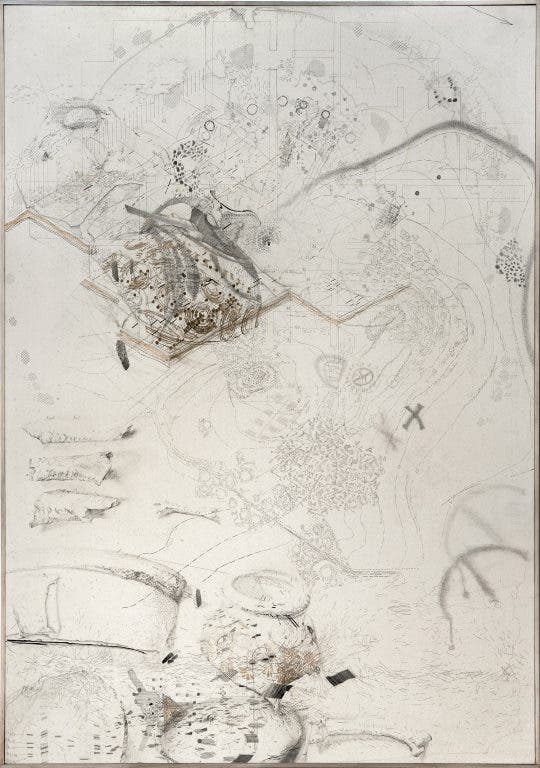
The artifacts in Eve Ingalls’ art appear to be embedded in the canvas, as if the artist dug into the surface of the raw canvas and discovered the ancient vases, urns and jars that rest within.
As visitors look at the ink-and-graphite renderings on view at the Bernstein Gallery at the Woodrow Wilson School on the Princeton University campus, the artist wants them to see each canvas as an archeological site. Some works consist of two panels, which give a feeling that there’s hidden terrain to be explored behind the artwork, almost like a curtain, the artist says. (But that’s not literal, actually trying to separate the panels could get you in trouble.)
“It’s sort of as if one’s trying to be somewhere, remember something in this complex world where there are so many layers, cultural layers and scientific thrusts,” Ingalls says. “I think that’s an important thing to remember.”
For Ingalls, the works in the exhibit — titled “Sited Memory/Underground Shadows” and running at the Bernstein through Oct. 21 — are archeological sites, ones she didn’t want to disturb much, which is why the artifacts she drew appear to rest in the ground. “If that’s an archeological field and I’m digging, I don’t want to release anything too much from the surface,” she says.
Another theme of the pieces is the idea of the earth as a drawing surface, with human beings “drawing” culture after culture into the earth’s surface. Some of those cultures are big, some are small, new ones are created and some are gone and have left behind traces of what they once were.
That ties “Sited Memory/Underground Shadows” to the theme of memory. The show is part of the Princeton University Museum of Art’s exploration of arts and memory through campus events like the “Life and Death of Buildings” exhibit at the museum, and other events on campus and throughout the Princeton community.
Ingalls hopes that her work leads to viewers thinking about their own memories, imagining our memories as part of the archeological site. “It’s not necessarily that you want to be back where you had that memory,” she says, “but you want to find a place from where you can remember that thing.”
In “Phase Passage,” there is a fairly realistic depiction of archeological artifacts, bowls, vases, urns and bottles. Above them is a flowing scroll marked with nine rows of lines that resemble divider lines on a multi-lane highway. The artist says the piece is about an archeological site that has moved on.
“Still Point” shows mountains resembling elephant toes, at the top of the mountain. To the right is a sloped portion of terrain with an arrow pointing at what looks like water. Arrows are prominent in these works. Some arrows are simple lines, and look like markings you’d see drawn on plans. Other arrows have a 3-D effect and appear to be existing, floating, in the image and casting a shadow.
Asked why she includes the arrows, Ingalls replies. “You’re asking because I’m asking. We develop this language to define things and it’s part of research and the presentation that would develop like a verbal language. There’s also the visual language where you have different types of arrows you use to project an idea, to create diagrams.”
“Still Point” got its name from a T.S. Eliot poem. It is dominated by scenes of mountains that have not been excavated much, except for one opening that’s almost house-shaped, and shows a bowl and vase standing upright, little else has been discovered at this site and the two artifacts appear as if they’re waiting for someone to retrieve them.
Ingalls first started working on these in the 1980s. When she took them out of storage, she saw that they weren’t finished, and still relevant, so she completed them in 2008. Rediscovering work and adding it to it decades later is something that never happened to her before, and she doesn’t expect it to happen again.
“I thought they were finished, so it’s really exciting to open them up again with another layer. They became much more active.”
And they are waiting to be discovered.
Find out what's happening in Lawrencevillefor free with the latest updates from Patch.
“Sited Memory/Underground Shadows” is on view at the Bernstein Gallery at the Woodrow Wilson School at Robertson Hall on the Princeton University Campus, through Oct. 21. A panel discussion, “Architecture as Memorial” will be held in conjunction with the exhibit on Oct. 18 at 6 p.m. followed by an artists reception. For information, call 609-258-0157.