Community Corner
What Not To Do When Giving a Speech
With college commencement right around the corner, Zach Levine takes a look at what it takes to give a memorable speech.
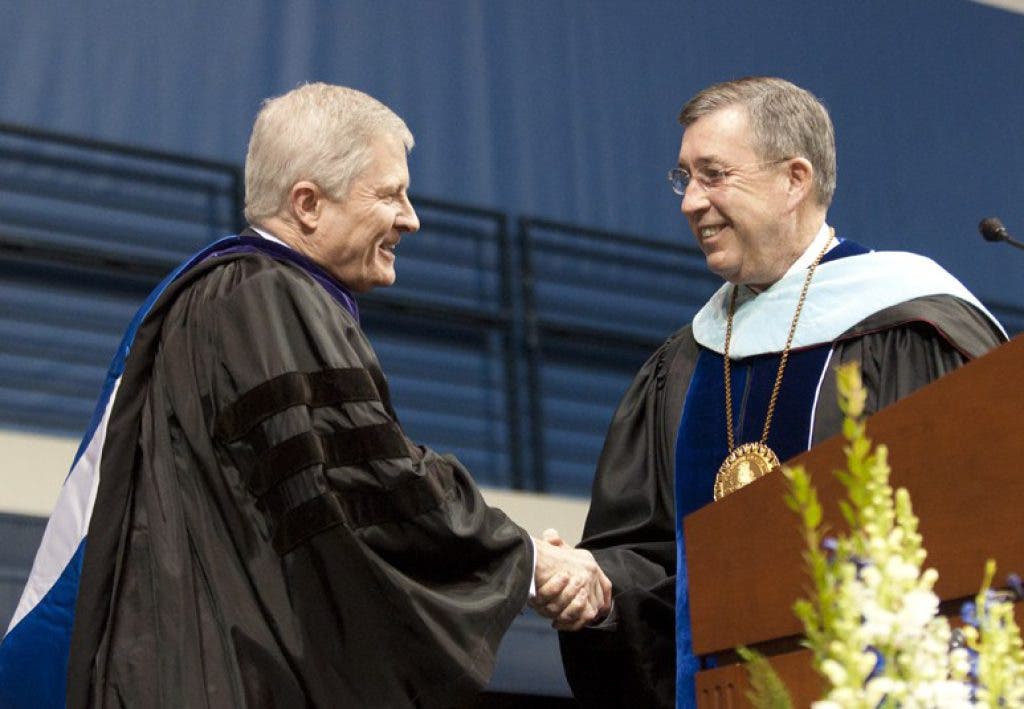
Hello again everyone and welcome back to the Monmouth U Corner here on Long Branch Patch. My name is Zach Levine, and I would like to quickly congratulate all students who will be throwing their caps in the air in the coming weeks for graduation. Finishing up college is a huge feat, and one that should not be quickly tossed aside.
Now I will always remember my high school graduation, where our valedictorian gave a great speech about bracing for the future and accepting all responsibilities that come our way. He then ended with a baseball metaphor, saying every time life throws you a curveball, hit it out of the park. He was roundly applauded for his speech.
This was then followed by a speech from the salutatorian, who for some reason spoke of robots coming to take over the United States, and our class having the abilities to take down the robot overlords. Yeah. ... I’m still scratching my head over that one.
Find out what's happening in Long Branch-Eatontownfor free with the latest updates from Patch.
Now when I went to Rutgers University and graduated in the spring of 2008, our commencement speaker was Rey Ramsey, the co-founder and CEO of One Economy Corp. He gave a pretty powerful speech at the time, though many were unable to hear it and some didn’t pay attention due to the massive rain storm that hovered over the graduates.
One just needs to visit YouTube for a few minutes to see some great commencement speeches over time. Comedians like Conan O’Brien, Seth MacFarlane and Will Ferrell have all delivered hilarious commencement speeches, and many people of prominence, like President Barack Obama, Steve Jobs and Oprah Winfrey have all given powerful speeches to future graduates.
Find out what's happening in Long Branch-Eatontownfor free with the latest updates from Patch.
So for all valedictorians, salutatorians, honored commencement speakers and random people who decide they want to grab the microphone during graduation and give a speech, please allow me to offer some tips as to what makes a strong and poignant commencement speech.
1. Know your audience, and your facts
When I was in middle school, we had several speakers at our graduation. Our first speaker was dryer than bread left out in a desert. He spoke in a low tone, and barely showed any emotion when talking. It seemed like he would be more comfortable reading the newspaper than to a crowd of 14 year olds.
The next speaker quickly said, “Hey I was watching The Simpsons last night …” which immediately peaked our interest. Who doesn’t love Springfield’s favorite family? Except he continued, “Homer Simpson works in Sector 17 of the Springfield Nuclear Power Plant.” See this was when The Simpsons were a huge television show, and everyone graduating knew every last detail about the show. The audience quickly turned on the speaker, since Homer works in Sector 7G, not 17. So therefore, I say speak loudly, show emotion, and know your facts before speaking.
2. If you’re going to tell a joke about a specific person in the crowd, make sure they know about the joke
So when our college commencement speech began, the university president kicked off the proceedings. He started with some jokes that went over alright with the crowd, and then a cell phone “rang” over the public address system. He yelled at the crowd, demanding to know what person in the crowd had a ringing phone, before realizing it was his.
He then proceeded to “answer” his phone, and told us that calling him was the Rutgers University field goal kicker Jeremy Ito. This led to a small ovation from the crowd, and a confused look from all the students, especially Ito himself who was sitting several rows back from the stage, graduating that very afternoon. Everyone turned to look at Ito, who shrugged his shoulders and let out a confused smile. The president then said Ito told him that everyone should turn off their phones for this event. It was a good idea at first, but if Ito was let in on the joke, it might have been much more effective.
3. Tell some jokes, but don’t start a stand-up routine
Jokes are always a good way to start a speech. It eases the tension of the afternoon and shows people that you are there to have a good time. However, don’t turn graduation into your own personal stand-up showcase. Leave the microphone stand alone, don’t hold on to it like you’re Seinfeld.
This is something I always have a fear of when I watch public speeches in all honesty. I’ve seen way too many speeches go south because the orator decides they want to turn this speech into an audition tape for Saturday Night Live. As long as the correct balance of humor, poignancy and words of encouragement is brought together, a successful speech will be given.
So there you have it. I hope I helped some people who will be giving speeches in the future, whether they are Best Man speeches, Commencement speeches or really any other kind of speech. Some may still be confused though, and to those, I say tune in next week, when I present my first annual Commencement Address. Thanks for reading!