Schools
Rapid Rise Puts Nittel in Charge of District Curriculum
Somerset native follows Superintndent Rossi from Roxbury district.

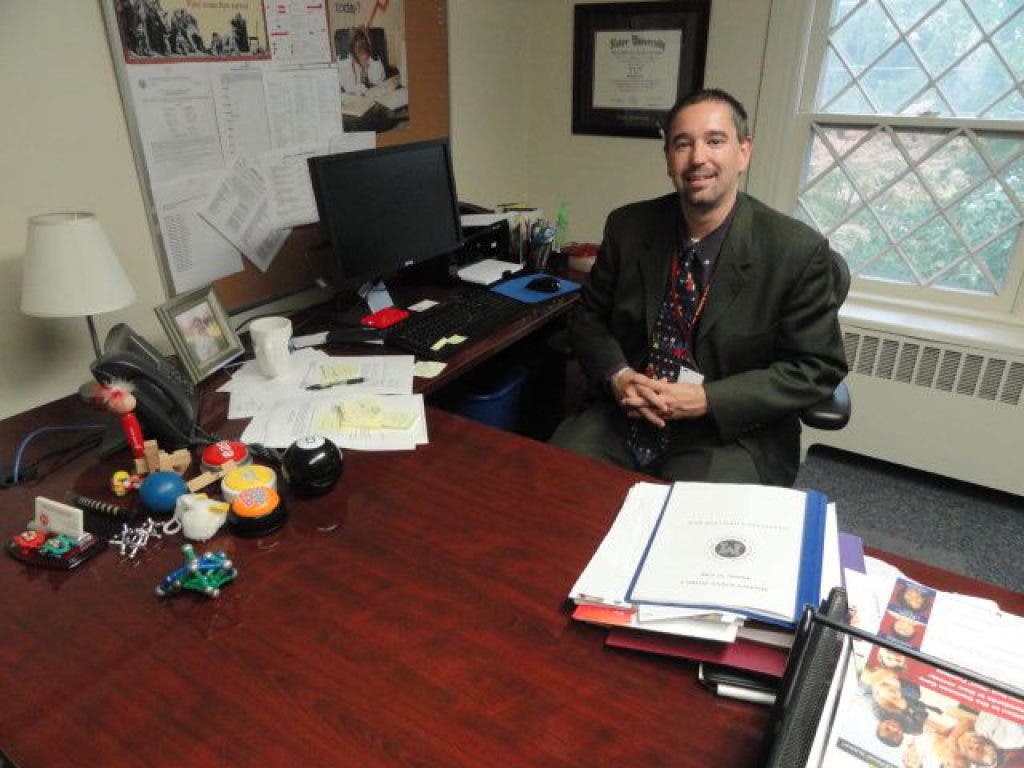
Ask Madison’s new director of curriculum and instruction, Lee Nittel, about his experience and he’ll tell you he once worked as a professional musician playing tenor saxophone across a wide oeuvre which included jazz, R&B, Fifties, soul and horn cover bands.
The 42-year-old native of Somerset, who worked for 10 years as a middle school band director, is now helping to orchestrate the educational content for the Madison school district.
A graduate of Rowan, who obtained his master's degree at Rider, Nittel began his career as an educator as a music teacher in Franklin Township. His first administrative job was in Great Meadows near Hackettstown and he later worked as a vice principal in Randolph before serving as principal at Eisenhower Middle School in Roxbury for the past four years.
Find out what's happening in Madisonfor free with the latest updates from Patch.
Nittel’s wife, Danette, is a clinical research scientist for Johnson & Johnson and he has a 7-year-old son in the Lopatcong school system.
Madison Superintendent Michael Rossi, the former Roxbury schools chief, hand-picked Nittel to oversee curriculum in the position held by then-Assistant Superintendent Barbara Sargent.
Find out what's happening in Madisonfor free with the latest updates from Patch.
Nittel’s job responsibilities are substantial.
“I oversee all professional development for teachers, and make sure the district curriculum is aligned with state core content standards, and now, federal common core standards,” Nittel said in an interview at the offices. “I am also the district’s affirmative action officer, and do some of the human resources [functions] in the hiring of teachers. I am also involved in the supervision and evaluation of all teachers.”
Curriculum refers to the courses students take. “At the elementary school level, this would be reading, writing and math programs,” said Nittel. “In middle school, higher math programs, and a balanced literacy approach in language arts.
“In high school, Advanced Placement and honors courses become important, and that means taking a look to make sure we are in compliance with minimum state requirements. In Madison we are above the state minimums and are ranked high.”
“We are assessing all of these courses, as well as student performance each year, with benchmarks the district gives in all courses to make sure we have the proper curriculum for students and that teachers, parents and other stakeholders have the proper tools in the classroom.”
Nittel also is helping implement the online parent portal, a centerpiece of Rossi’s strategy to bring improved communication and transparency to the district. Roxbury opened its portal three years ago.
“The portal will give parents a consistent view of how students are doing, where they can see daily progress instead of waiting for reports to come home,” Nittel said. “There is also accountability with teachers. They do feel more accountable to get those grades up, begin some kind of process to get that information out. With thee tools, grades come up, and it also holds the students more accountable. This transparency means parents can help the students succeed a little bit better, it’s better than a phone call to teacher.
"Teachers still have to keep up those communications.”
The portal, which is scheduled to be up and running after the New Year, represents radical change for teachers.
“What it means for teachers is that they have changed some of the things they have done for so long, such as the grading process,” said Nittel. “Some teachers start to change, not everybody, but some. [Student] issues will come to light much quicker.
"A lot of veteran teachers are excellent teachers, great classroom management, but they are just doing something from the ‘80s and haven’t changed,” Nittel said. “My job is to make them aware of some of the things they can do. Some see the benefits and some of them don’t. [The process] is an
appreciative inquiry. We look for people’s talents and use them. It sparks new energy into their thought process.”
Plans also call for electronic student portolios beginning in kindergarten.
“The portfolios will include everything a student has done, all test scores, writing, other benchmarks, a variety of data to show the growth of that child," Nittel said. "Looking at that, we can see a kid’s growth process in addition to standardized tests.”
Teacher training, Nittel, said, “is where 90 percent of what we are trying to do happens. It is differentiated training, to boost the top but bring along the bottom.”
“I am more interested in teaching and instruction,” he continued. “Through awareness and professional development, teaching kids in an engaging manner, getting people more aware of different students’ learning styles, and connecting them to 21st Century real-life scenarios. That means infusing technology into their instruction, getting kids hands-on, online, using Web 2.0 tools, working collaboratively and posting their work online.”
In the current budget atmosphere, Nittel said more teachers are looking into program-specific grants to fund new technology. BASF, for example, has awarded a $5,000 grant for science.
“There are some things in Madison that are quite antiquated,” Nittel said. “We want to upgrade the way teachers teach and the tools they use, and not all of it costs a lot of money.
"Teaching is so consuming during the day, there’s not a lot of time for teachers to do their own professional development. That’s part of my job as I see it, to bring in professional development to help them in the classroom, give them these opportunities as much as possible. I would hope they have some intrinsic motivation to better themselves.”
Every district teacher, in concert with administrators, each year is required to write a Professional Development Plan. The PDP is supposed to help teachers set “some kind of goal” and serves as on evaluation system. The PDP is very detailed, and is audited by the state every three years or so, Nittel said.
“I like to create an educational environment conducive to the best possible results for the kids. That also means working closely with teachers to make sure their environment is good. If they feel supported that will trickle down to students. We want an environment where they like to come to work and feel comfortable teaching.”
“We are all here for the students,” he said. “Any decision we make at the central office has to have good results for the kids, that’s who we are here for.”
Get more local news delivered straight to your inbox. Sign up for free Patch newsletters and alerts.