Schools
Ramapo Ridge Middle School Wants To Shape Up NJ Children
Bergen County Student Council student leaders come together to create a plan against childhood obesity.
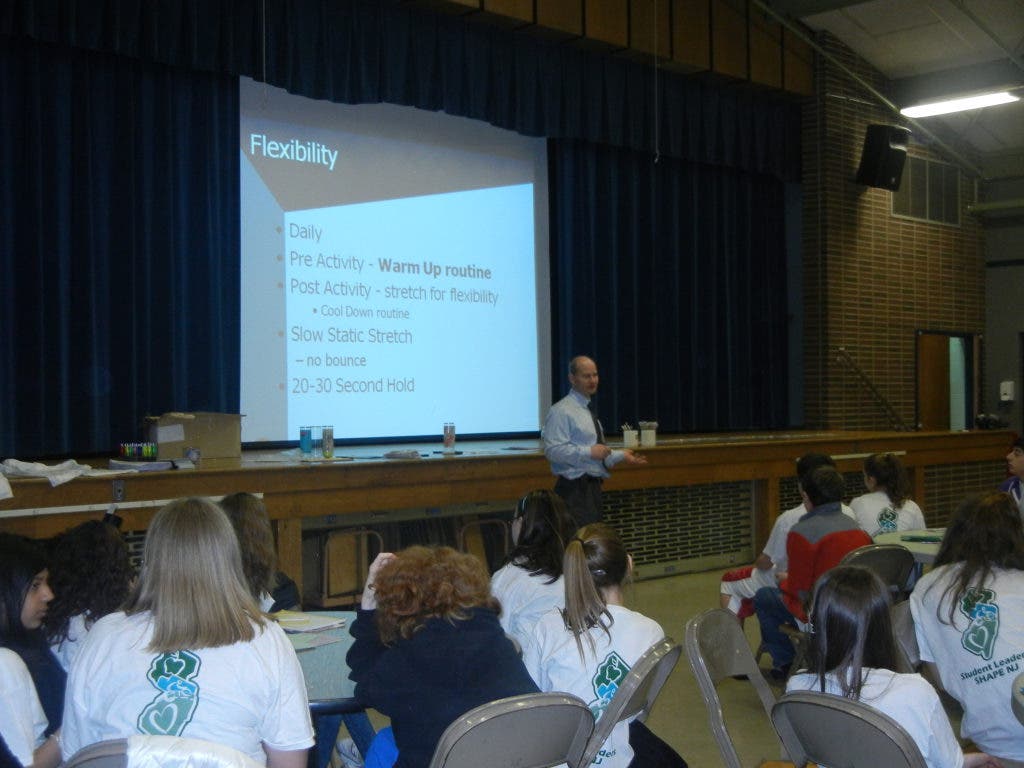


Ramapo Ridge teacher and Student Council Advisor, Courtney Levine, along with fellow teacher Jo Ellen Wall, organized a Summit meeting for Student Council student leaders, discussing the dangers of childhood obesity and how they can change their environment to create healthier choices.
Ms. Levine reached out to experts at The Valley Hospital and to Peri Nearon, MPA, the Director at the Office of Nutrition & Fitness, of the State of New Jersey.
When asked why obesity was chosen as a topic, Ms. Levine responded,
Find out what's happening in Mahwahfor free with the latest updates from Patch.
“The students were aware of Michelle Obama’s commitment to decreasing childhood obesity and thought it was a great idea to take on. We reached out to the Bergen County Schools and asked them to send us their student leaders. The students will learn all about the cause, affects and ways to prevent childhood obesity in their environment. They will create an action plan to bring back to their individual schools.”
Thirteen Bergen County Student Council Schools attended the all day seminar. Speakers from The Valley Hospital addressed the students on everything from the importance of nutrition and physical fitness to learning how to calculate your Body Mass Index (BMI).
Find out what's happening in Mahwahfor free with the latest updates from Patch.
Nutrition
Janet Brancato, registered dietician for The Valley Hospital, gave the students a few tips on how to be mindful of what you eat. She suggested looking at labels, serving sizes and the percentage of sugar and fiber in each product. Ms. Brancato also suggested eating less fast food.
“Definitely stay away from supersizing your meal to avoid the extra fat and sodium.”
Ms. Brancato asked students to try a new food each week.
“Make a goal for yourself to add more nutrients to your eating plan. Get involved with the food planning and shopping in your house. Be part of the process of creating your meals.”
The registered dietician also suggested that distractions during mealtime can cause us to overeat.
“Shut off all distractions, such as cell phones and TV’s when you eat, so you can get the signal of fullness. Everybody’s body is different. Take care of the body you have.”
Physical Fitness
Donald Tomaszewski, director of Sports Medicine for The Valley Hospital discussed the importance of physical fitness and healthy lifestyles. He explained the benefits of exercise, such as reduced heart disease, blood pressure, cholesterol levels and increased muscle strength and endurance.
“This is a great time for you at your age to build your bone and muscle mass that will have an affect on you later in life. As you get older, you start to lose bone and muscle mass. Your metabolism drops and it’s much harder to build your body up.”
Mr. Tomaszewski described the F.I.T.T. formula to use when putting together an exercise program.
“Frequency, Intensity, Time and Type. How often will you exercise? How hard will you exercise? How much time will you dedicate to exercise and what type of exercise will you do? These are the questions you have to answer to come up with a plan for yourself.”
He continued by giving specific examples of frequency of exercise.
“Minimum three days a week. One of the recommendations for teenagers is that you should do vigorous activity twenty minutes, most days of the week, whether it be an exercise or a form of play.”
BMI
Dr. Paul Pelavin, Pediatric Endocrinologist at The Valley Hospital talked about the importance of Body Mass Index in calculating if a child is obese. He also addressed the topic during a question/answer period with the Student Council students.
Many students wanted to know how many Americans does obesity affect? Dr. Pelavin answered,
“Approximately 30% of Americans are obese and another 30% are overweight.”
Dr. Pelavin also addressed the question whether it was better to be underweight or overweight?
“Neither. Both can be a sign of a problem and should be addressed by your doctor. Kids who are very thin, have weaker bones.”
Registered Dietician, Janet Brancato was asked to describe a perfect lunch to pack for school.
“Whole grains with a lean protein are best. Add a milk and a fruit or vegetable as a snack.”
Ramapo Ridge Middle School Physical Education and Health teacher, Chris Diaz asked the panel, “what role has technology played on impacting childhood obesity?”
Dr. Pelavin responded, “It’s been a great impact on childhood obesity. For example, TV in a child’s bedroom is related to obesity. Children are spending so much more time inside instead of outside. They are not active enough.”
Peri Nearon, the Director of Fitness & Nutrition for the State of New Jersey addressed the students, explaining obesity has been a growing problem since the 80’s. She talked about a new plan the State Department is promoting to battle this problem in New Jersey.
“We are promoting an initiative called Shaping, NJ. It’s a public/private partnership that’s a little bit different than educating kids and people about individual change. It’s now about the environment and changing the environment.”
Shaping NJ’s mission statement reads:
“The Office of Nutrition & Fitness will lead in coordinating partnerships to build a statewide capacity to effectively implement policy and environmental change to improve healthful eating, physical activity and to prevent and control obesity because of its link to chronic disease.”
When asked what factors are causing childhood obesity, Mrs. Nearon offered,
“I like to call it ‘The Perfect Storm’ because it’s really not any one thing. It is everything. We aren’t walking or biking to school. We don’t have a lot of movement in our day. Some schools are cutting recess to promote a more competitive academic environment. There are safety issues about using parks and recreation facilities, so we don’t use them. Parents are fearful to send their kids out to play, ever advancing technology, and video games and then throw in your fast foods, packaged foods, processed foods and portion sizes.”
When asked how students can make a change, Mrs. Nearon responded,
“Go back to your school and look at your environment at your school. Look at what’s in your vending machines, look at your physical education program and see where change needs to be made.”
She also noted cultural changes over the years.
“When I was a kid, going out to dinner was a treat. It wasn’t something that you did all the time. Culturally, going out to eat wasn’t something that you did all the time. Today, people go out all the time and if they don’t go out, they bring food in. If you didn’t prepare the food, you have no idea what is in that food.”
Mrs. Nearon mentioned a few sobering facts to students.
“This is the first generation of children expected to live shorter lives than their parents.”
She also noted that obesity is considered a national security issue because men and women aren’t fit enough to enter the armed forces, which is depleting our forces.
Mrs. Nearon continued by stating that the cost of treating obesity in New Jersey alone was $2.2 billion dollars in 2009 and is projected to reach $9.3 billion dollars by 2018.
“We really want our children to be healthy.”