Schools
Channel 21 Welcomes Back Student-Produced Video Programming
Newly purchased broadcast equipment brought the channel back on-line



Anyone in Manchester who tuned their cable box to channel 21 has seen a slideshow of static images with written information for about the past five years.
Now, with a new piece of equipment in place, budding video producers at are once again broadcasting their work into residents' homes.
"It was a little frustrating," said Station Manager and Video Arts Teacher Keith Eckert. "The kids would do these projects and they couldn't come up on the station."
Find out what's happening in Manchesterfor free with the latest updates from Patch.
Though Principal Alexander George helped by airing student projects throughout the high school for their peers to watch, the reintroduction of video broadcast capabilities to MTHS-21 has helped to energize the student work.
"This year the excitement is a lot higher because it gets to go in front of the whole town," Eckert said.
Find out what's happening in Manchesterfor free with the latest updates from Patch.
When the station video broadcast equipment went off-line in 2006, the channel essentially became a message board for school and community events.
"That equipment was from 1996 — the original equipment," said Eckert, who is in his seventh year as the video arts teacher at the high school.
Students helped lead the charge to get their station's video back on-line. The digital broadcaster that they needed to purchase didn't come cheap — they needed about $10,000.
That took fundraising.
"Lots of fundraising," Eckert said.
Qaudeer Johnson and Nick Solly, who graduated last year, and Craig Leppert of the class of 2009 led the nearly five-year fundraising effort, Eckert said. The Manchester Township Educational Foundation provided a grant and the also contributed to the cost of the new equipment.
Now, with their work shown throughout town, students are inspired to do more.
"Before we were just making small videos, and now we have to try harder because we're editing ceremonies and games that go on the air," said senior and video production student Nicole Spicer.
"You know that there will be a lot of eyes watching and you want to put your best foot forward," George said. "It's positive motivation for kids to do their best."
George, a former journalism teacher, said that he would tell his students the importance of finishing school with a strong portfolio of work, be it written or video.
"I think it's about opportunities for the kids," George said. "The TV program and journalism and elective programs like that allow kids to leave here with a good idea of what this program looks like and what my interest might be moving forward."
Superintendent of Schools David Trethaway said that students can now more easily "show the community what the school is all about" with their broadcasts.
"We look at it as a community service," he said.
The station has two main programs, "Spotlight," a 15-to-20 minute show featuring interviews with teachers, students, staff and community that is "basically a talk show," Eckert said.
The other still-untitled show is a 30 minute monthly magazine show that will feature features on staff members, events and community happenings.
The station will also feature Hawks sporting events and special school programs, such as a financial aid night or stress anxiety program for elementary students.
"Which is good because sometimes parents can't come out to these things," Trethaway said.
"A high school should be a centerpoint of the community, and this will help bring it together," Eckert said.
In addition to informing students, parents and the community, the station allows students to hone their skills before heading off to college.
"To get into some of the more competitive schools in those areas, that's a big piece of the puzzle," George said. "It's also an opportunity for kids to be exposed to something they wouldn't normally be."
The studio was opened in 2005 as part of that year's referendum, George said, though some of the equipment dates back to 1996. Only one piece of equipment — the master recording deck — has to be sent out for cleaning; the rest, including cameras and the studio's 12 computers, are cleaned by Eckert and his students.
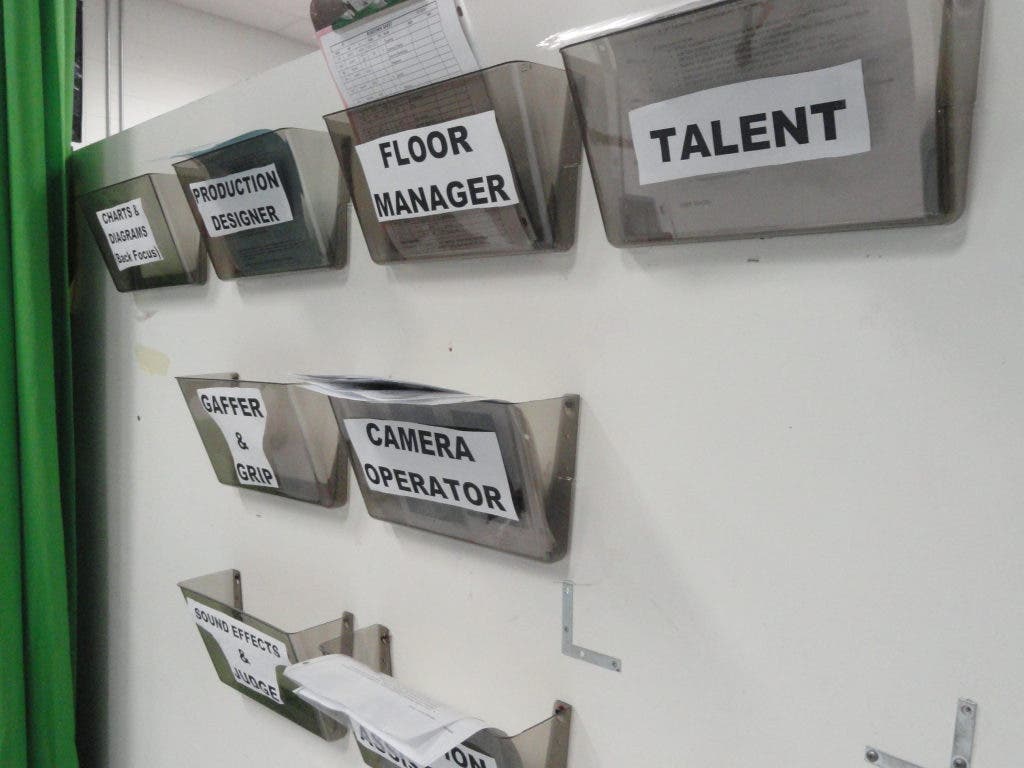
Five seniors are in a course called Studio Production in which they essentially manage the station. Video II and Video I students shoot their own pieces which are broadcast during the shows. Thirty-three students contribute to the shows and rotate station responsibilities each week.
"They do everything and that's our motto: student produced, student taped and student run," Eckert said. "All I do is oversee everything and make sure it is appropriate."
"These guys do almost all the work," Trethaway said. "They do a great job."
Eckert, who before coming to Manchester worked at a Los Angeles TV news station, said that he aims to show his students what working for a TV production is like.
"This studio is run exactly how a professional studio is run," he said. "We do tape format, we log all the tapes and have a huge video library with all of our tapes. Everything is run to a T just as a studio was."
Students learn how to edit their video on Final Cut Express software. Though content is produced in standard definition, Eckert said that the broadcaster is limited to SD video and anything shot in high definition would require conversion to a lower resolution before it hit the airwaves.
Students are responsible for brainstorming ideas, scheduling shoots and editing their work on time.
"The way Mr. Eckert is, he doesn't tell us what to do," said senior Ja'Quil Brown, who has spent three years in video classes. "We're independent and he'll just guide us and tell us what to do better and how to make ourselves better. It's kind of like a little college course."
Eckert said that the classes also promote team building as students are paired up to work on reports.
"It's very rare that a student will take a camera and shoot by themselves," he said. "There is usually a group of at least four working on a story."
The station already has a full slate of programming — both from students and other sources such as PBS — on its schedule. More is in the works — the first monthly magazine show is expected to air at the end of December and a student debate show is in the works. Eckert recently also asked his students to brainstorm ideas for other shows which would air in the Spring. Eckert said that he hopes to have digital video program library online by the end of the school year.
Now, the goal is to make the program self-funding by having content sponsored by the community.
"[Sponsors] are basically donating money and we are thanking them," Eckert said, adding that the acknowledgement would be similar to what is seen on public broadcasting, rather than advertising. Anyone interested in sponsoring the station and its programming can contact Eckert for more information.
The new equipment also means that the station no longer has to pay an outside company $100 per month to manage the slides shown on the station.
"Yes, we spent $10,000 [on the new broadcaster], but we don't have to pay anyone anymore," Eckert said. "Overall, it's a big savings."
In addition to class, students can also participate in Video Club, which focuses on shooting events, creating titles and graphics and other tasks that cannot be completed during normal class time.
Not only are students learning, they are also having fun, said senior Cassidy Gobel, who has taken video production since entering high school.
"[Eckert] taught me how to use a camera and edit videos and basically put together a good video or commercial or PSA," she said, all skills that will come into play in an increasingly digital world.
Get more local news delivered straight to your inbox. Sign up for free Patch newsletters and alerts.