Schools
Manchester Students Told the Power to Stop Bullying is Within Them
Box Out Bullying program gives students ways they can help others


As you read this sentence, somewhere in this country a child is being bullied by another student. Nearly 160,000 children have missed school today because of bullying. Nearly 16 million children have witnessed some form of bullying.
And chances are, you know a child who is being victimized. You may even know a child who is a bully.
In the wake of a number of highly publicized incidents where students have either lashed out at bullies or have turned to a more dire solution — suicide — schools all over the state and the nation are focusing on the issue of bullying this month.
Find out what's happening in Manchesterfor free with the latest updates from Patch.
“Nearly 160,000 students miss school due to fear every day,” said Jeremy Rubenstein, president and creative director of Box Out Bullying, an interactive presentation designed to show students there are options and ways to stop bullying at its source.
Rubenstein and his partner in the project, Ryan Redebaugh, brought their presentation to the Manchester schools in the last week, finishing up with a presentation to the district’s middle schoolers on Monday morning.
Find out what's happening in Manchesterfor free with the latest updates from Patch.
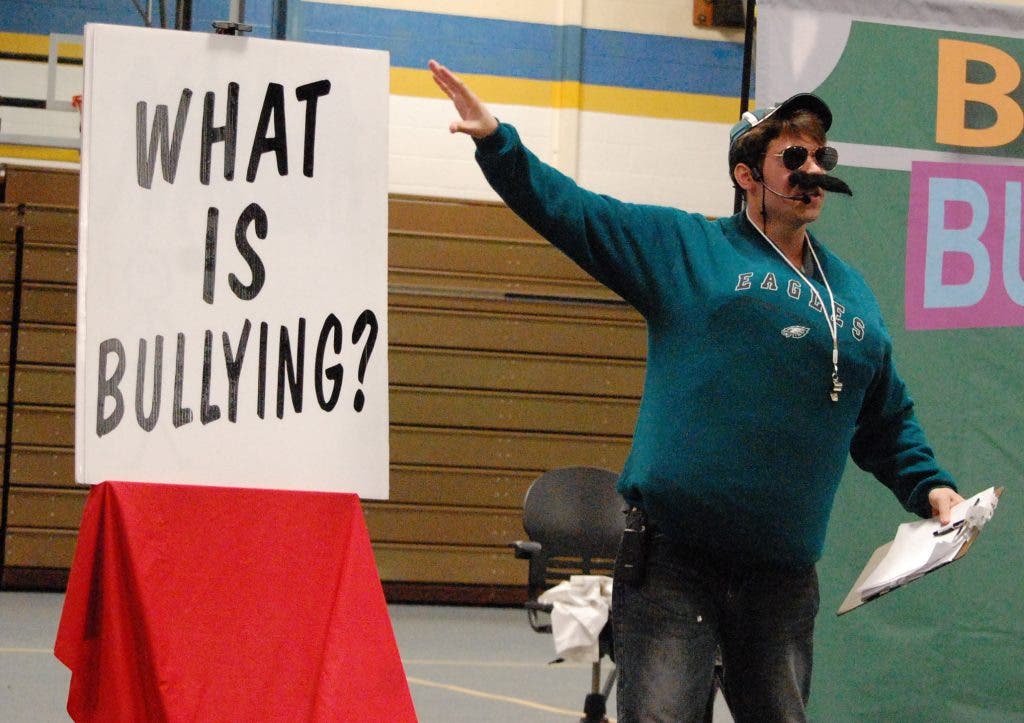
Through role-playing and comedy, the duo — performing as cousins Tom and Jerry — drive home messages about bullying throughout their roughly 30-minute show.
Rubenstein said the inspiration for the project was an experience he had as a teacher. A student committed suicide in the district where he worked, and instead of addressing the situation and the issues surrounding it head on, the district kept it under wraps, he said.
In 2008, he reached out to Redebaugh — the pair attended Penn State together — with the idea for Box Out Bullying, and within a year the duo was traveling the country, bringing their anti-bullying message to students from elementary age through middle school.
“No matter where you go, all the issues are the same, as are the solutions,” Rubenstein said. “Whether you’re in Harlem or Lancaster, Pa., the issues are the same.”
During the program, Tom – played by Rubenstein – displays the characteristics of a bully in his approach to opening a trunk. They define the types of bullying that take place: direct bullying, where a student is physically touched; indirect bullying, where the bully uses hurtful words – name-calling, mean comments about someone’s appearance, spreading mean rumors – to harass another student; and cyberbullying, where the words and actions take place on the Internet or through texting or other uses of the cell phone.
“Despite what we’ve always been told about sticks and stones, words really do hurt,” Redebaugh told the students. “Ignoring name-calling doesn’t make it hurt any less.”
The students are asked to give the trunk a name – the Manchester middle schoolers named it Patrick – and personalizing it helps drive home the idea of how Tom’s actions, directed at a person, could be hurtful. Eventually, through the power of positive actions, the box magically opens, and Tom and Jerry drive home their key messages one more time:
- Don’t be a bully.
- Help those who are being bullied
- Include all students, especially those who are being left out, to short-circuit bullyin
- Tell an adult – a parent, a teacher, someone you trust – if you witness bullying
One of the primary goals, Rubenstein said, is to empower the bystanders, because they can make the biggest difference. But the program also makes students stop and think about their own actions.
“A lot of times students don’t realize what they’re doing is hurtful,” said Nancy Driber, principal. The program is just one piece of the proactive approach they take at school, she said. There is a daily announcement that reminds the students about treating others with respect.
Lesson plans that accompany the Box Out Bullying program, which Driber noted was paid for by the school’s Parent Teacher Association, help keep the messages fresh in the students’ minds as well, which is important because the challenges – and the opportunities for bullying – have increased greatly in the age of cell phones and Facebook.
Diane Pedroza, principal at , said the program’s message, of creating and building empathy for others and promoting an inclusive school culture was important.
“It was an interactive and entertaining program and a good way to support our current program (called Second Step and Steps to Respect) included in our health lessons to create a peaceful and safe school community,” she said.
“I thought it was terrific,” said Marjorie Stevens, principal at . “The students started to use the ideas and suggestions right away. We are utilizing the lesson plans that were sent to each of the schools to reinforce the message. In addition, our guidance counselor has been into each of the classrooms to teach a lesson on respect.”
“The Box Out Bullying was a great tie-in to our other programs and we are most grateful to the PTA for bringing it into the schools,” Stevens said.
“Feeling safe in school is your right,” Redebaugh told the students.
“This is a celebration, not a lecture,” said Rubenstein, whose interest in the topic has him conducting research on bullying. “We want them to know that together, we can make a difference.”
For more information on the Box Out Bullying program, go to www.boxoutbullying.com.