Schools
Holocaust Survivor Brings History to Jefferson School
Marion Blumenthal Lazan addressed Maplewood and South Orange fifth graders
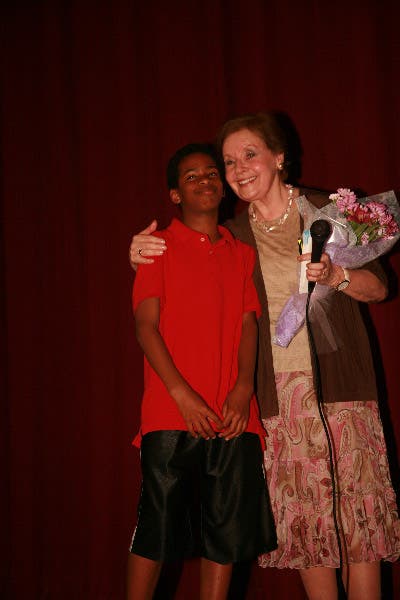


When Marion Blumenthal Lazan was 10, she lived in a concentration camp. Instead of Silly Bandz, she collected pebbles and used them to represent her family members, hoping they were still alive and that one day she would reconcile with them.
Blumenthal Lazan shared her story with fifth-graders from Jefferson School, Clinton School and South Mountain School and read to the students from her children's book, Four Perfect Pebbles: A Holocaust Story.
Blumenthal Lazan held her audience of mostly 10-year-olds spellbound as she chronicled her experiences, beginning with arriving at the Westerbork refugee camp in Holland when she was four years old. Six years later, Blumenthal Lazan arrived at the German concentration camp of Bergen-Belsen (where Anne Frank died). She described, matter-of-factly, how Hitler rose to power and how, along with her older brother Albert and their parents, she was swept up in the threatening veil of Nazism that left her family trapped in wartime Germany.
Though Blumenthal Lazan's family was one of the first to move into Westerbork in 1939, where they could live together as a family in a barracks that resembled a little house, by 1940, Germany had invaded Holland and life in the work camp became crowded and food scarce.
From her memoir, Blumenthal Lazan read, "Dutch Jews from all over Holland were rounded up by the thousands and brought in to be processed. Some stayed only a few days; others remained for months. None had any control over his or her fate."
Westerbork was turned into a transit camp as many Jews waited to be deported to the various death camps in Germany or eastern Europe. She recalled that her mother said she knew it was just a matter of time for them.
In her book, Blumenthal Lazan recalled her mother's words, "Even the very worst conditions at Westerbork were a heaven by comparison. For Bergen-Belsen was hell. The only way we managed to survive in those early months of 1944—cold, hungry, and completely degraded—was on hope."
Describing to the students her days at Bergen-Belsen, Blumenthal Lazan went through a checklist of everyday life: dysentery leading to dehydration, filth, foul odor, lice and its spread of typhus. She spoke of her survival technique, her belief that finding four pebbles of similar shape and size would give her the hope that all four members of her family would survive.
Find out what's happening in Maplewoodfor free with the latest updates from Patch.
Her story resonated with the fifth-graders, as Blumenthal Lazan pointed out she was their age during World War II. Blumenthal Lazan had also autographed her book for students who had purchased them during the June 2 talk.