Arts & Entertainment
Patch Profiles Adam Rudolph, Percussionist Par Excellence
Insights into the mechanics of vibration, inspiration and creation.
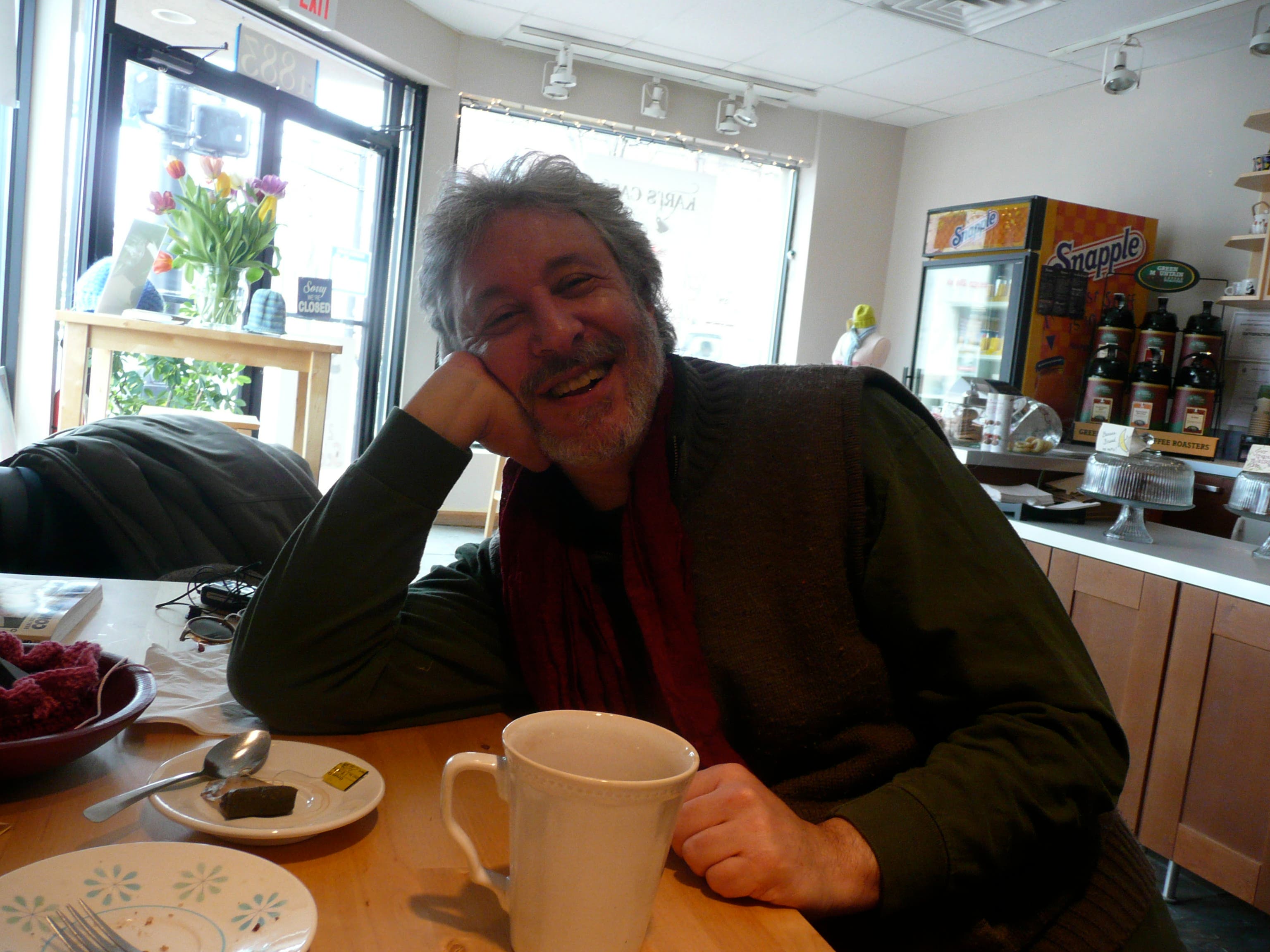

Adam Rudolph moved to Maplewood a couple of years ago from Venice, California with his wife, the artist Nancy Jackson. His grown daughter, Hannah Rudolph, lives in Austin, Texas.
His new CD YeYi, A Wordless Psalm of Prototypical Vibrations, is being released next month by Meta Records. Upcoming performances include Roulette NYC, March 8, 15, 22 and 29; Puffin Foundation, Teaneck, NJ, April 3; and (le) Poisson Rouge, April 10.
Tell me about yourself: I was born in Hyde Park, Illinois—about a half-block away from Barack Obama's current house. [Editor's Note: Pretty sure Barack Obama's current house is 1600 Pennsylvania Avenue, Washington, DC, but we know what Rudolph means.] My mother was a social worker and stay-at-home mom and my dad was accountant who was an intense music lover. My family always encouraged and supported me. I was the oldest of three brothers. My middle brother is Associate Dean of Stanford Business School and youngest brother is a radio astronomer/astro-physicist in southern California.
Find out what's happening in Maplewoodfor free with the latest updates from Patch.
Were you always musical? I took classical piano lessons as a kid. My teacher was nice, but I was always composing my own pieces. By the time I was thirteen or fourteen, I was regularly going to The Point, an outdoor gathering place where a lot of people played. I learned that street drumming came naturally to me. I was good at it and so got more and more involved.
I attended the high school at University of Chicago Lab School and later designed my own major, ethnomusicology, at Oberlin College. It was a way to study everything that was relevant to me. Music comes from something that's greater than music and can be about something that is greater than music.
Find out what's happening in Maplewoodfor free with the latest updates from Patch.
So what was it like being musically inclined and growing up in Chicago? Hyde Park in the 1960s was an incredible cultural center for Chicago. I got to hear great musicians such as Muddy Waters, Howlin' Wolf, Otis Spann. I saw how a musician's instrument can serve deep feelings.
What is your connection with Africa? When I finished Oberlin, I drove a Chicago cab to earn money and in 1977 went to Ghana West Africa. Things were different then. It took me two weeks to be able to schedule a phone call back home to let them know I arrived safely.
There I was in Ghana studying music. I learned about how music can function in different ways: for healing, for psychological transformation, for harvesting, for birth, for adult transitions and for funerals. In Africa, music was not just presented in formal concerts like in the West.
Who were some of your influences? I came to know Foday Musa Suso. We met in Gambia and he and I came back and started a group called Mandingo Griot Society. This was well before Paul Simon combined African and jazz rhythms with traditional Mandingo Core music. We put out recordings and toured all over the U.S.
Most people hadn't heard African music live. We invited the great, world-music and jazz innovator Don Cherry to play on our record. Cherry invited me to tour and live in Europe with him in Sweden.This was about in 1978. That's when I became serious about composing—when I living there. Cherry encouraged me to start writing. It's when I went on my first tours. Since then, I've given hundreds of concerts all over the world.
What does music mean to you? Music can be transformative. I'm not just interested in playing music—I'm interested in playing music that's not about just music. I want to express something, something that appeals to your sense of your own aboriginalness, experience, insights.
I'm a post-binary composer. I create formats for improvisation. I generate forms in a macrocosm, in an improv setting. For example, what is a topic we're going to talk about now? Yoga? That's the macrocosm. The microelement is in the actual improv dialog. It requires an advanced sense of how to listen and an evolved imagination. My interest lies in composing in the moment versus writing compositions that can be played.
Tell me about your creative process, your inspirations. Inspiration is a mystery. The practice is to be aware and awake. Then everything can be something, whether it's coming in from the outside or coming up from your own unconscious and intuition. Creation is all about the cultivation of the imagination. Is it beamed down from the cosmos or does it rise up from the oceanic depths of the unconscious? It's important to be open to it when it comes. And to cultivate and honor it when it comes. That doesn't preclude studiousness though.
In creativity, when you have an idea, you need to develop technique so you can have freedom of expression. If something comes to me that I can't play—I invent it. I'm an autodidact.
Music is really the most transcendent of the arts, it exists in the realm of vibration. Really looking and really listening, deep listening, is important. When you move past style in music into the essential elements, it's a door to freedom. The same elements exist in the abstract–color, form, motion texture, balance, tension and release, sound and silence, emptiness. I get inspiration from other art forms as well as nature–trees, human nature, how people walk and talk, how leaves wave, smells.
And what about vibration? Music is ultimately about vibration. The reason that music is so powerful is that we ourselves are vibration. Physicists know that everything is vibrating at different rates. A table appears solid but it's not. Music is an alchemy that affects us powerfully because it affects what we are ourselves.
The vibration manifests as a duality: sound and motion. We experience music temporally—it moves through time. Sound has to do with the overtone series. Everything from melody to harmony.
And where does yoga enter your equation? Yoga is the unity of mind, body and spirit. It relates to what I learned from my Tabla drumming teacher, Pundit Taranto Rae in India. I studied with him for twenty years. Music is a form of yoga.
I've been practicing Hatha since 1975. I think about my music in that way. The connection is breath. It all comes from the idea of breath. Through intention to action: moving into a yoga pose or striking a drum with my hand, or conducting an orchestra or placing finger to keyboard.
What do you think of Maplewood's yoga scene? Shakti has been a center to connect with people on certain wavelengths. It's so supportive and relaxed. I love it there. Anna Winkler is the greatest and best yoga teacher I've ever had.
You currently work with three different music groups. I conduct Go: Organic Orchestra. It's a Core of deconstructed, pure-musical elements with 42 performers. I teach its concept around the world. Moving Pictures is my mid-size ensemble. It varies between a quintet and octet and I both play and conduct. Hu Vibrational is a percussion trio geared toward ostinatos of circularity. Steven Reich was influenced by this and also Sly And The Family Stone and James Brown. It's moving in circles related to experience. When African-based patterns go around and around it becomes a "call" to enter the moment of community and transcendence.
Tell me a story about being in Africa. I was twenty-one when I first arrived in Ghana. My first week there I met a drummer, who took me to a Tigiri meeting. That's a spiritual cult. One thing that struck me was that everyone, kids and chickens too, was running around. Then suddenly the most intense drumming began, then sacrifices, then people going into trances.
I'd seen some things in Baptist churches in Chicago but nothing like this. There was no official beginning, just all of a sudden they're tapping on the drums and then twenty to thirty people are in heavy trances—purely from the music and songs and dancing. The drumming was designed; evolved over the centuries. The rhythms, overtones and patterns called socially agreed-upon psychological entities down. Everyone knows who is possessed by which spirits.The upshot was that I started to cry, not because I was sad but because it was so powerful. I attended these meetings every week for the rest of my time in Africa.