Neighbor News
Don't Leave Pets In Hot Cars!
Reasons why it's never a good idea to leave your pet unattended in a vehicle.
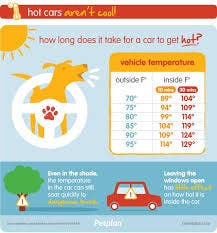
Now that the hot weather is here (finally!), we know that it is tempting to bring pets along for the ride on a nice day; it gets them out of the house and it’s fun, since many pets (probably with the exception of cats) enjoy car rides. Remember, though, that leaving your pet sitting in a parked car on a warm day, even in the shade and even if it’s only for a few minutes, can result in serious illness or death.
Never leave pets unattended in a vehicle. This is not simply an admonition coming from animal lovers; this is the law here in Matawan (as well as in the State of New Jersey; see N.J.S.A. 4:22-26). Matawan Borough Ordinance 15-15 was amended in 2015 to include the following language: “No animal shall be left unattended in a motor vehicle without sufficient airflow or under extreme heat conditions (70 or more degrees on a sunny day and/or more than 84 degrees inside the vehicle) as to render the animal susceptible to heat prostration or any other adverse condition that would be caused by said behavior, including death.” (View the entire ordinance here: http://www.matawanborough.com/matawan/Your%20GOVERNMENT/Public%20Notices/Public%20Notice%20Archive/O1515%201st%20Publication.pdf?1464183541 )
The American Veterinary Medical Association estimates that hundreds of pets die from heat exhaustion every year due to being left in parked vehicles (https://www.avma.org/public/PetCare/Pages/pets-in-vehicles.aspx). Even if you think you will be gone for only 10 minutes, on a 70 degree day the inside temperature of a car can reach 89 degrees; on an 80 degree day, the interior temperature can be as high as 99 degrees. No matter what the outside temperature is, the temperature inside the vehicle can rise almost 20 degrees in 10 minutes.
Find out what's happening in Matawan-Aberdeenfor free with the latest updates from Patch.
Unlike people, dogs and cats can’t sweat through their skin; in extreme heat, their fur acts like an added layer of insulation, trapping heat. They cool off by panting to dissipate heat from within the body, or by lying on a cool surface such as tile (https://www.washingtonpost.com/national/health-science/dogs-and-cats-can-usually-deal-with-the-heat-but-their-owners-must-be-careful/2012/07/09/gJQAlOqtYW_story.html). The enclosed or semi-enclosed interior of a vehicle on a warm day qualifies as “extreme” for a fur-bearing animal, and certainly does not provide a cool surface on which to lie. Leaving a bowl of water in the vehicle is not enough.
The normal body temperature for a dog or cat is around 101.5 degrees. Pets can “…succumb to heat stroke when [the] body’s core temperature rises excessively – typically to 105° Fahrenheit or higher” (https://www.petfinder.com/dogs/dog-health/banfield-heatstroke-dog-cat/ ). When their core temperature rises rapidly, as in a hot vehicle, cats and dogs are unable to cool themselves sufficiently, leading to possibly fatal complications of heat stroke that include seizures, organ failure and clotting problems.
Find out what's happening in Matawan-Aberdeenfor free with the latest updates from Patch.
Cracking the window(s) has little effect on a vehicle’s interior temperature. A study published in the Journal of the Louisiana State Medical Society, Volume 147(12) 1995, concluded that …"cracking" the windows enough to let in air…[was] demonstrated to be ineffective”, and stated, “As in other studies, we found that "cracking" the windows is an ineffective attempt to keep the car interior at an acceptable temperature” (http://www.injuryprevention.org/states/la/hotcars/hotcars.htm).
Initial symptoms of heat stroke are excessive panting, salivating and discomfort; further symptoms include vomiting or diarrhea, becoming disoriented or seizures (https://www.petfinder.com/dogs/dog-health/banfield-heatstroke-dog-cat/ ). If you see an animal in distress in an unattended vehicle, many sources recommend calling 911 immediately. The Humane Society of the United States recommends the following additional steps:
- Take down the car's make, model and license-plate number.
- If there are businesses nearby, notify their managers or security guards and ask them to make an announcement to find the car's owner. (http://www.humanesociety.org/animals/resources/tips/help-dog-in-hot-car.html?referrer=https://www.google.com/) (Ideally, this should be done if there is someone who can remain with the vehicle.)
In an effort to crack down on people leaving pets in hot vehicles, the last several summers the New Jersey SPCA conducted roving patrols along the Jersey shore, looking for animals in distress left unattended in vehicles (http://www.nj.com/ocean/index.ssf/2015/07/roving_shore_patrols_will_arrest_non-nj_residents_who_leave_dogs_in_hot_cars.html). According to Captain Rick Yocum of the NJSPCA, an average of six summonses per day were issued in previous years. Fines range from $250 to 1000.
Two states have “good Samaritan” laws that allow private citizens to take matters into their own hands; to date, New Jersey is not one of them, i.e. although NJ State law prohibits leaving an animal unattended in a hot vehicle, it does not allow for a citizen to break into that vehicle to free the animal (http://aldf.org/cases-campaigns/action-alerts/dogs-in-hot-cars/overview-of-state-laws-leaving-unattended-animals-in-vehicles/). However, according to the Animal Legal Defense Fund, these types of laws “…are becoming more prevalent” around the country, and as more people become aware of the danger posed to an animal left unattended in a hot car, the more likely it is that a concerned citizen can alert the authorities to an animal in distress before it is too late.