Business & Tech
Millburn-Short Hills Company Helps People Go Solar
Geoscape Solar is helping solar energy become mainstream throughout the area.
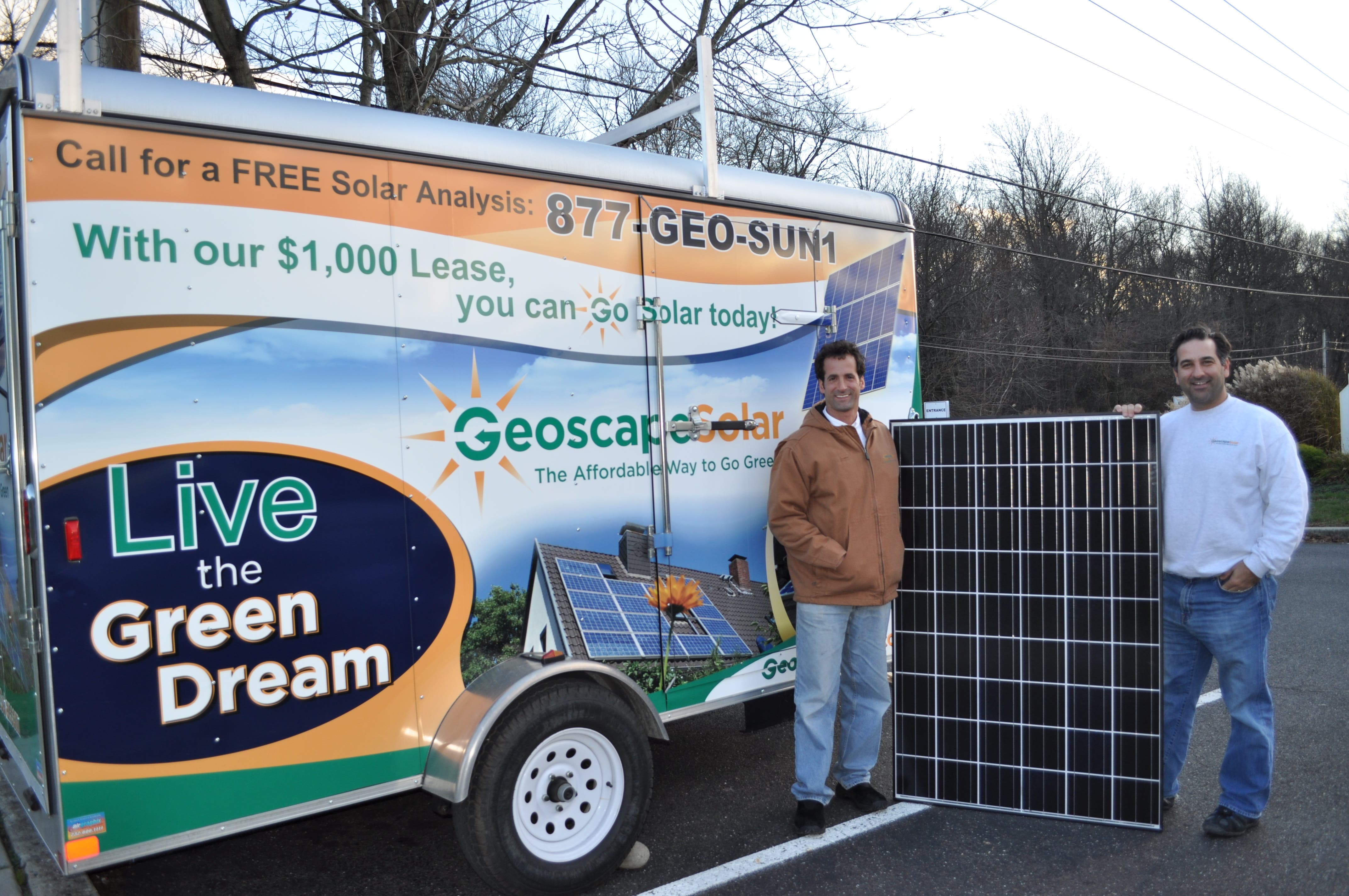


Years ago solar panels were large, obtrusive structures placed on rooftop stilts. They stood out like a sore thumb. Today as everything "green" becomes increasingly mainstream and the aesthetics continuously improve, solar panels are growing in popularity.
"I think it looks so cool," said Fawn Gargano, of Cape May County. "It gives a modern look to my house."
"I think of solar panels like the first freezers," said Jeff Chavkin, co-founder and president of Geoscape Solar, the Millburn-Short Hills company that installed Gargano's solar system.
Find out what's happening in Millburn-Short Hillsfor free with the latest updates from Patch.
"Everyone had the block of ice delivered. Then someone got a freezer, and you were the strange one on the block if you had it. But then the government starting saying 'blocks of ice are not cost effective,' and suddenly everyone was looking at the freezer saying, 'Wow, that's pretty neat.' Then the prices start coming down. Then the government starts paying you to put in a freezer, and everyone wants one. That's what's going on now with solar."
Gargano likens solar panels to another piece of technology that was once scoffed-at; to something that everyone now carries around religiously.
Find out what's happening in Millburn-Short Hillsfor free with the latest updates from Patch.
"I knew it was the way to go, like cell phones before anyone had them," she said.
The preconceived notions of solar are disappearing. The panels have become so popular, Chavkin added, his customers throw parties to show off their new energy-efficiency.
Chavkin and Mike Boches started the company in 2008, at a time when the government was offering major incentives to install solar energy.
"We decided we wanted to do something different, something that gives back," Chavkin said. "I used to sell donuts for Little League. My kids sell CFL light bulbs. It's a different world."
Geoscape works with residential and commercial clients. The average residential solar energy system costs about $50,000, including installation. It is a hefty investment, but one that will pay itself back in five and a half to six years.
The company makes going solar seem like a no-brainer. "We make solar simple and affordable. You make money. Together, we help save the planet," the website states.
How do you make money? The obvious way is by vastly decreasing, or entirely eliminating, your monthly energy bills. Customers also profit by net-metering—selling unused solar power back to the power companies.
"First you use your solar power during the day to meet your own needs. Any excess electricity you generate actually spins your meter backwards so you never waste your solar energy production. At night and on cloudy days when you are not producing as much electricity, you draw energy back from the utility company, just as you do now," the site explains.
The second income source is through the Solar Renewable Energy Certificates (SREC). Chavkin said for every 1,000 kilowatt hours of electricity your system produces, you receive one SREC. Power companies that sell their electricity in New Jersey have to buy SRECs (usually from brokers who buy them from solar system owners) to comply with the state's renewable portfolio standards ("RPS"). By the year 2025, at least 2.5 percent of energy must be from solar. Currently, solar accounts for about 0.1 percent of New Jersey's electricity production.
The Green Dream Team said they want to change the energy landscape, one house at a time. The first step is a free solar analysis, during which they explain the solar energy process and how it works for each customer. They do this by looking at satellite images and a year's worth of energy bills.
After determining if your house is viable for solar energy, the second step is to perform a detailed site analysis or inspection. It costs $300 and usually is completed within a week or two of the initial phone call.
Finally, customers decide whether to lease or buy the system. The company works with customers to find creative ways of funding.
They were the first company in the state to offer a leasing program, creating a more affordable option for customers who are not completely ready—or able—to commit to solar energy. Gargano is among the customers who chose the leasing option. She said her monthly payment is less than her former average monthly electric bill.
In the past, the company has been able to promise customers government incentives to help cover more than half the cost of the installation.
In New Jersey, the NJ Renewable Energy Incentive Program (REIP) initially offered a rebate of $1.75 per watt used, which covered about 20-25 percent of the system cost. In its second funding cycle for 2010, REIP rebates were reduced to $1.35 per watt for residential systems. The program was closed after receiving 1,000 applications in the first 10 days. The third cycle is planned to open in September 2010, and funding levels have not been announced.
Geoscape encourages clients to move forward with solar plans rather than wait for the rebate to be announced. In the six to eight months it will delay the project, you will have already started paying off the system, Chavkin said.
A federal tax credit, for residential and commercial customers, is in place through 2016. A tax grant program for commercial customers is scheduled to expire at the end of this year, unless it is renewed by Congress.
Several utility companies—including PSE&G, JCP&L, Atlantic City Electric and Rockland Electric—offer solar financing programs to customers within their territories.
Despite the cutbacks in incentives, Geoscape continues to see applications and inquiries rolling in. Unfortunately, not all houses are candidates for solar energy.
The biggest roadblock is shading. Chavkin's own house is not a candidate for solar energy because the forest behind his property sheds too much shade on his roof.
"I just had to turn down eight of ten customers in Short Hills because of too much shading. I'm not going to ask someone to cut down his favorite tree. And to cut down 10 trees, it wouldn't make sense."
Technologically, solar energy has not changed drastically over the years: efficiency has increased just five percent over 30 years. The difference today is awareness.
"Two years ago, it was just a concept. Now most people know someone who has looked into it. It is becoming a little more fore front."
Greater awareness coupled with government incentives has encouraged more companies to enter the solar arena. "This is on the good side for clients," said Chavkin. "They can hear competitive quotes. I've never quoted anyone who hasn't talked to another company."
When choosing a company, customers are embarking on a long-term relationship. Geoscape offers a 5-year bumper-to-bumper warranty, with specific component warranties ranging from 10 to 25 years.
While Geoscape Solar often has to turn away customers in this area due to shading issues, Chavkin encourages everyone to request the free analysis. The more people who do, the more the power source will become mainstream.
"That's the whole idea in our industry, to get it mainstream," he said. "In 10 years, 50 percent of every house that can have solar will have solar. It just makes sense."