Schools
How Do YOUR Kids Study???
Are distractions — including texting, Facebook, and downloading music — part of your child's homework routine?

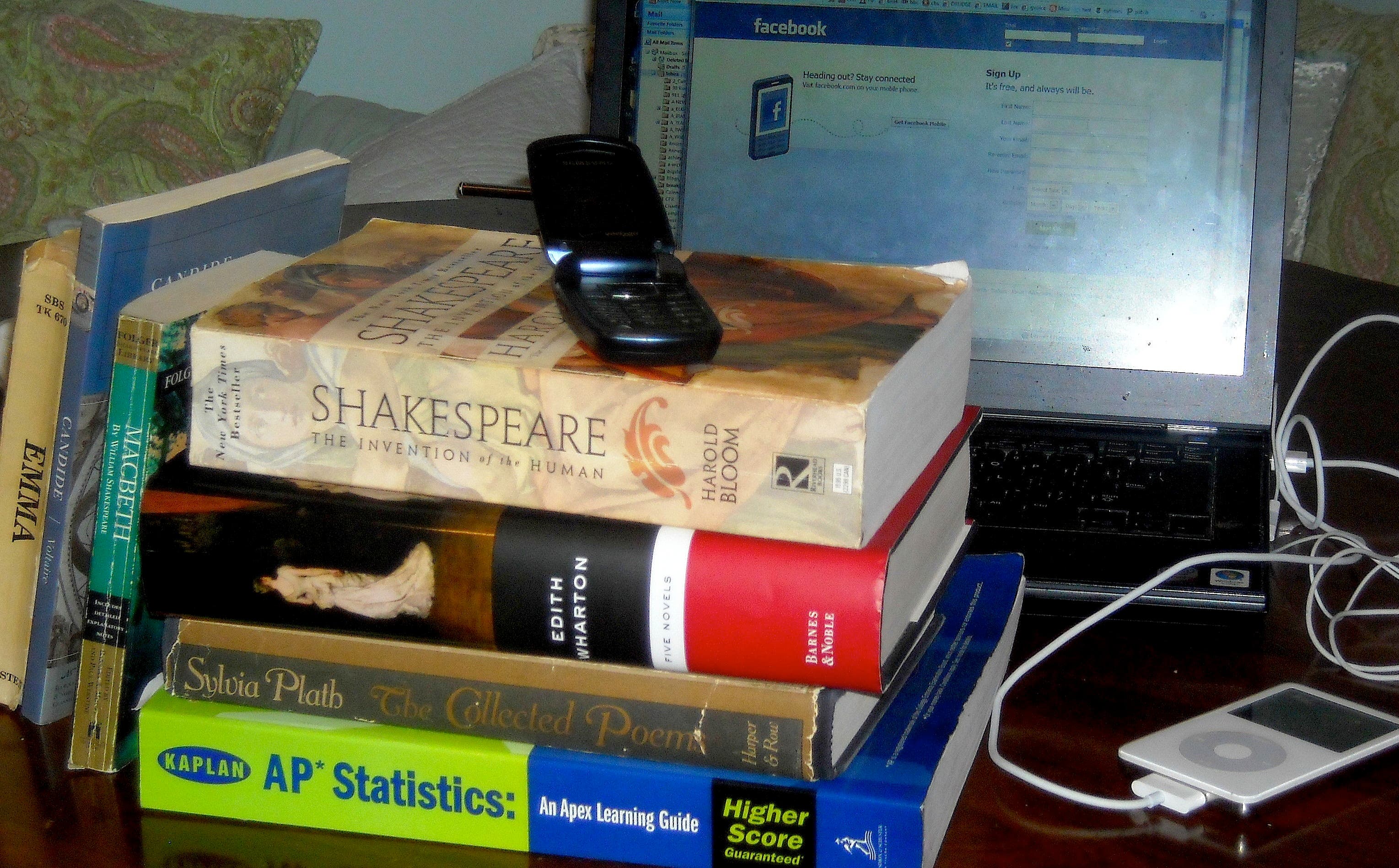
When left to their own devices, most kids today prefer the following homework preparation:
iPod Earbuds In — Yes.
Facebook Page Up: Of Course.
Find out what's happening in Montclairfor free with the latest updates from Patch.
IM Pop-Ups: Operative.
TV On: Check.
Find out what's happening in Montclairfor free with the latest updates from Patch.
After-School Snack Ready —Yup.
Cell Phone On: DUH!
Sound familiar?
The good news is, kids today are becoming efficient multi-taskers. The bad news is, they're driving their parents crazy.
Parents, after all, were raised to believe that kids learn best in a quiet room free of distractions. So watching their kids try to memorize scientific data while simultaneously "facebooking" friends can be irritating and unnerving. After all, a child's academic success can be credited (at least partially) to an organized, clutter-free work environment. Right?
Wrong, says a recent New York Times article entitled, "Forget what You Know About Good Study Habits." The Times states, "Psychologists have discovered that some of the most hallowed advice on study habits is flat wrong."
The article goes on to say that, perhaps surprisingly, students in a scientific study were able to memorize and retain information better in a messy, chaotic environment than in a tidy, organized one. Dr. Robert A. Bjork, UCLA psychologist and author of the study explained, "When the outside context is varied, the information is enriched, and this slows down forgetting."
But wait! This contradicts everything parents knew — or thought they knew — about kids' study habits.
"You can always find tons of data saying that students should have a quiet space, free from distractions etc., etc., etc.," says Deborah Grasso, math instructor at Renaissance Middle School. But "in this tech age, there are so many MORE distractions! . . . how do you stop them from texting and Facebook? It is just too easy for them to take out a multi-function phone — use the calculator application — and end up being sidetracked, texting, or chatting away."
Deborah Maher, a Language Arts teacher at Glenfield Middle School, concurs. "My own sons, many of my middle school students, and many of my college students would tell you that they absorb and retain new content best when listening to music, IM-ing their friends, and perusing Facebook, all at the same time. Go figure!"
One Montclair teenager, who preferred not to be named, explained it from a kid's point of view. "Facebook is bad (for concentration) because too many alerts come up. Music is good because it helps block out external noise. Texting is good because, while you're waiting for a reply, you can get in a good two minutes of work," he says cheerfully. (It's possible that parents won't feel reassured by this.) "Sometimes I just wander off when I'm doing homework, but when I listen to music I feel like I don't need to leave."
Maher feels that a student who understands what works best for him/her, even if it's unconventional, will be able to develop successful study habits. Studying amidst distractions is, she says, "an acceptable way to do homework, given that the student understands the learning priority and is cognizant of what process/environment works successfully for them."
Just as the subjects in the UCLA study did, some Montclair parents reported that their children study best in varied environments. These parents don't mind a computer at the kitchen table or papers strewn across the living room rug, as long as the homework gets done.
"One of my children does her written homework best in the dining room, where she is near other people," says a Glenfield/Hillside parent of two. "She studies for tests in her room. My other child does a combination of working at his desk and working in the kitchen on longer projects."
Susan Thomas, another Montclair parent, says, "I would concur that the location (for doing homework) need not be the same. The more important factors from my point of view are the ability to concentrate and to get in the habit of regularly doing homework at productive times for your household's schedule."
Chances are, your kids can't operate three electronic devices while memorizing the Pythagorean theory (though they'll try to convince you they can) so you may have to make the call as to whether they're allowed to study with the TV, Facebook, and cell phone on. An article on study skills from education.com advises: "Keep in mind that every child is different, and there is no perfect equation for study skills success that will fit them all equally. Know your child's needs, goals and temperament. Discuss expectations, but instead of threatening or bargaining, consider helping her to initiate a pattern that is both individualized and efficient."
In other words, with all the modern gadgets available to kids these days, there seems to be no greater invention than a sensible parent.
Get more local news delivered straight to your inbox. Sign up for free Patch newsletters and alerts.