Health & Fitness
Montclair Releases Latest Water Quality Report: See Test Results
Where does Montclair get its drinking water from? Find out here.


MONTCLAIR, NJ — The Montclair Water Bureau released the township’s latest water quality report earlier this week, noting that no violations of contaminant levels were found.
The 2022 report – which covers testing done between Jan. 1 and Dec. 31 – can be seen online here.
Where does Montclair get its water from? According to municipal officials:
Find out what's happening in Montclairfor free with the latest updates from Patch.
“The Township of Montclair and the Borough of Glen Ridge obtain their water from the North Jersey District Water Supply Commission (NJDWSC). The Township of Montclair and the Borough of Glen Ridge are partners in the NJDWSC, which owns and operates the 29.6 billion-gallon Wanaque Reservoir and Treatment Plant and the seven-billion-gallon Monksville Reservoir. The Borough of Glen Ridge has three interconnections with Montclair through which it receives its water supply. The water is received by the Township of Montclair through its Grove Street pumping station and is pumped throughout Montclair. The Montclair system also includes three municipal wells, one in each of the three pressure zones.”
The water bureau noted that Glenfield Well and Lorraine Well will run in the Spring/Summer of 2023 with carbon absorbers. Meanwhile, Rand Well will be updated with carbon absorbers in the near future.
No wells will operate without carbon treatment, the Montclair Water Bureau stated.
Find out what's happening in Montclairfor free with the latest updates from Patch.
“Our water is monitored for many different kinds of substances on a very strict sampling schedule, and the water we deliver must meet specific health standards,” the bureau wrote in this year’s report.
“Here, we only show those substances that were detected in our water (a complete list of all our analytical results is available upon request),” the bureau continued, discussing last year’s test results. “Remember that detecting a substance does not mean the water is unsafe to drink; our goal is to keep all detects below their respective maximum allowed levels.”
The Montclair Water Bureau noted that although E. coli was detected, the water system is not in violation of the E. coli maximum contaminant level.
MONTCLAIR SOURCE WATER ASSESSMENT
Federal law requires each state to establish and implement a Source Water Assessment Program. The New Jersey Department of Environmental Protection (NJDEP) completed Source Water Assessment Reports and Summaries for all public water systems in 2004.
“It is important to note, if a drinking water source’s susceptibility is high, it does not necessarily mean the drinking water is contaminated,” the NJDEP states. “The rating reflects the potential for contamination of source water, not the existence of contamination.”
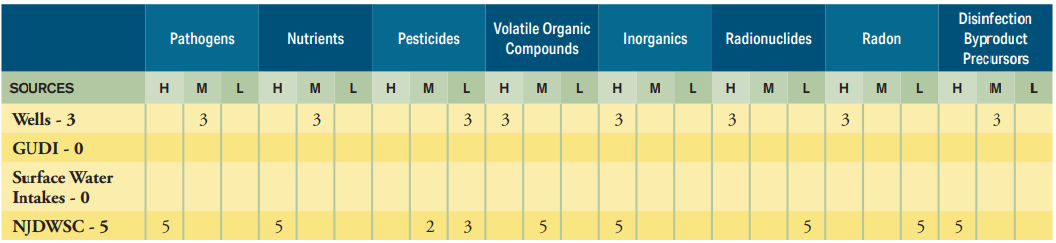
Montclair’s source water assessment was included in this year’s quality report. It included “susceptibility ratings” for seven categories of contaminants and radon. The table provides the number of wells and intakes that rated high (H), medium (M), or low (L) for each contaminant category.
For Montclair, only its three municipal wells were assessed, which is why each contaminant has a “3” below it falling under the (H) (M) or (L).
“The [North Jersey District Water Supply Commission] has five source water intakes that were assessed,” the Montclair Water Bureau told Patch. “The only value that differs on their assessment is ‘Pesticides.’ This is because geographically, two of the source water intakes are at medium risk for contamination, while the other three intakes are at low risk for contamination.”
Send local news tips and correction requests to eric.kiefer@patch.com. Learn more about advertising on Patch here. Find out how to post announcements or events to your local Patch site. Don’t forget to visit the Patch Montclair Facebook page.
Get more local news delivered straight to your inbox. Sign up for free Patch newsletters and alerts.