Community Corner
Montclair Synagogue Learns About Civil Rights In Alabama
Members of Bnai Keshet in Montclair travelled to Montgomery, Alabama for some eye-opening lessons on the civil rights movement.


MONTCLAIR, NJ — The following news release comes courtesy of Bnai Keshet. Learn more about posting announcements or events to your local Patch site.
Members of Bnai Keshet in Montclair, NJ, travelled to Montgomery, Alabama Thursday through Sunday, Nov. 7-10 to into the heart of the American Slave trade, the city where a group led by civil rights lawyer Bryan Stevenson created the Equal Justice Institute, the Legacy Museum: From Enslavement to Mass Incarceration, and the National Memorial for Peace and Justice, a lynching memorial.
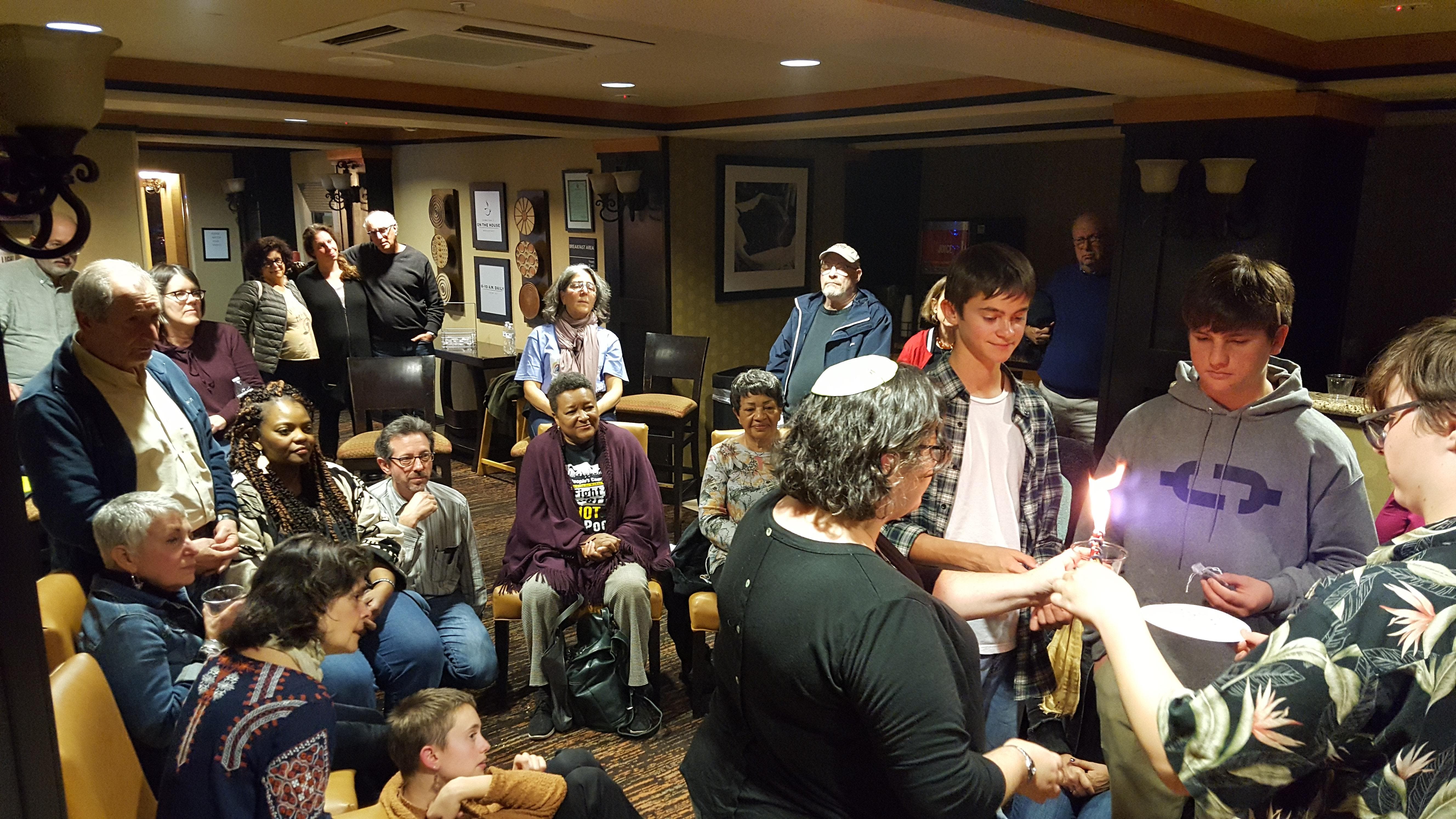
The group--43 adults and teens, Jews and friends—spent much of the last year preparing in study groups, doing community-building exercises, reading Jewish texts and sermons on slavery, mass Incarceration and the role of Jews in southern slavery, and listening to guest speakers including Tanya Coke, the Ford Foundation’s gender, racial, and ethnic justice director, and Randy Susskind, Equal Justice Institute’s deputy director.
Find out what's happening in Montclairfor free with the latest updates from Patch.
The group spent two full days immersed in realities of the history of slavery, lynchings, civil rights struggles and mass incarceration. They had an engaging local tour guide their first day who grew up in a family of civil rights heroes from Montgomery and spoke from deep personal experience, and devoted their second day to taking in EJI’s Legacy Museum and lynching memorial.
“I left the museum and memorial, as did so many from our group, believing in the power of learning from these profound heart-opening spaces and wondering if this presentation of the material might finally offer a method, an opening for all who are willing to truly learn this history”, Bnai Keshet member Yael Silverberg-Urian observes in her written account of the experience.
Find out what's happening in Montclairfor free with the latest updates from Patch.
As the group gathered upon arriving in Montgomery Thursday, Bnai Keshet Rabbi Ariann Weitzman reminded everyone to “center our experience through a Jewish lens, examine the legacy of slavery in our texts, and promote the work of turning history into communal memory” says Silverberg-Urian.
Montgomery entrepreneur Michelle Browder, who runs More Than Tours gave her New Jersey travelers a civil rights tour of Alabama’s rich history as the cradle of the confederacy where the Civil Rights Movement began. At lunch, she introduced everyone to her father, the first African American minister named to Alabama’s prison system more than 40 years ago by then-Gov. George Wallace. She also talked about Aurelia Browder, her aunt, the first named plaintiff in Browder vs. Gayle, a 1956 federal appeals ruling that declared segregated public busing unconstitutional, and ended the bus boycott.
“Michelle and her father spoke about the bridge between slavery and present day mass incarceration of men and women of color with penetrating truths,” Silverberg-Urian says.
The second full day fell on the 81stanniversary of Kristallnacht, a fitting context for taking in the sobering truths displayed at EJI’s museum and lynching memorial, immersed in narratives and rarely seen first-person accounts depicting the legacy of genocide, slavery, lynching, and racial segregation across generations. Silverberg-Urian said the impact of the first-person accounts holds great promise for being a “profoundly emotional teaching tool”.
“We were moving through individual histories that wove together a fabric of terror and dehumanization from slavery, reconstruction, Jim Crow and mass incarceration,” Silverberg-Urian says. “I was laid bare to hear the spirituals from a caged woman and the cries of two children calling fearfully, ‘Mama? Mama?’”
The lynching memorial, 800 six-foot monuments symbolizing thousands of lynching victims and the counties and states where they were terrorized, was deeply moving, Silverberg-Urian said, and the group from Bnai Keshet, recited the Mourners Kaddish on the grounds. Two EJI staffers explained that the memorial’s use of sculpture, art and design was meant to contextualize racial terror. “It’s the most comprehensive collection of names of men, women and children lynched in the U.S.,” Silverberg-Urian says.
Their final stop was to chat with three women from Alabama’s Poor People’s Campaign about current issues, then they headed back North. Silverberg-Urian says though they mourned the abuses and violations perpetrated by white Americans, the group was energized by the trip. “It is incomprehensible that humans can treat anything living with such brutality,” she says. “But we’re energized and motivated to formulate our next steps.”
Don’t forget to visit the Patch Montclair Facebook page. Send local news tips and correction requests to eric.kiefer@patch.com
Get more local news delivered straight to your inbox. Sign up for free Patch newsletters and alerts.