Politics & Government
Trump Wants To End Mail-In Ballots: What NJ Voters Need To Know
New Jersey saw a major bump in voting by mail during the 2020 election – when Joe Biden defeated Donald Trump.


President Donald Trump says that he wants to make changes in how U.S. elections are run, including one that would end mail-in voting for the 2026 midterms.
Earlier this week, Trump announced that he wants to do away with mail-in ballots and voting machines. The president’s comments came after he told Fox News that Russian President Vladimir Putin echoed his grievances about mail voting and the 2020 election during their Friday meeting in Alaska.
Trump has claimed there is “massive fraud” due to mail voting, although experts say that voting fraud in the U.S. is rare. As an example, an Associated Press review after the 2020 election found fewer than 475 cases of potential fraud in the six battleground states where he disputed his loss, far too few to tip that election to Trump.
Find out what's happening in Montclairfor free with the latest updates from Patch.
Here’s what New Jersey voters need to know about mail-in voting:
NEW JERSEY ELECTION LAWS
Find out what's happening in Montclairfor free with the latest updates from Patch.
Over the past few years, New Jersey has expanded access to voting in several areas – including mail-in ballots.
The state offers “no-excuse” absentee voting, meaning that any voter can request and cast an absentee/mail ballot – without having to give a reason why. New Jersey municipalities with fewer than 500 residents are allowed to conduct all elections by mail.
Voters must request a mail-in ballot at least seven days before the election. Ballots can be returned via mail, placed in a secure drop box (see locations here), or delivered to the local county board of elections office. Ballots must be postmarked on or before 8 p.m. on Election Day, and be received by their county board of elections on or before the sixth day after the close of the polls.
Voters can track their mail-in-ballot through an online portal run by the state division of elections.
Learn more about New Jersey’s election laws here, and learn more about voting by mail here.
Article continues below
Mail-in voting got a huge boost in New Jersey when the coronavirus pandemic hit in 2020. Gov. Phil Murphy signed an executive order that required ballots to be directly mailed to every registered voter.
New Jersey increased its voter turnout from 61 percent to 78 percent that year – giving it the highest rate in the nation, according to the Brookings Institution. Former President Joe Biden defeated Trump in 2020, also outperforming him in New Jersey.
When New Jersey stopped sending out automatic mail-in ballots for the 2021 election, voter turnout dropped back down to previous levels, a trend that continued when Trump won a second term last year. About 7 percent fewer New Jerseyans voted in the 2024 election than in 2020.
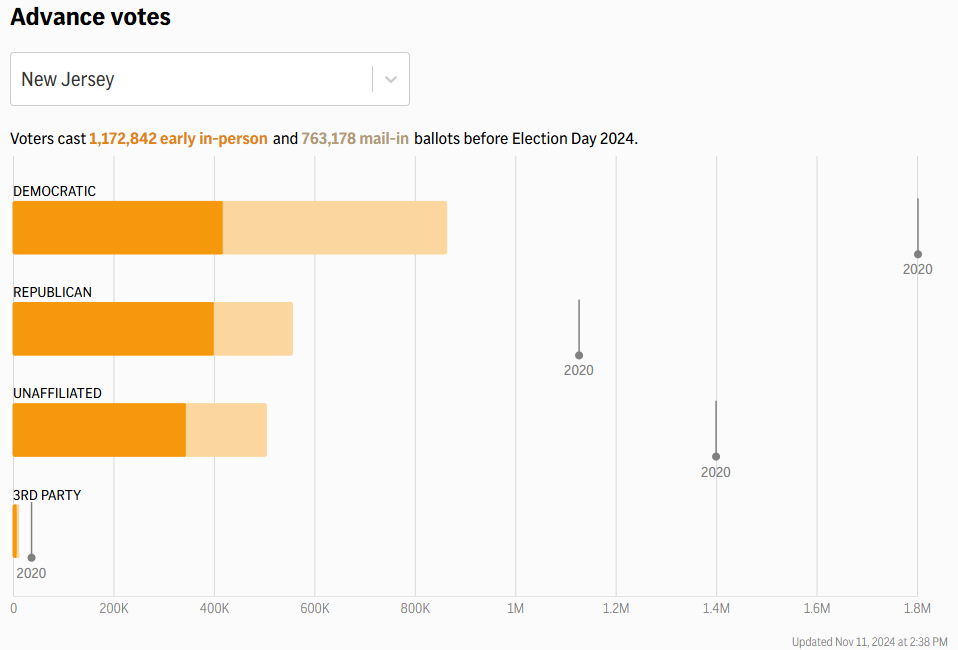
According to the Associated Press, voters in New Jersey cast 763,178 mail-in ballots prior to the 2024 general election. There were 6.68 million registered voters and 4.32 million total ballots cast in New Jersey.
STATES RUN ELECTIONS
Constitutionally, Trump is on shaky ground with his latest announcement about election changes. Unlike in many countries, elections are run by states.
Trump claimed in his social media post that states “are merely an agent for the federal government in counting and tabulating the votes” and must do what the federal government “as represented by the president of the United States” tells them to do.
Election lawyers said that’s a misrepresentation of the U.S. Constitution.
PATCHWORK OF LAWS
Two states with vote-by-mail elections, Washington and Oregon, are challenging an earlier executive order by Trump that sought to require that all ballots be received by Election Day (not just postmarked).
The states argue that the president has no such authority, and they are seeking a declaration from a federal judge in Seattle that their postmark deadlines do not conflict with federal law setting the date of U.S. elections.
Six other states and Washington D.C. allow elections to be conducted entirely by mail: California, Colorado, Hawaii, Nevada, Utah and Vermont.
States have a patchwork of election laws that accommodate their individual needs and circumstances.
Counties in North Dakota and Nebraska can opt for elections by mail, and nine states — Alaska, Arizona, Florida, Kansas, Maryland, Missouri, Montana, New Mexico and Wyoming — allow specific small elections to be conducted by mail. Additionally, Idaho, Minnesota, New Jersey and New Mexico permit mostly mail elections for certain small jurisdictions.
WHAT’S THE ISSUE WITH VOTING MACHINES?
Trump said in his post that voting machines are more expensive than “Watermark Paper,” a little-used system that has gained favor and investments among some voting conspiracy theorists who believe it would help prevent fraudulent ballots from being introduced into the vote count.
However, watermark paper would still have to be fed through some sort of tabulating machine.
While some jurisdictions still have voters use electronic ballot-marking devices to cast their votes, the majority of U.S. voters already vote on paper ballots, creating an auditable record of votes that provides an extra safeguard for election security.
WHAT HAPPENS NEXT?
Only Congress can implement new election rules under the Constitution. While the document is clear that state entities determine the “time, place and manner of elections, it does allow Congress to “make” or “alter” rules for congressional and presidential elections. Importantly, the president isn’t mentioned at all in the Constitution’s list of entities with powers over elections.
Although Republicans control Congress, it’s unclear that even his party would want to eliminate voting machines nationwide, possibly delaying vote tallies in their own races by weeks or months. Even if they did, legislation would likely be unable to pass because Democrats could filibuster it in the U.S. Senate.
The Associated Press contributed reporting for this article
Send local news tips and correction requests to eric.kiefer@patch.com. Learn more about advertising on Patch here. Find out how to post announcements or events to your local Patch site.
Get more local news delivered straight to your inbox. Sign up for free Patch newsletters and alerts.