Schools
Girl Scout Reaches Gold While Teaching Parents about Teen Thinking
Serina Bsales' workshop on the adolescent brain answers parents' questions.

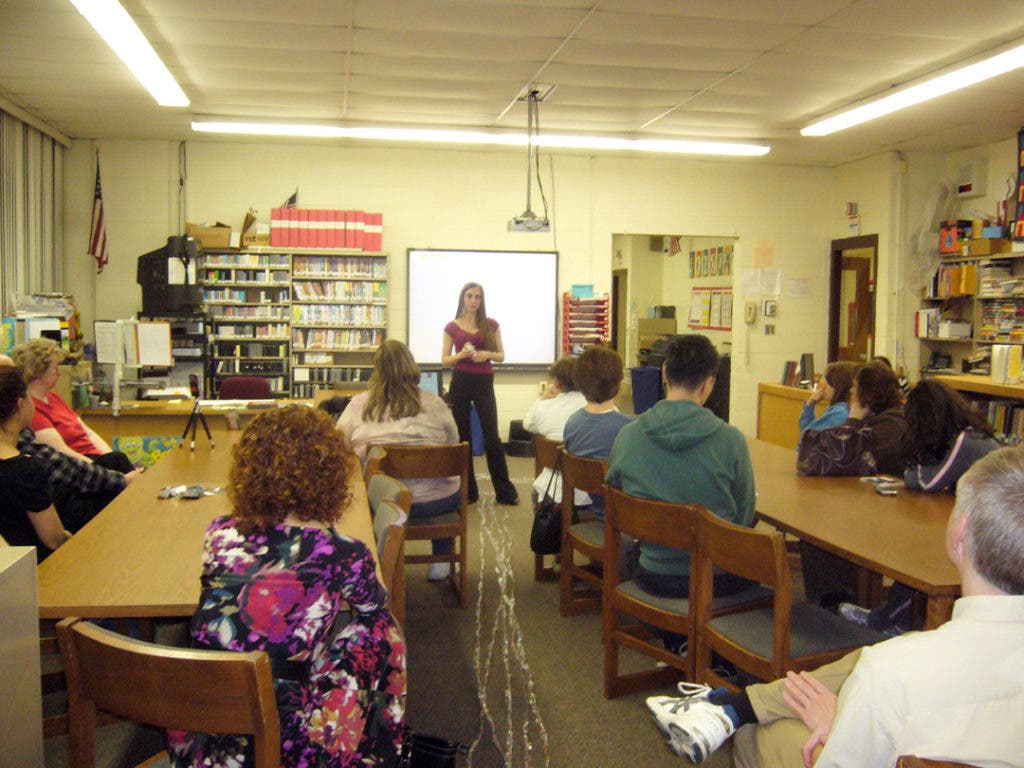


Four nights this week, senior and ambassador-level Troop 1868 Girl Scout Serina Bsales has made an impact on parents with her educational workshop on the teenage brain. She presented at , , and
After more than a year of research and planning, Bsales' Project T.A.T.T.O.O. (Talk About Tough Teen Options Openly) will earn her a gold award — the highest a Girl Scout can achieve — requiring 65 hours of leadership and community service.
Bsales, who plans to become a psychiatrist, chose to focus on the adolescent brain and how its development affects the teen-parent relationship. Her approach as an upcoming professional in psychology and neuroscience combined with her teenage perspective gave the presentation a refreshing and authentic appeal for parents. She punctuated her slideshow with "checkpoints," reminding parents that the brain is responsible for many teen behaviors and parenting making a big difference in the outcome.
Find out what's happening in Montvillefor free with the latest updates from Patch.
“Pick your battles and be a positive role model,” Bsales told parents.
Using a 3D model of a human brain, she showed how the brain develops from the bottom up and goes through a pruning process at age three, and again during adolescence when it becomes “hard-wired” for activities and habits teens will retain throughout their lives. The frontal lobe, which is responsible for decision-making, does not fully develop until age 25, she said, which is why parenting and communication have a critical impact at this stage. Bsales created a slide showing the four primary parenting styles based on expectations and guidance.
Find out what's happening in Montvillefor free with the latest updates from Patch.
According to Bsales, experts consider “authoritative” the most effective form of parenting, where the parent considers the child’s feelings and acts as a guide to help them solve their own problems. There are expectations without the use of a punishment or reward system. Children tend to develop higher self-esteem and independence with this type of parenting.
“Authoritarian” parenting, on the other hand, is demanding but not responsive to a child's needs and concerns. There are high expectations and a rigid set of rules and behaviors that can lead to more rebellious behavior.
“I have seen children of authoritarian parents turn out to be the most rebellious people I know,” Bsales said.
“Indulgent” parenting involves responsiveness with little demand. Leniency and low expectations can lead to impulsive, reckless behavior. Children of indulgent parents have the highest risk of teen drug abuse, according to experts, Bsales said.
“Neglectful” is the worst form of parenting, with no demand or responsiveness. The lack of guidelines and affection often results in a child who feels unwanted, she said.
Bsales told parents, “Keep your boundaries clear and your expectations known. Teach respect and trust.”
She also said that teens have a terrible time reading facial expressions, a tendency to overreact and limited emotional control. An immature pre-frontal cortex is the cause. She called it a "recipe for disaster."
“If your child hurts your feelings and you expect them to know from your facial expression how you feel, they may mistake it for anger and get defensive,” Bsales said. “That would lead to an argument that could be avoided if you just say how you feel.”
She explained that many typical teen behaviors we see are only temporary due to the underdeveloped pre-frontal cortex and limbic system. She advised parents to make a list of the behaviors that bother them about their teen so that they can recognize the scene and not fall into the same trap again and again.
Bsales gave pointers on active listening and communication, using “I” statements, and said parents need to keep in mind that certain behaviors are unavoidable at times.
“It’s not worth getting into an argument about. They don’t even know how they are acting at times and don’t realize they are reacting,” Bsales said.
Regarding how teens behave at home versus with their friends, Bsales had good news.
“Teens test their limits with you because they know you love them unconditionally,” she said.
“You are the biggest influence in your teen’s life,” she told parents, with a warning. “This comes with power. While you can drive them in the right direction, you can also drive them in the wrong direction.”
Bsales said teens want the type of stimulation that thrilled them as children, leading them to seek higher stimulation and risk to achieve the same level of excitement. They don’t realize the dangers in those risks. She said the top three leading causes of teen deaths nationwide are accidents, homicides and suicides, which are all linked to impulsive behavior.
“Teens are exploding with energy and idealism, so you really don’t want to fight them," she said. "They do not stop to think of the permanency of their actions.”
She said it is best to guide them in the right direction by encouraging them to take healthy risks, including exploring new opportunities, developing a social identity, and directing their energy to help themselves and the community.
However, parents should not protect teens from failing.
"Risks should never put a teen in danger, but should require them to risk something, whether it be failure, criticism or other possible unwanted outcomes," Bsales said.
This helps them gain confidence, courage and the ability to resist impulses.
“In teen brains, the 'go light' tends to shine bright, but 'caution' and 'stop' aren’t completely wired yet,” Bsales said.
New research has proven that teens need as much sleep as children. Sleep deprivation causes poor school performance, mood disorder, traffic accidents and increased use of caffeine, nicotine and alcohol.
“As a parent, you are the training wheels in their life," Bsales said. "Provide the support and balance they seek and when it’s time for them to ride without you, they’ll continue to use the skills you’ve taught them."
As part of her Project T.A.T.T.O.O. Gold Award, Serina Bsales is holding a fundraiser party for teens ages 12-18 on March 28 from 7- 9 p.m. at the Senior House, 356 Route 202, Montville. There will be a DJ, photographer, airbrush tattoos, snacks, and a green screen. Admission is $5. She will be selling tickets at the high school beginning Monday.