Business & Tech
A Young Doctor's Touch Tempers the Aches
Chiropractic care is controversial for some, while others find it a panacea for pain.
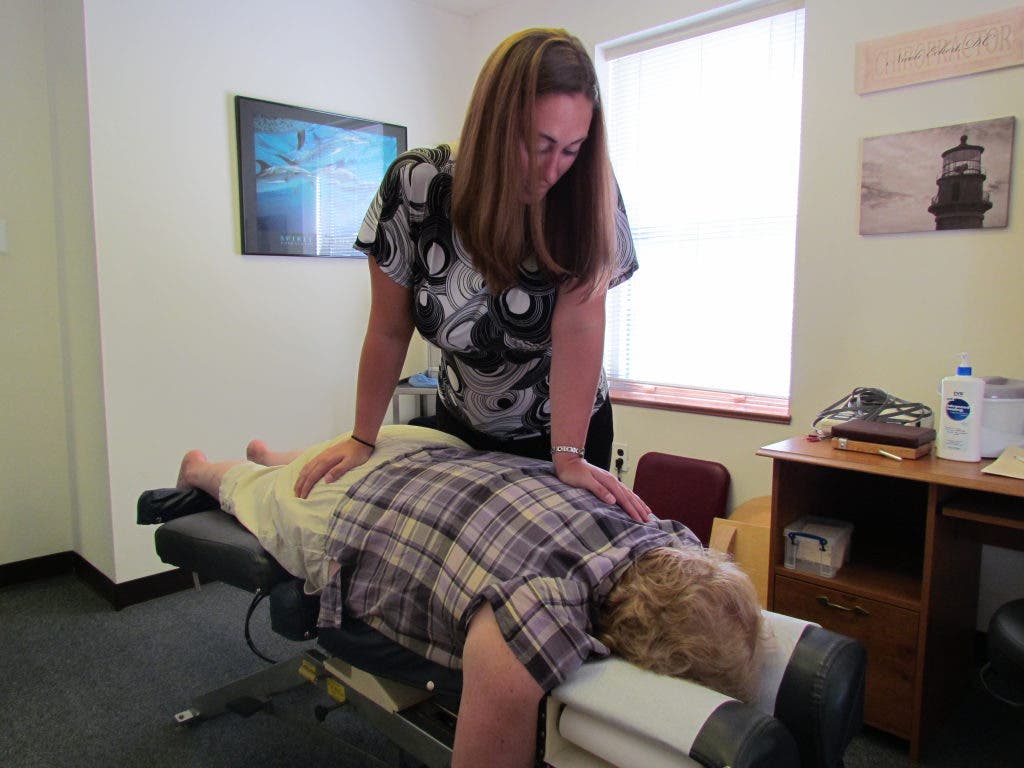

Nicole Eckert positions her client facedown onto the vinyl padded table, leans closely toward the woman’s spine, and presses with her palms into the small spaces between the vertebrae.
Patricia Meilands, 57, has been suffering from muscle strain and a misalignment of her spine, explains Eckert.
“On a scale from one to 10, with 10 being the highest,” asks Eckert of the woman lying prone, “how is your pain today?”
Find out what's happening in Moorestownfor free with the latest updates from Patch.
“I think it feels like a seven,” responds Meilands of Burlington Township.
“OK. We’re going to get you feeling better,” declares Eckert, a board certified doctor of chiropractic (DC), who opened A Chiropractic Touch at 702 E. Main St. last March.
Find out what's happening in Moorestownfor free with the latest updates from Patch.
Tapping with light force, Eckert applies a spinal adjustment—also referred to as spinal manipulation—by moving a joint beyond its usual resting point, but not enough to cause an extreme movement. One of the theories of chiropractic stimulation is that the body has an inborn ability to heal itself and resist disease.
For the patient, the aim is full-body versatility and freedom of movement.
On this early morning, Eckert is dispensing treatment on herself; hot pink Kinesio Taping is wrapped around Eckert’s right foot.
“My sisters and I played in a soccer tournament last weekend and someone tripped over me,” says Eckert. “The tape supports the joint but allows it to move while healing” and is applied to stimulate and increase circulation of blood and lymphatic fluid.
Eckert, the middle child of five girls, grew up in Toms River. Always athletic, she played lacrosse along with soccer in high school. She graduated from Lebanon Valley College in Annville, PA, where she was on the swim team.
It was during her college years that Eckert developed excruciating migraines.
“My mom took me to several doctors who couldn’t get rid of the pain, except when I was given medication,” says Eckert. “Then, she took me to a chiropractor,” who eased the recurrent throbbing headaches.
That did it for the 25-year-old. She became a big believer in the power of chiropractic care. She enrolled in Palmer College in Florida, where she completed the three-year program in chiropractic medicine.
After an internship in Daytona Beach, Eckert returned to New Jersey, and a friend in the field led her to her present office, where “the previous doctor had decided to retire.”
With two occasional staff workers, Eckert is mostly a one-woman operation.
“This office was basically set up to accommodate most of my needs,” says Eckert “But, I’m still getting to know how to use it administratively. What’s important to me is giving my patients the best care.”
She averages nearly 40 patient visits weekly. Former devotees of her predecessor stayed on with Eckert and, including new patients, she has a database totaling nearly 100.
Eckert, a formidable young woman with a strong stride, is new to her specialty, but smart and driven. She believes people of all ages can benefit from chiropractic care. And, she’s fully aware of critics dismissing vertebral stimulation as futile.
“I want people to know that adjustments are safe,” says Eckert, “and when done with specific intent can provide a reduction in pain. People are under the false belief that neck stimulation can lead to a stroke. That is not true if it is by an experienced doctor.”
Besides Kenisio Taping therapy, methods like Active Release Technique (ART), stretch tight muscles and try to retrain them back into shape, adds Eckert.
“When you hear a cracking sound [during a manipulation], it is a misnomer that it is a bone on bone crunch,” Eckert further explains about treatments. “It is a release of gas trapped between the vertebrae in the spinal disc space that has been putting pressure on the nerves.”
Bottom line, folks like Meilands want to be free of pain.
“I began visiting a chiropractor on the advice of a friend for a painful shoulder I once had. It helped. Now, I'm here for this," says Meilands, pointing to her back. “I have a tendency to get out of whack.”
Perhaps the most compelling testimony comes at the last part of Meilands’ session. Earlier, chronic pain derailed her ability to ambulate swiftly.
As Meilands anchors her feet, Eckert asks, “So Patricia, now on a scale from one to 10, how is your pain?”
Smiling, Meiland answers, “I don’t feel any.”