Business & Tech
Straightening Out That Smile
Morrone & Kaye Orthodontics wire up kids in Moorestown and Mount Holly.
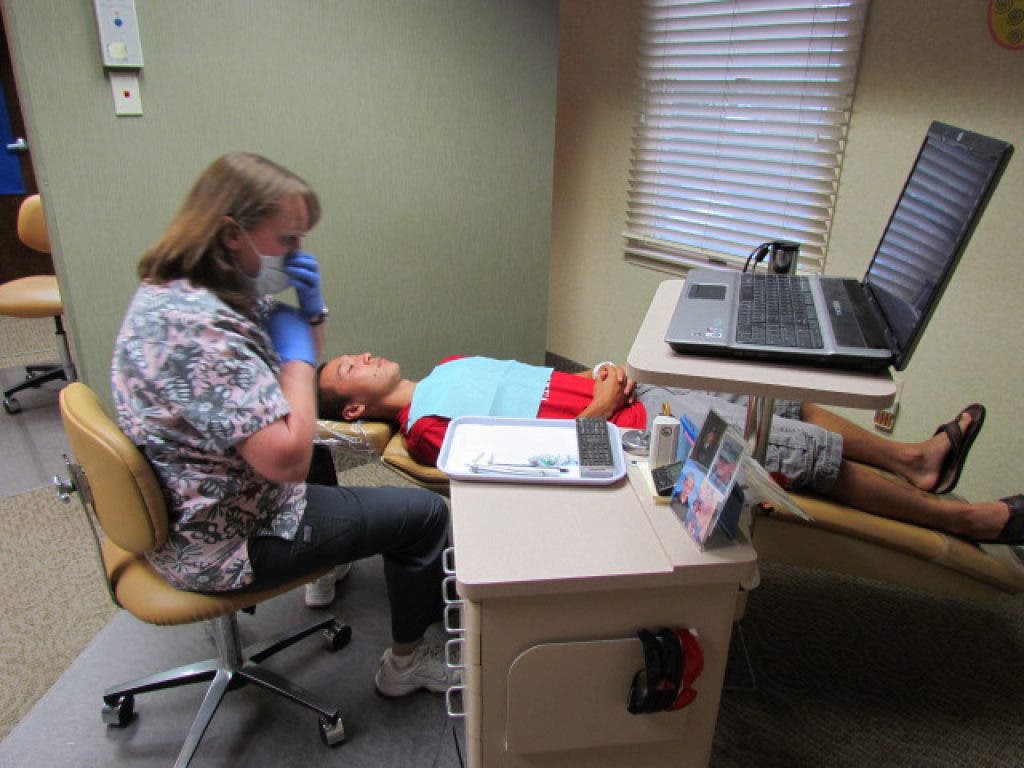


When asked if he is excited, J.D. Elberfeld, 16, quietly nods and smiles, “Yeah…I guess so.”
Elberfeld has been anticipating this day for almost a year. The Rancocas Valley Regional High School soccer player is getting his braces off.
“There is nothing better than taking braces off and seeing kids smile,” Dr. Richard Kaye, says with enormous enthusiasm. Kaye is one-half of the practice, . “It is a very gratifying field.”
Find out what's happening in Moorestownfor free with the latest updates from Patch.
No doubt. Lining the wall of one of the consultation rooms are portraits of smiling patients, mostly teenagers, but a few proud and satisfied adults, beaming with newly straightened teeth.
“Every patient has their portrait taken when they have their braces removed,” Kaye says, a sociable guy who grew up in Toms River, but is now a Moorestown resident. “It’s something we offer as part of the treatment costs.”
Find out what's happening in Moorestownfor free with the latest updates from Patch.
Orthodontics is cosmetic treatment that bestows a sense of confidence and assurance on the patient, says Kaye. Plus, straight teeth are healthy teeth—it’s easier to floss and brush aligned teeth.
“We live in an age in which we care about appearances,” says Kaye, who says kids come in as young as 7 for consultations. “There is no charge to be seen for a consult.”
Kaye says braces usually begin at $5,000.
“We begin watching a young child to see if the bite is normal, or if the jaw is expanding properly … I just had a boy in today who we have been seeing for almost five years, and we haven’t charged a penny,” he further explains.
Some patients see Kaye because of mouth pain.
“Many general dentists don’t recognize the symptoms of TMJ,” or temporomandibular joint disorder, which is an umbrella term referring to acute inflammation of joints in the mouth, he says. “In our practice, we recognize that at times when a bite is not functioning properly, it’s a joint problem."
In the cheery treatment room of this Mount Holly office, patients lounge on seven dental chairs, as assistants snap x-rays and aid in brace rewiring, amid jungle grass curtains and animal masks mounted on walls. A tropical tree stands rooted in the waiting room, across from chimpanzee quilts.
“It was rather serendipitous how we came to decorating this office in a safari theme,” explains Kaye, 51. “My family and I had visited the San Diego Zoo at about the same time we started to decorate here.”
Kaye says their other office in Moorestown on Main Street is bedecked in a nautical theme.
After receiving a pharmacy degree, Kaye studied at Georgetown University School of Dentistry, where he met his wife and business partner, Mary Beth Morrone. After graduation, Kaye did a residency, while Morrone attended an orthodontic program at the University of Medicine and Dentistry of New Jersey (UMDNJ).
Kaye worked in general dentistry for nearly eight years. In 1995, he returned to school, and he received his orthodontic certificate from Temple University. By this time, Morrone was partners in a Cherry Hill practice.
For the last 13 years, the couple has run both offices—although Morrone has been on hiatus for the last eight years, since the youngest of the couple’s three children was born. (“She’s working her way back in recently," says Kaye, "doing some administrative work.”)
But a professional team of 15, including orthodontist Andrew Wilbur, DMD, who has been an associate nearly nine years, skillfully treats the mostly word-of-mouth patients, alternating days between Mount Holly and Moorestown.
Around the room, orthodontic devices lie among dental tools on trays. Pamphlets describing modern appliances sit on counters. Herbst appliances—encourage lower jaw growth. Protraction headgears—correct front teeth underbites.
When Morrone and Kaye first practiced, most braces worn by patients were traditionally stainless steel.
“Patients still wear them,” Kaye says, although kids tend to jazz them up with color-coded bands—in splashy hues from the color wheel—that hold the brackets in place.
Other patients, turned off by the tin grin look, opt to correct crooked teeth with Inspire Clear, braces made from clear porcelain.
“They are a lot more fragile,” Kaye says.
Within the last 10 years, Kaye says, with newer technology, orthodontists are able to treat more complex cases with Invisalign, transparent removable trays that are changed every two weeks.
Kaye says he sometimes has to instruct people about false advertisements claiming to straighten teeth within six months.
“That can’t be done. The process of moving teeth is a biologic movement,” Kaye clarifies. “When you move a tooth, the space needs time for the bone to reorganize and fill in with new bone.”
Lying supine, Elberfeld opens wide as a plier snips and scraps the steel brackets. He adjusts the goggles slipped to him by Kaye.
“That’s so any breaking cement from the braces doesn’t get into his eyes,” Kaye explains.
“I like to educate people,” says Kaye as he moves in closer to Elberfeld. “It is hard to have people trust, if they don’t understand.”