Health & Fitness
How Much Is COVID Spreading In Morristown As NJ Infections Slow Down?
Local infections have declined but remain among the highest since the pandemic began, and recent data shows stress on hospitals.


MORRISTOWN, NJ — The omicron-variant surge has shown signs of slowing down in the Morristown area, with a decline in new infections for the second straight week. But case totals still remain among the area's highest since the pandemic began.
In fact, Morris County's reported total of 645 new cases Thursday remains higher than any of the area's case counts before the omicron wave, according to the New Jersey Department of Health.
Here's what's happening in Greater Morristown.
Find out what's happening in Morristownfor free with the latest updates from Patch.
Cases
Morris County averaged 825.7 infections per day this past week, according to the state health department. That's an improvement over the prior week, when the county averaged 1,422.9 new cases per day. The week before, Morris County averaged 1,637.4 daily infections.
Find out what's happening in Morristownfor free with the latest updates from Patch.
Morris County hit a record daily case total Jan. 7 with 1,775 reported infections, but the area's average case totals have gradually declined since.
Here are the local case numbers:
- Morristown saw 294 new cases from Jan. 10 to Wednesday, bringing the town to 3,877 cases since the pandemic began, according to Morris County data. That's a 7.6 percent increase to Morristown's infection total in nine days.
- Officials reported 295 Morris Township infections in that span, putting the township at 3,503 cases since the onset of the pandemic. The case total increased 9.2 percent from Jan. 10 to Wednesday.
- Morris Plains's case total grew from 1,074 to 1,157 for a 7.7 percent increase in nine days.
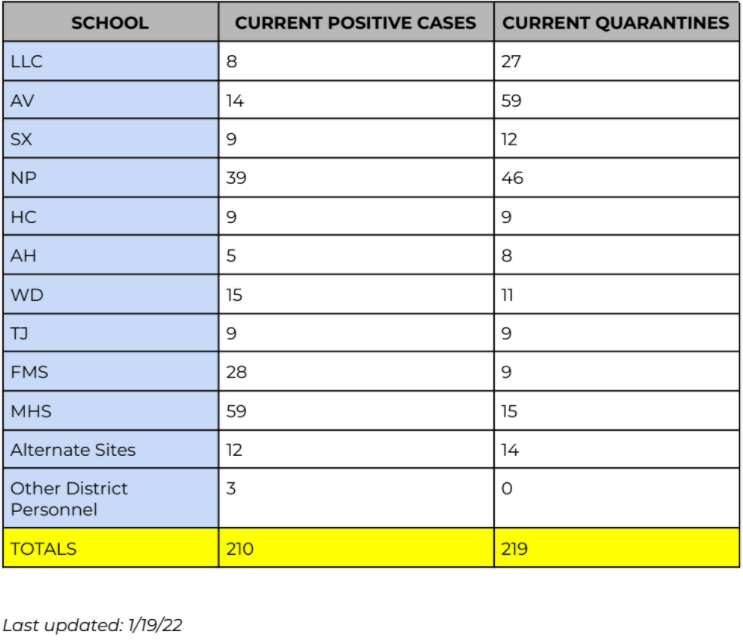
The Morris School District reported the following totals as of Wednesday on its COVID-19 dashboard:
Hospital Data
The number of patients with confirmed or suspected COVID-19 in New Jersey hospitals has declined in recent days. After an omicron-wave peak of 6,089 on Jan. 11, COVID hospitalizations are down to 4,966 as of Wednesday.
Hospital-specific data, which comes from the U.S. Department of Health and Human Services, only reflects hospital capacities through the week ending Jan. 13. The most recent week of data indicates strain on many local hospitals as of last week.
The ratio of COVID-19 hospitalizations to total beds provides insight on how much strain a hospital is under. The ratio becomes concerning when it crosses 10 percent, and anything more than 20 percent represents "extreme stress," according to a framework the University of Washington's Institute for Health Metrics and Evaluation developed.
Additionally, ICU capacity also indicates hospital strain, hospital-capacity experts told NPR. When COVID-19 patients fill more than 30 percent of ICU beds, it suggests a hospital is under "high stress." Sixty percent or more indicates "extreme stress."
Several Morristown-area hospitals fell into the data categories of high or extreme stress for the week ending Jan. 13. Here's what federal officials reported in that timeframe:
- Morristown Medical Center: COVID-19 patients occupied 24 percent of adult inpatient beds and 20 percent of adult ICU beds.
- Saint Clare's Denville Hospital: COVID-19 patients occupied 23 percent of adult inpatient beds and 28 percent of adult ICU beds.
- Chilton Medical Center (Pompton Plains): COVID-19 patients occupied 37 percent of adult inpatient beds and 40 percent of adult ICU beds.
- Kindred Hospital New Jersey (Dover): COVID-19 patient data unavailable.
- Overlook Medical Center (Summit): COVID-19 patients occupied 26 percent of adult inpatient beds and 17 percent of adult ICU beds.
- Cooperman Barnabas Medical Center (Livingston): COVID-19 patients occupied 35 percent of adult inpatient beds and 18 percent of adult ICU beds.
But the hospitals still have beds available for those in need. The New Jersey Hospital Association has urged people not to delay medical care, including trips to the hospital.
Here is the federal data for overall bed use in Morristown-area hospitals for the week ending Jan. 13:
- Morristown Medical Center: 77 percent of adult inpatient beds and 58 percent of adult ICU beds were in use.
- Saint Clare's Denville Hospital: 63 percent of adult inpatient beds and 62 percent of adult ICU beds were in use.
- Chilton Medical Center (Pompton Plains): 84 percent of adult inpatient beds and 58 percent of adult ICU beds were in use.
- Kindred Hospital New Jersey (Dover): 82 percent of adult inpatient beds were in use. ICU data was unavailable.
- Overlook Medical Center (Summit): 65 percent of adult inpatient beds and 38 percent of adult ICU beds were in use.
- Cooperman Barnabas Medical Center (Livingston): 90 percent of adult inpatient beds and 43 percent of adult ICU beds were in use.
Vaccine Data
As of Thursday, 46.7 percent of Morris County's fully vaccinated population received the COVID-19 booster shot, according to the Centers for Disease Control and Prevention.
The CDC reported that 78.8 percent of Morris County's vaccine-eligible population — people 5 and older — have completed their first COVID vaccine course. As of Thursday, 92.9 percent of Morris County residents 5 and older have received at least one COVID shot.
Deaths
Twenty-eight people in Morris County died from COVID-19 in the past week, according to the CDC.
See more local news and resources:
- Looking for a COVID test? Here's what to know about Morristown's local testing centers.
- Here's where to find a COVID-19 booster shot — or first or second vaccination — around Greater Morristown.
- Gov. Phil Murphy issued an executive order Wednesday that will require employees in health care settings or "high-risk congregate" environments to receive COVID-19 vaccinations and booster shots. Workers in those settings will soon lose the choice to opt out of the requirement by undergoing weekly testing. Read more.
Although most people with COVID-19 get better within weeks of the illness, some experience conditions known as long COVID or long-haul COVID, according to the CDC. Learn more about long COVID at the CDC's post-COVID conditions page.
Thanks for reading. Have a news tip? Email josh.bakan@patch.com. Subscribe to your local Patch newsletter and follow the Morristown Patch Facebook page.
Get more local news delivered straight to your inbox. Sign up for free Patch newsletters and alerts.