Politics & Government
Racial Gaps Still Plague NJ, Advocates Say
Wealth gaps. Voting. Prisons. Here are some ways New Jersey can "Make Black Lives Really Matter," these activists say.


NEW JERSEY — When Laura Sullivan looks at the Garden State, she sees "two New Jerseys."
In one part of the state, families have enough in their bank accounts to weather the economic uncertainties of life and carve out bright futures for their kids. But in the other part, which is disproportionately made up of Black and Brown households, many families are struggling to keep food on the table.
“This is the definition of injustice,” she said.
Find out what's happening in Newarkfor free with the latest updates from Patch.
Sullivan, a staff member at the New Jersey Institute for Social Justice (NJISJ), is among the advocates who are trying to raise awareness about the state’s longstanding racial wealth gap.
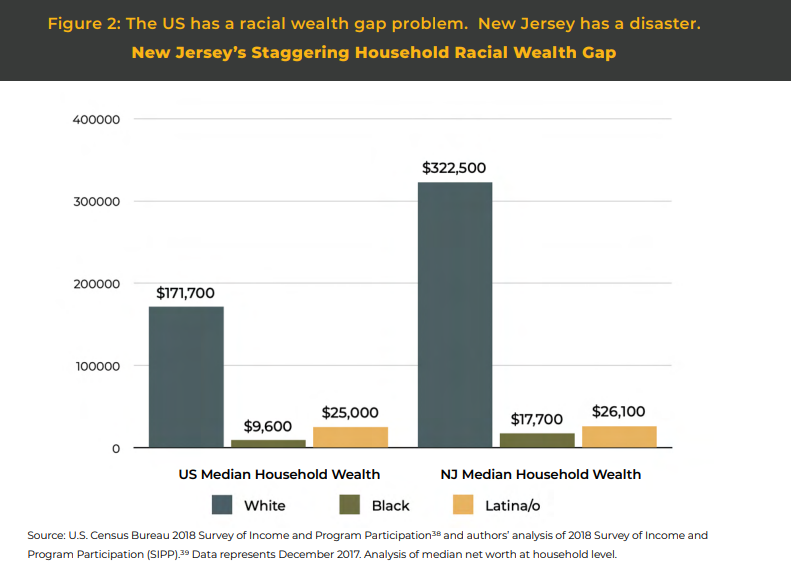
According to recently released research spearheaded by Sullivan, the median household wealth of white families in New Jersey is $322,500, compared to just $17,700 for Black families and $26,100 for Latina/o families (see chart below).
Find out what's happening in Newarkfor free with the latest updates from Patch.
The gap is just as bad for single people, researchers said. The median net worth of white New Jersey residents, is $103,500, compared with just $4,900 for Black individuals and $2,300 for Latina/o individuals.
The report also highlights other financial disparities in New Jersey, including income and homeownership. According to the NJISJ:
“While 17% of Black New Jerseyans have household incomes under the official poverty threshold (about $22,000 for a family of three), only 6% of white New Jerseyans do. The median income of white households in the state is $91,764 – over 60% more than the median income of Black households at $56,301. And while three-quarters (75.9%) of white families own their own homes in the Garden State, just 38.4% of Black families do.”
“The U.S. has a major racial wealth gap problem,” Sullivan said. “New Jersey has a racial wealth gap disaster.”
“Economic disparities and the racial wealth gap in New Jersey were created by design – by our institutions, our public policies and through social exclusion and violence,” said Andrea McChristian, the group's law and policy director.
“Therefore, we must enact policies that repair past and ongoing harms to make the 'Two New Jerseys' one and to close the racial wealth gap,” McChristian said.
Some of the group's recent suggestions for fighting the wealth gap include:
Baby Bonds – “Create and fully fund a universal baby bonds program that is progressively designed to provide the greatest support to children of color from low-wealth households (A1579/S768).” See Related: New Jersey 'Baby Bonds' Could Shrink Gap Between Rich, Poor
Guaranteed Income – “Develop and resource targeted guaranteed income pilot programs in northern, central and southern New Jersey urban communities.” See Related: $12K For Free: Newark Ramps Up 'Guaranteed Income' Experiment
Cancel Student Loan Debt – “Cancel student loan debt and avoid future student debt with expansion of tuition-free college and increased state investments in higher education.” See Related: Student Loan Forgiveness Could Change Lives In NJ – Here's How
Expand Homeownership – “Strengthen New Jersey’s existing homeownership programs and launch new initiatives to meet the specific needs of Black families and reduce racial homeownership disparities.” See Related: Foreclosed Homes Should Go To Families, Not Flippers, NJ Lawmakers Say
While the wealth gap is an urgent problem, it’s not the only “crack of structural racism” that needs to fixed in New Jersey’s foundation, the nonprofit said.
The Newark-based NJISJ kicked off Black History Month earlier in February by releasing their 2021/2022 Agenda to Make Black Lives Really Matter in New Jersey.
“From the ravaging of Black communities by the coronavirus pandemic, to persistent violence by police against Black people, to disparities in wealth, health and criminal justice, we are seeing our very foundation erupt into earthquakes from the deeply embedded cracks of structural racism,” the NJISJ argued.
“This is true right here in New Jersey, where Black people face some of the worst racial disparities in America,” the group said.
- See related article: Systemic Racism In NJ Added To Pandemic Deaths, Advocates Say
- See related article: New Jersey Has Highest Racial Disparity In Prison In US, Report Says
- See related article: See The Plan To Fix New Jersey's 'Racist' Infant Mortality Gap
Here are some of the longstanding racial issues the state needs to face, the NJISJ says – and some possible solutions, too.
TRANSFORM THE YOUTH JUSTICE SYSTEM
Close Youth Prisons, Invest in Kids – Close New Jersey’s three youth prisons and invest $100 million into creating a lockbox fund for front-end youth services and programs.
Implementation of a Community-Based System of Care for Youth – Pass and sign the Restorative and Transformative Justice for Youths and Communities Pilot Program bill (A4663/S2924) to develop restorative justice hubs and enhanced reentry services for the young people being released from New Jersey’s youth prisons in response to the COVID-19 crisis (Signed into law on August 11, 2021).
KEEP COMMUNITIES SAFE
Build a Culture of Accountable Policing – Ensure that law enforcement is guided by policies and systems designed to build a culture of accountability that are created and implemented through engagement with community members by:
- First Amendment Directive to protect civilians’ rights during police interactions (Issued by the Attorney General on December 7, 2021)
- Limiting military-grade equipment available to local law enforcement agencies through the federal 1033 program
- Banning and criminalizing police use of chokeholds (A1370/S265)
- Ending law enforcement qualified immunity
- Creating municipal civilian complaint review boards (A1515)
- Reducing police enforcement of non-serious offenses, particularly for youth
Invest in Community-Based Public Safety Options - Rethink policing by investing in community-based approaches to public safety that will decrease law enforcement’s footprint by:
- Developing mental health first responder and crisis intervention systems that rely on highly trained professionals other than police to address certain crises
- Reinvesting dollars into community-based services that empower communities—like schools, hospitals, libraries and parks
- Funding restorative justice programs and services
ENSURE DEMOCRACY FOR ALL
Free the Vote for People in Prison - Restore the right to vote to incarcerated people.
Same-Day Voter Registration - Enact same-day voter registration, including on Election Day (A1966/S247).
Early Voting - Enact comprehensive early voting using e-poll books (A4830/S3203) (Signed into law on March 30, 2021).
Racial Justice in Redistricting - Guarantee that New Jersey’s racial makeup is effectively represented in the redistricting process.
Right to Jury Service for People with Criminal Convictions - Restore the right to serve on a jury for people with criminal convictions.
Limited Police Presence at Voting Locations - Ensure voters can cast their ballot without fear by limiting police presence at voting locations except for emergency response (A4655/S2923) (Signed into law on January 18, 2022).
REPAIR THE HARM OF DIVESTMENT
Produce COVID-19 Racial Data - Ensure the Department of Health maintains and regularly updates COVID-19 impact data by race, ethnicity and other key demographics at the municipal and county levels (in compliance with P.L.2020, c.28) (Municipal data released and updated in 2021 to ensure compliance).
Establish Reparative Justice - Create the New Jersey Reparations Task Force (A938/S386).
Send news tips and correction requests to eric.kiefer@patch.com
Sign up for Patch email newsletters. Learn more about posting announcements or events to your local Patch site.
Get more local news delivered straight to your inbox. Sign up for free Patch newsletters and alerts.