Community Corner
Church On Rutgers-Newark Property Has Ties To Underground Railroad
Once a center for some of Newark's earliest Black activists, the church was designated a historic site by the National Park Service.


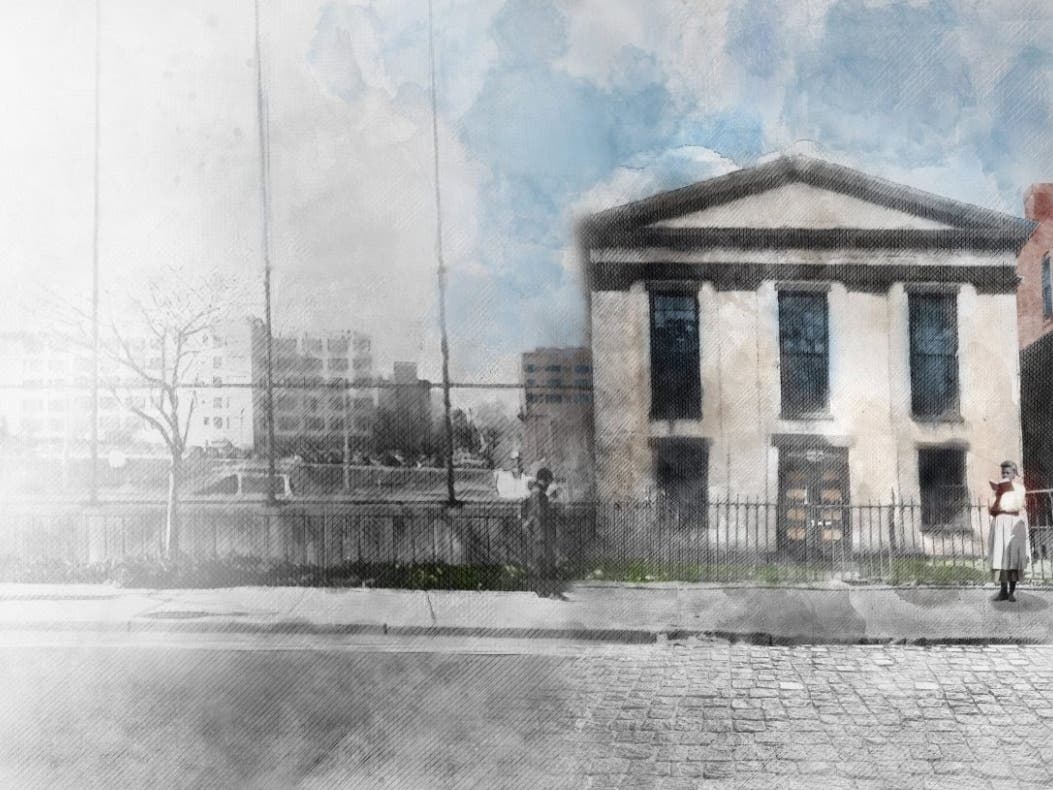
NEWARK, NJ — Once a center for some of the city’s earliest Black activists, a 19th-century church on Rutgers-Newark property was designated a historic site by the National Park Service due to its ties to the legendary Underground Railroad.
The Plane Street Colored Church – which is located on what is now Frederick Douglass Field – was recently accepted into the park service’s National Underground Railroad Freedom Network, Rutgers announced. Its congregation played a vital role in fighting slavery, raising money for freedom seekers, and hosting talks by radical figures such as Frederick Douglass, who spoke there in 1849.
Noelle Lorraine Williams, a historian and Rutgers-Newark graduate who wrote and researched the park service application, said the designation is an important acknowledgement of the church’s role as a hub of the abolitionist movement.
Find out what's happening in Newarkfor free with the latest updates from Patch.
“Very few sites are recognized nationally by the federal government as being connected to the Underground Railroad,” said Williams, director of the New Jersey Historical Commission’s African American History Program.
Williams said the site is one of the first in New Jersey to earn the designation.
Find out what's happening in Newarkfor free with the latest updates from Patch.
“Rutgers University and the City of Newark now stand as major contributors to African American history in the U.S.,” Williams said.
According to Rutgers-Newark:
“Williams, who is also an artist, learned of the church’s history while researching her multimedia project, ‘Black Power! 19th Century,’ which focused on the efforts of Black Newarkers to organize against oppression since before the Revolutionary War. She wrote and researched the application, submitted by the university, at the suggestion of Kenneth B. Morris, the great-great-great grandson of Douglass.”
“The church has a very special and layered connection to the Underground Railroad,” Williams said. “The teachers and clergy include national luminaries like the editor of the nation's first African American national newspaper and a reverend who was accused of taking part in the Denmark Vesey conspiracy, believed to be the most comprehensive plots in the history of the United States to overthrow slavery.”
An Underground Railroad Station was located only a few feet away from the church, and Junius Morel, a teacher there, sent a freedom seeker from Newark to Albany.
“This site is connected to radical people and histories,” Williams said.
The church also served as a foundation for contemporary Newark politics, Williams added.
“The NAACP, Urban League have roots with this group of people,” she said. “Louise Epperson, who fought for the rights and against the displacement of Black and Latinos during the building of UMDNJ in the late 1960s, attended the church.”
According to Rutgers-Newark:
“When the church building fell into disrepair, the congregation moved in 1905 to the Wickleffe Church, which later became the 13th Avenue Church. The Plane Street building stood on a block that was part of Newark’s Black community until the city condemned buildings there. From 1959 to 1967, redlining and a practice known as ‘slum clearance,’ moved 12,000 African American families from Newark’s downtown core. In 1967, Malcolm Talbott, provost of Rutgers-Newark, pushed through the renaming of Plane Street to University Avenue, according to historian Jack Tchen, director of Rutgers-Newark Clement A. Price Institute on Ethnicity, Culture, and the Modern Experience.”
Tchen said the historical designation, and the naming of Douglass field, are signs that Rutgers-Newark is reckoning with its past.
“Traditionally universities do not acknowledge the prior neighborhoods and occupants of the lands they bulldoze and build on,” he said. “I commend our campus reckoning with this systemic historic forgetting and initiating the process of decolonizing the history of Newark.”
Send local news tips and correction requests to eric.kiefer@patch.com. Sign up for Patch email newsletters. Learn more about posting announcements or events to your local Patch site. Don’t forget to visit the Patch Newark Facebook page.
Get more local news delivered straight to your inbox. Sign up for free Patch newsletters and alerts.