Business & Tech
City Without Walls Gallery: Beauty and Barbed Wire
Anchor for 'Lincoln Park Coast Cultural District'
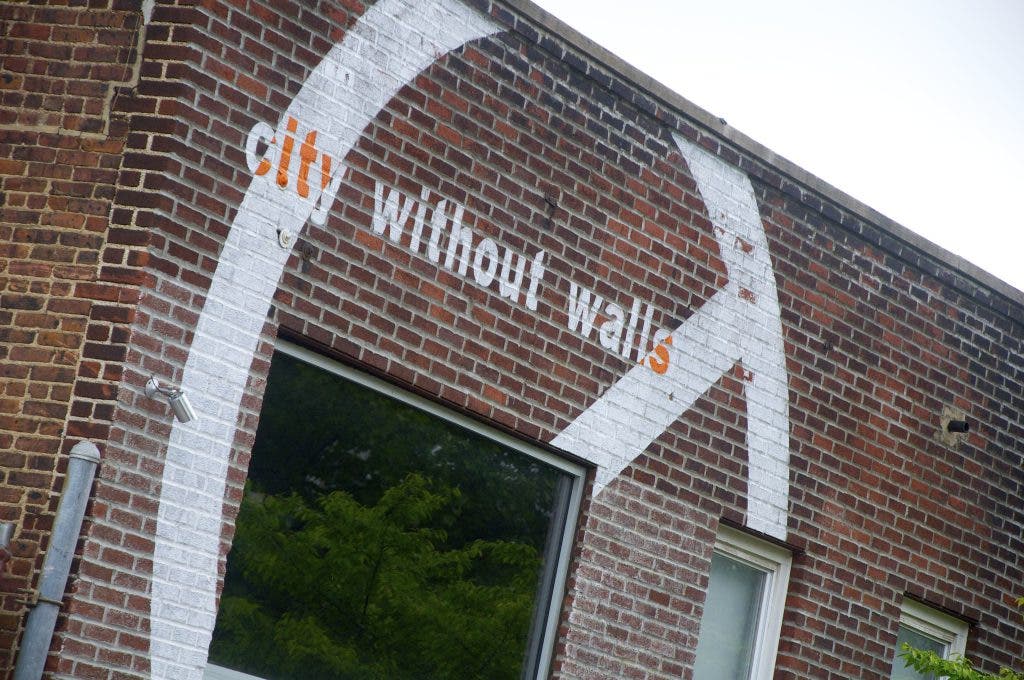
Like Newark itself, the City Without Walls art gallery offers glimpses of beauty and better things to come amidst the harsh realities of a gritty post-industrial urban landscape.
The gallery's very location epitomizes the confluence of hope and depression that characterize so much of the city. Tucked away on the corner of Crawford and Halsey streets in the Central Ward one block from Lincoln Park, a visitor encounters badly potholed streets, vacant lots guarded by menacing circles of barbed wire and forlorn empty old buildings.
But there's also a thriving church across from Lincoln Park; a new apartment building under construction down the street and a charter school and a freshly painted house adorned with red flowers in green boxes across the street. Not to mention the yoga studio and hip new art gallery in renovated brownstones around the corner.
Find out what's happening in Newarkfor free with the latest updates from Patch.
In 2005, two years after City Without Walls moved to Crawford Street from One Gateway Plaza, the future of the then-30 year old non-profit artist collective was thrown into doubt following a brutal assault on gallery staff that left executive director Joe Ford near death. The gallery was closed for six months and re-opened only after new executive director Ben Goldman, a local painter and former public policy expert and administrator, insisted on the installation of new security measures — and a personal life insurance policy.
Since then prostitutes and crack vials have given way to young professionals and upscale amenities and City Without Walls has been an anchor for what's being called the "Lincoln Park Coast Cultural District." The gallery also renewed its commitment to its mission, as defined by Goldman, "to help build the careers of emerging artists and building an audience for contemporary arts."
Find out what's happening in Newarkfor free with the latest updates from Patch.
The Newark School
In fact, the gallery's most recent exhibition, "The Newark School," which ended last week after an extended run, served as a ringing testimony to the success of both City Without Walls and the artists it has nurtured.
Race and the use of found objects were dominant themes of the well-received show. JC Lenochan's "Melanin Chronicles" series led off with a knob and key attached to fraying book titled "The Crisis of the Negro Intellectual." Charlee Swanson's "Shadowed Texture" was a harsh but compelling installation of barbed wire and Robert Richardson's mixed media "Scat" brought a haunted scarecrow-like figure to life using a discarded door, grill, pot and other reclaimed pieces of urban detritus.
Perhaps the most provocative and accomplished piece was James Andrew Brown's "Paradoxical Realities," a free-association contemplation of racially-charged images and words featuring imaginative variations of the word "nigger" and "white" as well as drawings and photo montages of monkeys, African masks, nose rings, clowns and businessmen with bow ties, done with watercolors, India ink and colored pencil over 32 12x12 inch pieces of paper.
Brown, an African-American artist who was born in Paterson, lives in Belleville and teaches at William Paterson University, describes the piece as a "social commentary on ethnicity" drawing on memory, emotion and "a great interest in language."
Brown said he worked on his tour de force during a "drawing marathon" that lasted 24 hours over two days. "I wanted to respond to things that first came to my head with rapid visualization," he said. "I didn't want to over-think it, but instead create a more honest type of image that was not cleaned up based on aesthetics."
The conceit of the show, said Goldman, was the play on the phrase "The New York School," which refers to the Manhattan-based abstract artists (made up of white men) who launched the famous Abstract Expressionist movement in the 1940s and '50s. In contrast, Goldman said, "The Newark School," was meant to highlight the influence of Newark's diverse group of artists, "largely people of color," on visual arts by using found objects and urban themes.
Mentoring and New Media
Next up for City Without Walls is Art Reach, a show that pairs established artists with high school students and opens June 9. A week later, "Newark New Media," featuring the video art of younger artists opens — on the giant video screen on the east side of the Prudential Center.
"Commuters coming into Penn Station will be able to see it from the train," said Goldman. "It will be very dramatic."
"Newark New Media" also pairs working artists with students, as does the gallery's City Murals project, which has resulted in over a dozen vividly painted murals on the side of buildings all over the city.
City Without Walls was, after all, established as artists collective and that sense of an artists' community has remained a guiding principle for the gallery, Goldman said. Local artists can become members for only $35, and are guaranteed that their work will be considered by the guest curators of gallery shows.
Over 200 artists are currently members, a number Goldman hopes to increase, along with the gallery's space and half-million dollar budget.
While funding comes from such established sources as the Geraldine R. Dodge Foundation, the Prudential Foundation and the New Jersey Council on the Arts, Goldman says the gallery needs at least a $1 million budget "to be sustainable."
That may be so, but many arts non-profits would be more than happy to have City Without Walls' 36-year track record.
And if the past is any indication, it's a good bet the gallery will continue to make good on its promise to, in Goldman's words, "use art, technology and mentoring to build careers, community and contemporary culture."