Politics & Government
COVID Lockdown Arrests In NJ Plagued By Racial Gaps, Report Says
If you're Black, the pandemic crackdowns in New Jersey were much worse, a new report says.


NEW JERSEY — Gathering. Hanging out. Being outside. Loitering at a bus stop. Playing basketball. These were some of the activities that earned New Jersey residents a ticket – and sometimes a trip to jail – during the coronavirus pandemic.
But if you’re Black, the crackdowns were much worse, a new report says.
The ACLU of New Jersey recently released a study dubbed “Policing the Pandemic: COVID-19 and Lockdown Enforcement in New Jersey.” Read the full report here.
Find out what's happening in Newarkfor free with the latest updates from Patch.
Citing data obtained through Open Public Records Act (OPRA) requests for police arrest reports, the ACLU-NJ came to two major conclusions about COVID enforcement in the Garden State:
- There were severe racial disparities in the number of police stops between Black and white communities
- There were clear racial disparities in arrests and searches of Black New Jerseyans
Need a refresher about pandemic lockdowns in New Jersey? Here’s what led the ACLU-NJ to launch their study, researchers said:
Find out what's happening in Newarkfor free with the latest updates from Patch.
“In March 2020, New Jersey launched its initial response to the COVID-19 pandemic by issuing policies aimed at limiting the spread of the deadly virus. Governor Phil Murphy’s Executive Order 103 and subsequent executive orders calling for residents to stay at home and socially distance allowed municipalities to make their own determinations as to enforcement. Those policies, created and imposed with vague boundaries, also implicated civil rights and liberties at every level of government. Given the unprecedented urgency of the moment, few voices questioned police practices or government attempts to use police to enforce social distancing.”
“The criminalization of non-compliance of stay-at-home orders in the face of threats to public health is not a new phenomenon,” the ACLU-NJ argued.
“COVID-19, however, has raised questions about the significant latitude granted to authorities and law enforcement and whether that latitude should face greater scrutiny,” the nonprofit continued.
CRUNCHING THE DATA
Some highlights from the report include:
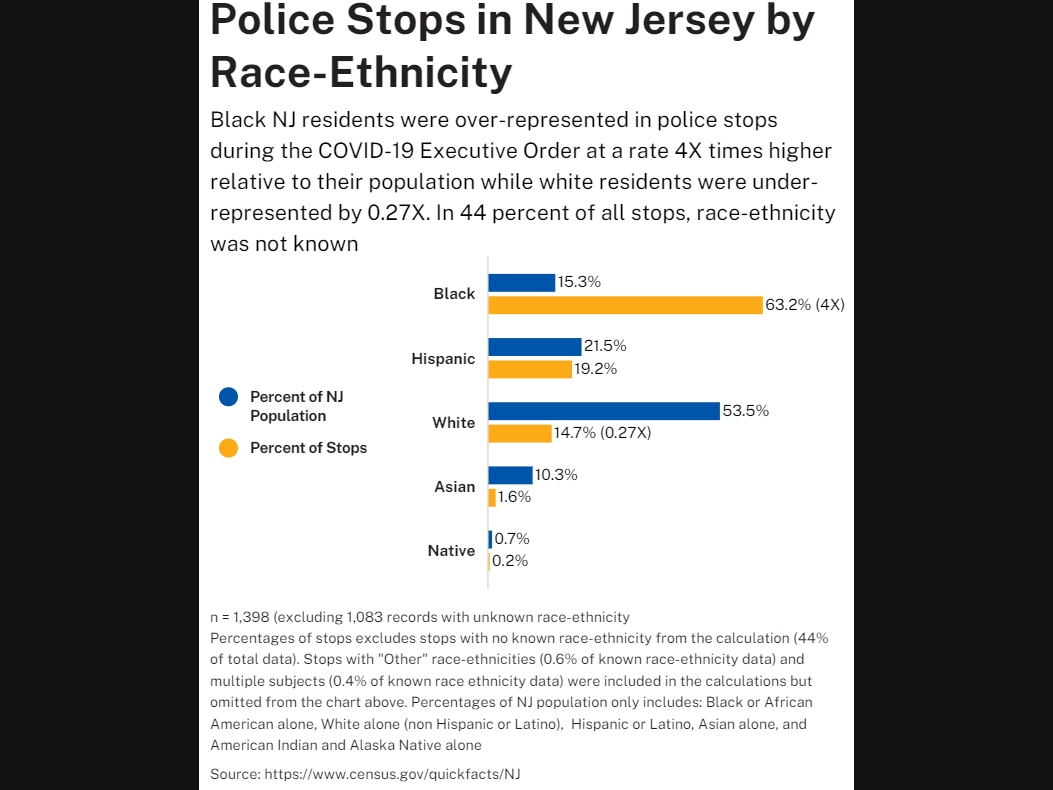
HALF OF ALL STOPS – Of all stops where race was recorded, Black New Jerseyans comprised 50 percent of all individual police stops, and 65 percent of individual stops where the race-ethnicity of the person was known … Black New Jerseyans were over-represented in stops for executive order enforcement at a rate four times higher than their relative population.
PUNISHMENT – Police stops of white residents were eight times more likely to have no punitive action taken compared to Black residents and 10 times more likely compared to Latinx residents. Asian residents were over 12 times more likely to have no punitive action taken compared to Black and Latinx residents.
POLICE RESTRAINT – Some local police departments made some questionable moves during the pandemic, the report says. In Trenton, where only 30 percent of the population is Black, every police record where race information was provided involved a Black person. But other police departments showed more restraint, including Lyndhurst, Woodbridge, Hillside and North Brunswick – where “virtually no one” was charged with a COVID-related offense from March to December 2020. Instead of issuing summonses or charging people with crimes, police in those four towns tended to inform individuals about the dangers of COVID, asked them to respect the mask and social distancing mandates, and offered assistance when faced with the occasional COVID-related medical emergency, researchers said.
Not all towns and cities saw severe racial arrest disparities during the pandemic, the ACLU-NJ noted. For example, in Newark – where about 50 percent of the population is Black – about 58 percent of all COVID-related charges were brought against Black people.
But overall, New Jersey has some serious explaining to do, researchers said.
“While unsurprising, the results of our report are dismaying,” the ACLU-NJ concluded. “They reflect the racial realities of New Jersey, from the worst racial disparities in prisons in the United States, to some of the most stark racial disparities in health outcomes in the country, and more than a dozen other metrics, from homelessness to veterans' care.”
“COVID merely pulled off the blinders around these well-familiar inequities, laying bare the impact of these disparities on communities of color who experienced higher rates of infection and death as a result,” the nonprofit asserted.
- See Related: Coronavirus Is Exposing Racial Gaps In NJ, Advocates Say
- See Related: Systemic Racism In NJ Added To Pandemic Deaths: Advocates
Send local news tips and correction requests to eric.kiefer@patch.com. Learn more about advertising on Patch here. Find out how to post announcements or events to your local Patch site.
Get more local news delivered straight to your inbox. Sign up for free Patch newsletters and alerts.